 0
0
 0
0

East Asia has emerged as a global critical minerals powerhouse, with China taking the lead on price discovery of rare earth elements and other key metals through the Shanghai Metals Exchange.
In an August 14th budgetary announcement, Indonesian President Prabowo Subianto announced the upcoming creation of a Mineral and Strategic Commodity Exchange, known in-country as BMKS or internationally as ICOMEX.
His cabinet were clear in their messaging: Indonesia exports enormous quantities of raw materials, and it’s time national firms and traders take the lead on determining prices. Indonesia holds world-dominant positions in the production of nickel, thermal coal, palm oil, and tin. They also produce vast exports of coffee, bauxite, rubber, and copper, yet the prices for these are determined on trading floors thousands of miles away in London or New York.
“With the commodity exchange ordered by the President, it is hoped that for all our natural resource commodities produced from our country, we ourselves will regulate the prices,” Energy and Mineral Resources Minister Bahlil Lahadalia told reporters in mid-August. “President Prabowo wants all the wealth in our country to be managed completely by our country at good economic prices”.
Reporting on the news, Antara wrote that the new ICOMEX will be supervised directly by the Financial Services Authority, and that “the platform is tasked with establishing an official ‘Indonesia Reference Price’ across various major export categories, shifting the balance of pricing power back to the producing nation”.
Asian Times reported why Indonesia might feel entitled to take the lead on setting price benchmarks. The London Metals Exchange (LME) has long been the world’s sole source for contracts on nickel, a market for which Indonesia has a greater share of than do all OPEC nations in the production of crude oil. Yet LME delivery standards deal only with material of a 99% purity, called Class 1 refined nickel. Class 1 has made up a shrinking component of the nickel market worldwide.
It is shrinking because Indonesia has changed the game by pumping out a variety of smelted nickel products now consumed for a variety of applications which don’t necessarily need to be 99.8% pure. The greatest of which are battery chemical precursors such as mixed hydroxide precipitate (MHP) and nickel sulfate that have powered the EV boom worldwide.
The plans for ICOMEX were welcomed by the Indonesian Nickel Miners Association, which has been lobbying for a national mineral exchange.
“For Indonesian producers, relying on LME pricing has forced them to navigate a fragmented pricing landscape characterized by arbitrary discounts, opaque bilateral pricing formulas and exposure to LME short squeezes that have little to do with battery-grade supply and demand market fundamentals,” wrote Rabiul Misa, a junior analyst at Bank Indonesia, in the Times.
Nevertheless, Misa writes that a commodities exchange needs more than just “resource nationalism” to succeed. It needs robust participation, easy settlement and arbitration architecture, transparency, deep liquidity, hedging instruments, and regulatory oversight that can be relied on. If contract and delivery processes become rigid or exert too much friction, workarounds, such as have plagued the Indonesian export markets from an oversight perspective for years, will inevitably return.
China suspends paper trading of gold
Plans are that the exchange will launch in January of the new year.
The announcement comes not long after a group of Chinese banks announced an end to the trading “on paper” of gold, osstensibly in order to protect their clients from volatility in Western markets, where the ratio of futures contracts and other paper-claims on gold compared to physical gold is substantially higher in Asia. Paper claims on gold allow for multiple “owners” of the same ounce of gold. Prior to 2025, some researchers suggested that the market has 100 claims to gold for every ounce of gold for sale in world vaults.
WaL reported at the time that one reason to suspend paper gold claims is that the Chinese market does, in fact, already exert pricing power over other metals, including rare earths, and several industrial metals, and that they want to extend this power to gold as well.
Gold-focused publications seemed to identify suspension as an attempt to use the outstanding physical positions of Chinese citizens, institutions, and the government to exert more influence over the spot price of gold, as not only is the Bank of China one of the largest gold purchasers by weight in the world, but the Shanghai Gold Exchange is the largest in the world which restricts its business entirely to the physical market.
An 18-item report presented by Lu Lei, deputy governor of the People’s Bank of China, during a briefing in April of 2025, revealed that the central bank was exploring the internationalization of specific product deliveries at the Shanghai Gold Exchange through the establishment of overseas delivery warehouses, as well as expanding the application of RMB benchmark prices in international mainstream markets. The report didn’t say where these warehouses would be located, but the London exchange uses hundreds of partner warehouses around the world to lend reality to the contract pricing available on their website.
Whether gold in China or nickel in Indonesia, Asian economies, and the Global South more broadly, are taking greater interest in how their materials are being priced. WaL
We Humbly Ask For Your Support—Follow the link here to see all the ways, monetary and non-monetary.
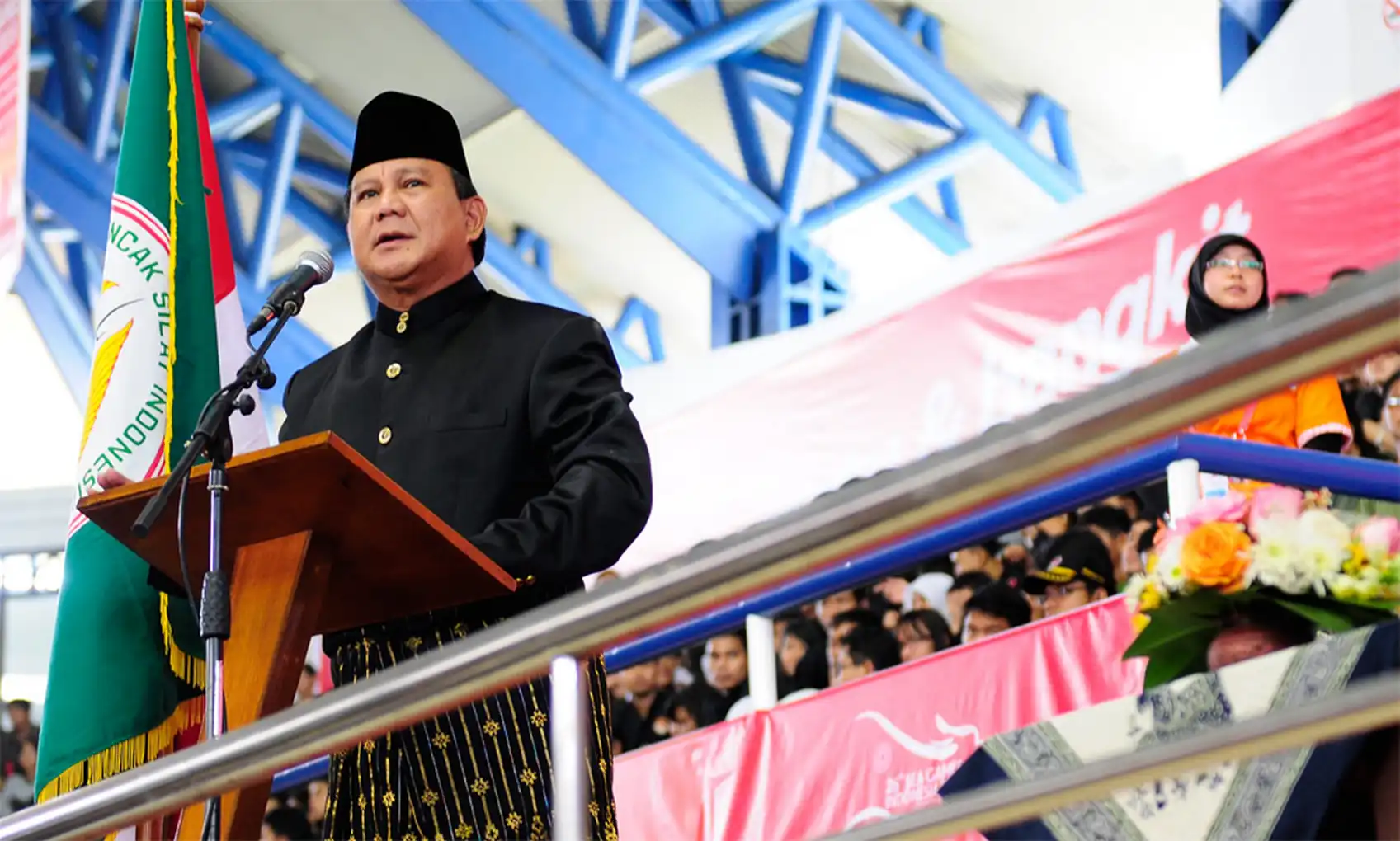
PICTURED ABOVE: Indonesia President Prabowo Subianto. PC: Prabowo Subianto, via Wikimedia Commons.