 0
0
 0
0

Another BRICS summit has come and gone, and the Western world will as usual want to know if the group has actually done anything substantial, above all on the questions and issues that the BRICS bloc have left unanswered and unsolved for years, namely, what is the plan to break free of the US-dominated economic and security regimes.
Representing 40% of the world’s GDP and half the world’s population, BRICS metaphorically has the tiger by the tail, and can neither let go nor hold on.
Fully revealing themselves to be antagonistic towards and free from US control or influence would certainly spur immense pressure and even retaliation, a choice that’s become ever more complicated for the bloc as they continue to welcome new members, some of whom have much closer ties to Washington than others. Hence, they cannot let go of the tiger’s tail.
At the same time, for the key members to achieve their highest political aims, separation from the US seems inevitable in order to be fully protected from its economic policing. Hence they cannot hold on either.
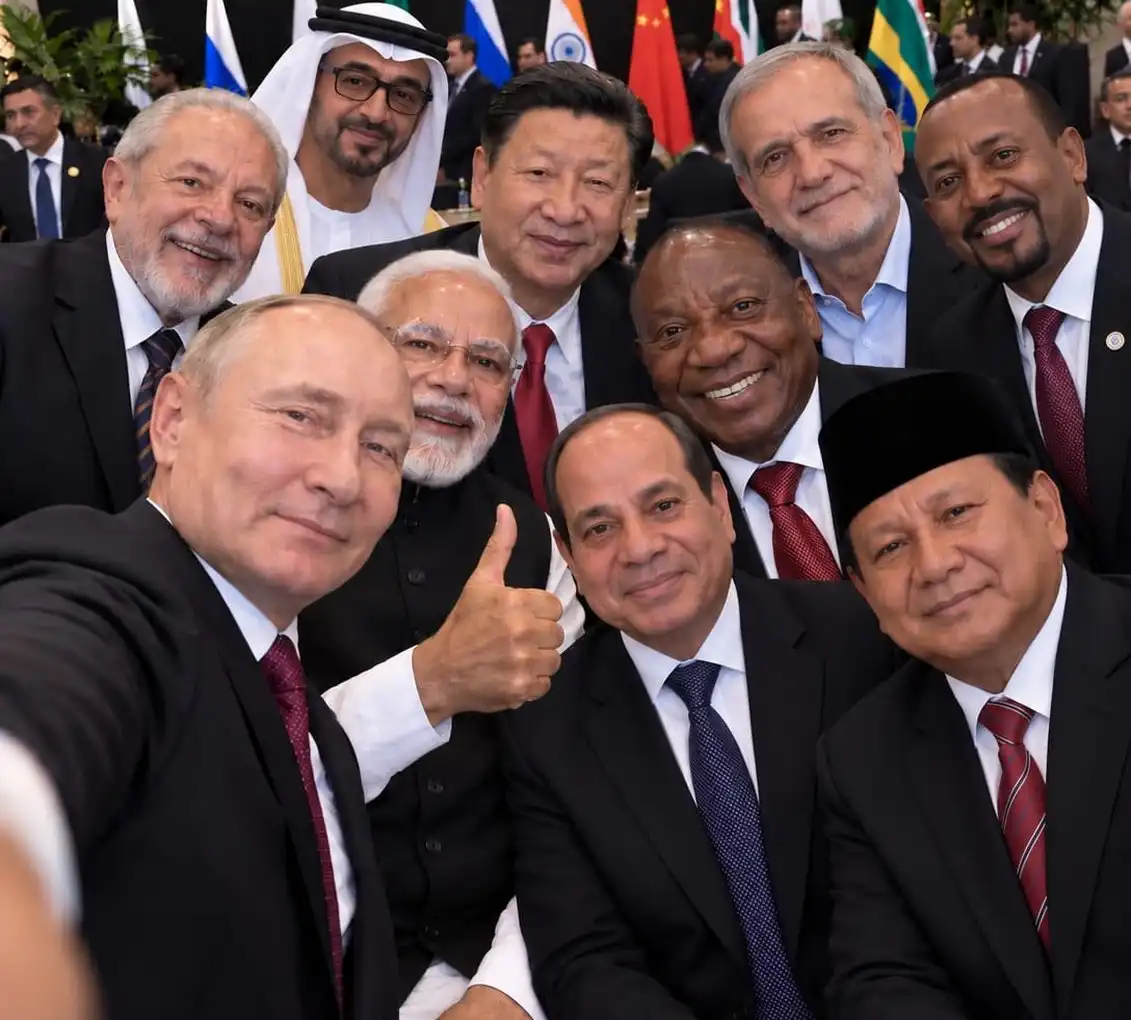
Held in India this year, the 18th annual BRICS Summit was described by the country’s Prime Minister Narendra Modi as a “coming of age” moment for the bloc. The summit’s theme was what one might call inward looking, and entitled “Building for Resilience, Innovation, Cooperation and Sustainability”.
“Over the past two decades, BRICS has established a distinct identity on the global stage. Now is the time for us to translate our unity and consensus within BRICS into tangible results on the global stage,” said the Prime Minister in an address to the assembled leaders on Saturday, the opening of the summit.
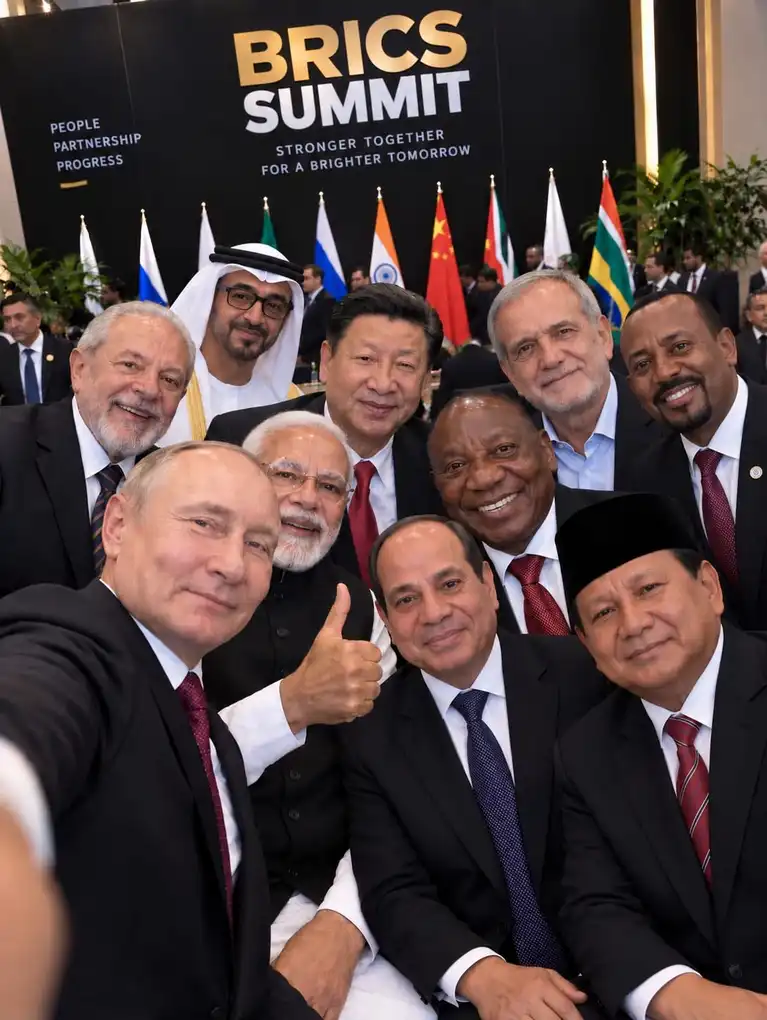
Coming of age
BRICS means different things to different people. For developing economies in the Global South, BRICS may mean a development partner more accustomed to the needs and conditions of low and middle-income countries. For members of the militaristic North Atlantic Treaty Organization (NATO), BRICS may mean a network for money laundering and sanctions evasion. For emerging economies beyond Europe and East Asia, BRICS may seem like a great place to market exports.
For investors, BRICS is often nothing but a name, or counterintuitively, the biggest driver of de-dollarization worldwide.
Modi’s notion that BRICS is “coming of age” suggests that at least some of this incongruity should be ironed out sooner rather than later, yet the diversity of its membership seemingly guarantees it won’t. Consider the case of 2 of its newest members: Iran and the UAE. They are on opposite ends of a two-way shooting range. Last year’s BRICS Summit decried the attack against Iran which US President Trump calls the 12 Day War as a “blatant breach of international law,” though this year’s unanimously-adopted declaration scaled back the rhetoric significantly.
It instead expressed the group’s “deep concern over the continued escalation of tensions” in the Middle East and called for “maximum restraint” without mentioning the US, UAE, Israel, or Iran by name.
Indian analysts speaking with Al Jazeera said that this language represents a modicum of diplomatic success, given that Iran has bombed targets in the UAE many times over the last 6 months, but also represents the constraints on BRICS to act decisively on the global stage. Perhaps in a nod to this, however, extensive, potentially resolutionary dialogue between India and China regarding their longstanding border dispute should be considered a major accomplishment from the summit.
Modi and Chinese President Xi Jinping used the summit to follow up on previous talks in China’s Tianjin regarding the pair’s high-altitude border in the Himalayas, and “reaffirmed that both countries should take a strategic and long-term perspective on their ties”.
“The two leaders expressed commitment to a fair, reasonable, and mutually acceptable resolution of the boundary question proceeding from the political perspective of their overall bilateral relations and the long-term interests of the two peoples,” an Indian-side readout of the discussions outlined. The Ladakh border dispute is one of 3 outstanding security challenges between BRICS countries, and its potential resolution would demonstrate to the others, as well as to the world, that the spirit of multilateralism and mutual benefit often touted by BRICS members can make actual change in the world.
Business and trade
Eschewing large issues like breaking away from the dollar, infrastructure for the circumvention of US unilateral sanctions and tariffs, or the development of a new trading currency, this year’s summit in New Delhi revolved around cooperation between the bloc’s members on issues like AI, critical minerals, and infectious diseases.
“With BRICS entering its third decade, the world expects not just ideas and commitments but concrete results from us,” Modi said in his keynote address.
Some of these concrete results will never manifest themselves in Western press. For example, Modi said there had been over 400 minister-level meetings in India between BRICS countries throughout August and September. Should anything have been agreed in any of them, the chances of it appearing in the Wall Street Journal for example, are negligible. Modi himself said that the summit saw the debut of the BRICS Integrated Early Warning System for the prevention of and response to infectious diseases, the BRICS Early Warning Data Integration Guidelines for disaster management, and the BRICS Logistics Supply Chain Cooperation Framework.
All of the major BRICS nations have been either sanctioned or had tariffs applied to their exports by US President Donald Trump, and these were major rhetorical points of frustration.
“We voice serious concerns about the rise of unilateral tariff and non-tariff measures which distort trade and are inconsistent with WTO rules,” the summit’s official declaration read. Russian President Vladimir Putin said in an address to leaders that his country had been sanctioned 30,000 times.
Modi said BRICS should set a target of “removing the top 10 trade barriers among BRICS nations,” while attending the BRICS Business Summit, and reviewing this by next year’s event.
Speaking on the subject of global trade, President Xi said that global rules should be written jointly and applied equally to all countries without double standards.
“A world without rules is like an intersection without traffic lights, where chaos and disorder would be inevitable,” he was quoted as saying by Xinhua. “The logic of might makes right should have been discarded long ago”. President Xi viewed open-source AI architecture development, inter-nation training programs, and smart manufacturing as initiatives China can take the lead on inside other BRICS nations.
Within the declaration document, it was clearly specified that the much heralded “BRICS Pay” or whatever the cross-border payment architecture that’s independent of the US-controlled SWIFT system is called, is not ready yet despite the strong showing of support it received during last year’s summit in Rio di Janeiro.
“We encourage the BRICS Payment Task Force to continue discussions, building on the ongoing work, to facilitate practical solutions for cross-border payments among BRICS countries, which are fast, low-cost, more accessible, efficient, transparent, and safe,” the declaration read. “…we acknowledge the work done to study the cross-border interoperability of payment and messaging channels, and the discussions on promoting trade settlements and investments using BRICS local currencies, while respecting national priorities and acknowledging that there is no one-size-fits-all approach”.
“Inside BRICS, there are different opinions, but all members of the group believe that national currencies should be strengthened and trade between the member states should be through the national currencies. But having a single currency is still under consideration,” Iranian Foreign Minister Abbas Araghchi told reporters at the Business Summit.
A “single currency” references the long-hypothesized and hinted at creation of a BRICS group unified trading currency supported by a basket of commodities including gold and the national fiat of each member, which has so far never materialized. WaL
Consider Following the link here to see all the ways, monetary and non-monetary, you can support this work and more like it.