 0
0
 0
0

Tulsi Gabbard announced on Friday, May 22nd, her resignation from the position as Director of National Intelligence (DNI), the highest position among US intelligence professionals, and one she has used to repeatedly undermine President Donald Trump’s narratives during his war against Iran.
Less than 2 weeks before announcing her resignation, officially to care for her husband who was diagnosed with a rare form of bone cancer, her office briefed Congress that Iran’s ballistic missile program remained substantially intact, contradicting the President’s claim that all Iranian forces had been obliterated.
In her resignation letter posted on X, Gabbard told Trump she was “deeply grateful for the trust you placed in me and for the opportunity to lead the Office of the Director of National Intelligence for the last year and a half”.
However, contradictory reports emerged immediately, with anonymous sources telling Reuters that Trump had long been displeased at Gabbard and had been looking for a reason to remove her from office.
“She was pushed out by the White House,” the source familiar with Gabbard’s departure told Reuters. “The White House has been unhappy with her for quite some time”.
Reuters continued, claiming that Gabbard had presided over several failures, including to properly remove active agents names from a list of security clearance revocations, and the office’s seeming inability to successfully target political opponents of Trump. Despite having access to the highest levels of classification, she has been absent from important White House security deliberations “including the US military operation that deposed former Venezuelan President Nicolas Maduro, the Iran war, and Cuba,” the outlet wrote.
Both Ms. Gabbard and a White House spokesman denied the claim, referring to it as slanderous. The timing does seem suspicious, however.
The timing
On May 13th, WaL reported that Congress received a US intelligence assessment—a synthesis of information gathered by some or all of the 18 different US intelligence agencies and prepared by the DNI’s office—which found that Iran retained the vast majority of its ballistic missile stockpiles, underground facilities, and mobile launchers, including access to 30 of its 33 facilities, and 90% of its underground storage and launch sites.
First reported by the New York Times according to sources within the Congressional team briefed and “people with knowledge of the assessments,” it contrasted starkly to what the American public has heard from its executive officials, with Trump himself suggesting Iranian missile fire had been reduced to a “scatter” just 9 days into Operation Epic Fury.
It wasn’t the first time that Gabbard’s office had prepared an assessment that directly contradicted Trump’s rhetoric. One week before Epic Fury, Gabbard told Congress that US intelligence had found no evidence to suggest that Iran was ever building a nuclear weapon, or that it was attempting to repair the damage inflicted by the US and Israel during their sneak attack on Iran in June, 2025.
Even before June, a US intelligence assessment found that Iran was not pursuing nuclear weapons and that even if it chose to do so, it would take up to three years for Tehran to be able to produce and deliver a nuclear bomb. In March of 2025, Gabbard said that “Iran is not building a nuclear weapon and Supreme Leader Khamenei has not authorized the nuclear weapons program he suspended in 2003,” which, like the March 2026 briefing, Trump dismissed as “wrong”.
Her assessment was reflected in the Intelligence Community’s annual threat assessment of 2025, but when asked about this assessment, President Trump said, “I don’t care what she said. I think they’re very close to having [a nuclear weapon]”.
Reports would eventually suggest that Trump may have been swayed by Israeli intelligence sources over and above his own.
What would prove to be Gabbard’s final US intelligence assessment—that Iran retains the vast majority of its ballistic missile stockpiles, underground facilities, and mobile launchers, which might warn Trump against reengaging with Iran as the current cessation of hostilities hangs by a threat—was just as swiftly dismissed by White House spokesmen as her earlier ones were dismissed by Trump himself. WaL
We Humbly Ask For Your Support—Follow the link here to see all the ways, monetary and non-monetary.
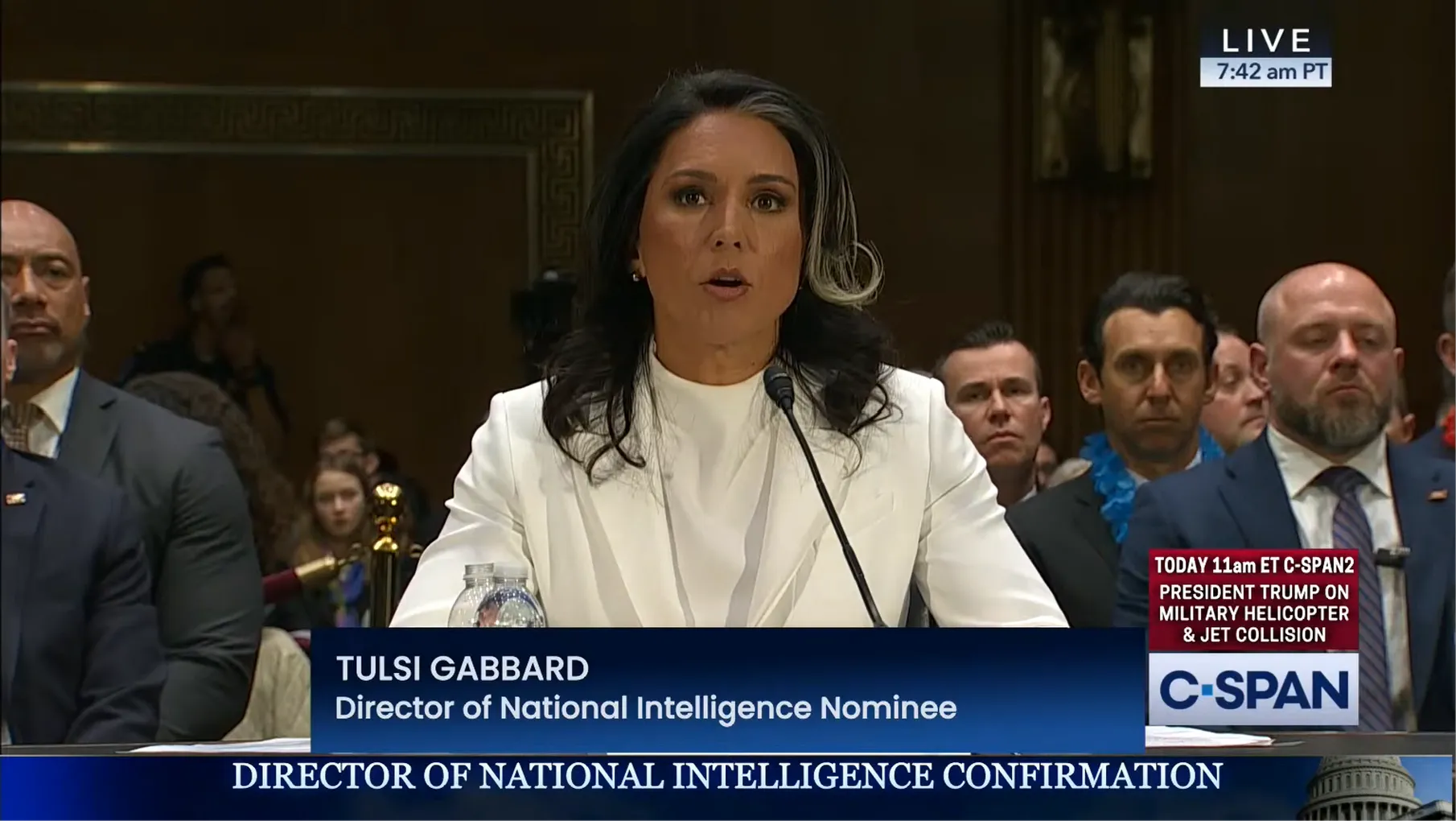
PICTURED ABOVE: Former Director of National Intelligence Tulsi Gabbard in testimony before the Senate Intelligence Committee. PC: C-SPAN, screengrab.