 0
0
 0
0

There could have been fewer clearer signs that the Trump Administration had accepted major concessions in advance of Thursday’s signing ceremony of the Memorandum of Understanding between his government and the Iranians than the media tour done by Vice President J.D. Vance between Monday and Tuesday.
With details of the text having been supplied to Western media by their Iranian counterparts while the White House remained tight-lipped, Vance was left to virtually speculate along with the news anchors in front of the cameras, suggesting that maybe this and maybe that could be possible if such and such event were to hypothetically occur.
Then the details broke late Wednesday night after Trump arrived for a meeting of the G7 heads of state, when he signed it with the support of his peers.
The text outlines nothing short of a historic victory for Tehran, the likes of which they themselves must not have thought possible.
In no uncertain terms, and provided there is no reneging of commitments during the proceeding 60 days of further negotiations, the Trump Administration has been forced to concede virtually all ground on virtually all issues.
Even the constantly reiterated promise of “no nuclear” has had to be substantially watered down. Given the Iranians have always said they never intended to pursue a nuclear weapon, and US intelligence has always concluded that was correct on the ground, the MoU’s inclusion of that same promise will mean little to those in the Washington foreign policy bubble.
It may please a section of Trump’s base, but almost certainly not enough to cushion the blow of reading that Trump has had to concede to Iran on the following issues: their ballistic missile industry, future nuclear energy program, support for proxies like Hezbollah and the Houthis, the issue of war reparations, control of the Strait of Hormuz, the $24 billion in frozen assets held in the US, the stated goal of regime change in Tehran, sanctions relief, and the perceived flight of Iranian people oppressed by the theocratic regime.
In short, beyond maintaining its already heavily damaged military positions in the Gulf States, a promise that Iran will never seek a nuclear weapon and that there will be 60 days of talks on arranging for the dilution of the 400 kilograms of 60% enriched uranium, Trump has had to accept Iranian demands while relinquishing his own on every single war issue.
It is nothing short of historic, and some of the language Trump has been using since the signing ceremony must be stunning his now-almost-certain-to-be-former supporters.
Trump said Wednesday that the US has taken a lot of Iranian money and will have to give it back.
“We have taken a lot of their money, and we have their money,” Trump said at a news conference in France as the G7 summit ended. “It’s not our money, it’s their money, and we froze it at a certain point in time. I guess we’re going to have to give it back, you know, if we didn’t give it back, nobody would ever invest in the dollar again”.
True enough, but it’s something he hounded former-President Barack Obama for doing when he worked with Iran to sign the JCPOA.
Secretary of State Marco Rubio, who was standing alongside Trump at the G7 summit, told reporters in the first days of the war that one purpose was to “destroy Iran’s missile capability,” something Trump also vowed to do when announcing the first wave of airstrikes.
“We’re going to destroy their missiles and raze their missile industry to the ground. It will be totally, again, obliterated,” Trump said on February 28th after the first wave of US-Israeli airstrikes. On Wednesday, he struck a different tone.
“I mean, they have to have some [ballistic missiles] because other people have some, you gotta have some,” the president said.
The MoU also included language that, although it lacked a timeline, spoke of lifting all sanctions on Iran—something that the country couldn’t get even under the JCPOA. On May 27th, the President told PBS News that Iran would not get sanctions relief in exchange for giving up their highly enriched uranium.
“No, no, not at all. Not sanctions relief, no,” Trump said. “They’re gonna give up their highly enriched uranium not for sanctions, relief”.
The MoU states all sanctions, not only those outstanding on the US side, but also those imposed by the UN Security Council—are to be lifted, an astonishing diplomatic coup for the Iranians. WaL
Consider Following the link here to see all the ways, monetary and non-monetary, you can support this work and more like it.
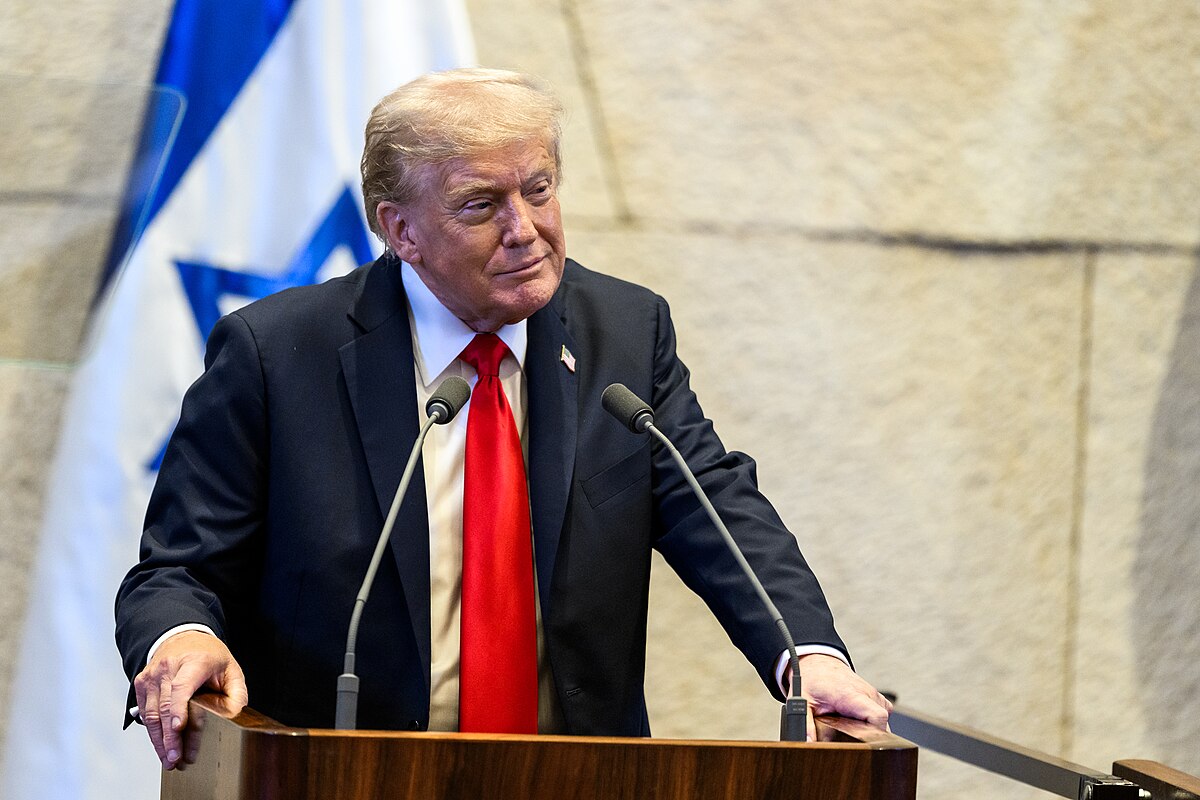
PICTURED ABOVE: President Donald Trump delivers remarks to the Knesset in Jerusalem, Israel, Monday, October 13, 2025. PC: White House Photo by Daniel Torok.