 0
0
 0
0

“Critical minerals” are all over the financial and economic news these days. Most commonly they refer to things like rare earths elements, tungsten, copper, and cobalt, but there are dozens considered “critical” by the US government.
Metals like silver, aluminum, tin, nickel, zinc, tantalum, phosphate, manganese, and antimony are all designated “critical” meaning that just about every metallic substance on the periodic table you’re likely to come into contact with is considered critical.
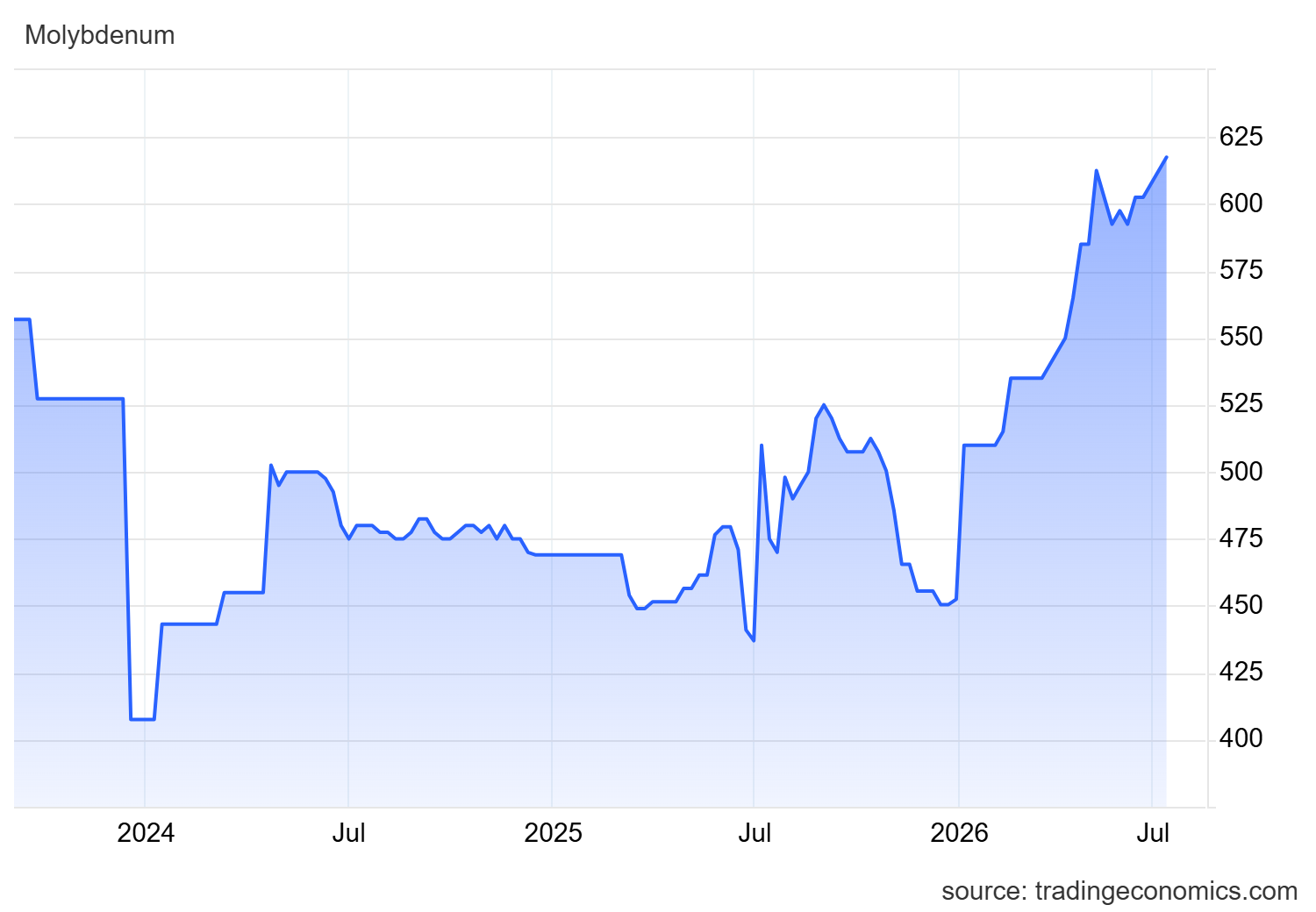
One that isn’t, however, is molybdenum, understandably referred to as “moly” shorthand. Needed as a versatile alloying agent in the production of stainless steel, moly is among those minerals that have dramatically increased in price year over year, and which like silver, copper, and tin, is now in a supply deficit, meaning the world consumes more every year than is mined.
Global production of molybdenum was at 168 million pounds (mlbs) in Q1, 2026, the same as in the previous quarter. However, consumption rose to to 180 mlbs, an increase of 9% in Q1 compared to Q4 of last year. This is according to the International Molybdenum Association.
China remained the largest user of molybdenum at 91 mlbs, up 10% from the previous quarter and 7% from the same quarter of the previous year. Europe, the second largest user of molybdenum, saw a 3% rise to 29 mlbs compared to the previous quarter, which was a 4% rise compared to the same quarter of the previous year. Use in Japan was 15% higher according to the same parameters.
Among metals priced by the kilogram, moly has seen one of the highest price increases over the last 12 months, notching 30% in gains priced in Chinese RMB. Only tellurium, indium, and germanium ingots have gained more over that same period. Tin, cobalt, silver, and tungsten, also gained more but are priced by the ton.
Despite expanding mine output, the Shanghai Metal Market estimates a global molybdenum supply deficit of nearly 13,000 metric tons in 2026. Because of this, and because of continual trade antagonism by the Trump Administration, China placed export controls on moly which entered into effect in January.
Moly production worldwide
Unlike almost all the other metals mentioned earlier, the USA is actually a rather large producer of moly. This is primarily due to 7 large mines in Arizona, Montana, Utah, and Nevada which produce moly as a byproduct, and 2 primary moly mines in Colorado. Together, they produced around 40,000 in 2025. China produced 97,000 tons last year, and maintain almost half of all known moly reserves, with 7,800,000 on the books last year.
Chile and Peru, given their extensive copper porphyry mining, also mine 5-figure sums of moly. An emerging location is Mongolia, where Rio Tinto’s Oyu Tolgoi deposit is estimated to produce approximately 452 million pounds of molybdenum over its mine life. Further down the corporate ladder, Erdene Resources owns a 100% of the rights to explore what might be an even larger deposit called Zuun Mod.
The maiden mineral resource estimate of Zuun Mod is 271 million tons at a grade of 0.051% moly, equating to 333 million pounds in the measured and indicated category, and an almost equivalent-sized resource in the inferred category. For non-mining investors, measured, indicated, and inferred are terms that refer to the degree of extrapolation made from single drill holes using decades of developed geologic methodology. Inferred resources are more speculative and less certain to be there.
Most of the global molybdenum produced is consumed for alloyed stainless steel, which is expected to account for 71% of all moly sales, but the metal’s versatility is seeing it emerge as a technological material as well.
“Molybdenum disulfide is one of the most promising two-dimensional semiconductor materials for future electronic devices, owing to its atomic-scale thickness, excellent electrical characteristics, and compatibility with next-generation chip architectures,” writes Mark Ntel Advisors.
“In 2025, researchers at Fudan University developed a 32-bit RISC-V processor integrating approximately 5,900 molybdenum disulfide field effect transistors, representing one of the most sophisticated functional computing systems built using a two-dimensional semiconductor”.
The market research firm calculates that the moly industry will experience a 10.6% compounded annual growth rate over the next 6 years. WaL
Follow the link here to see all the ways, monetary and non-monetary, you can support this work and more like it.
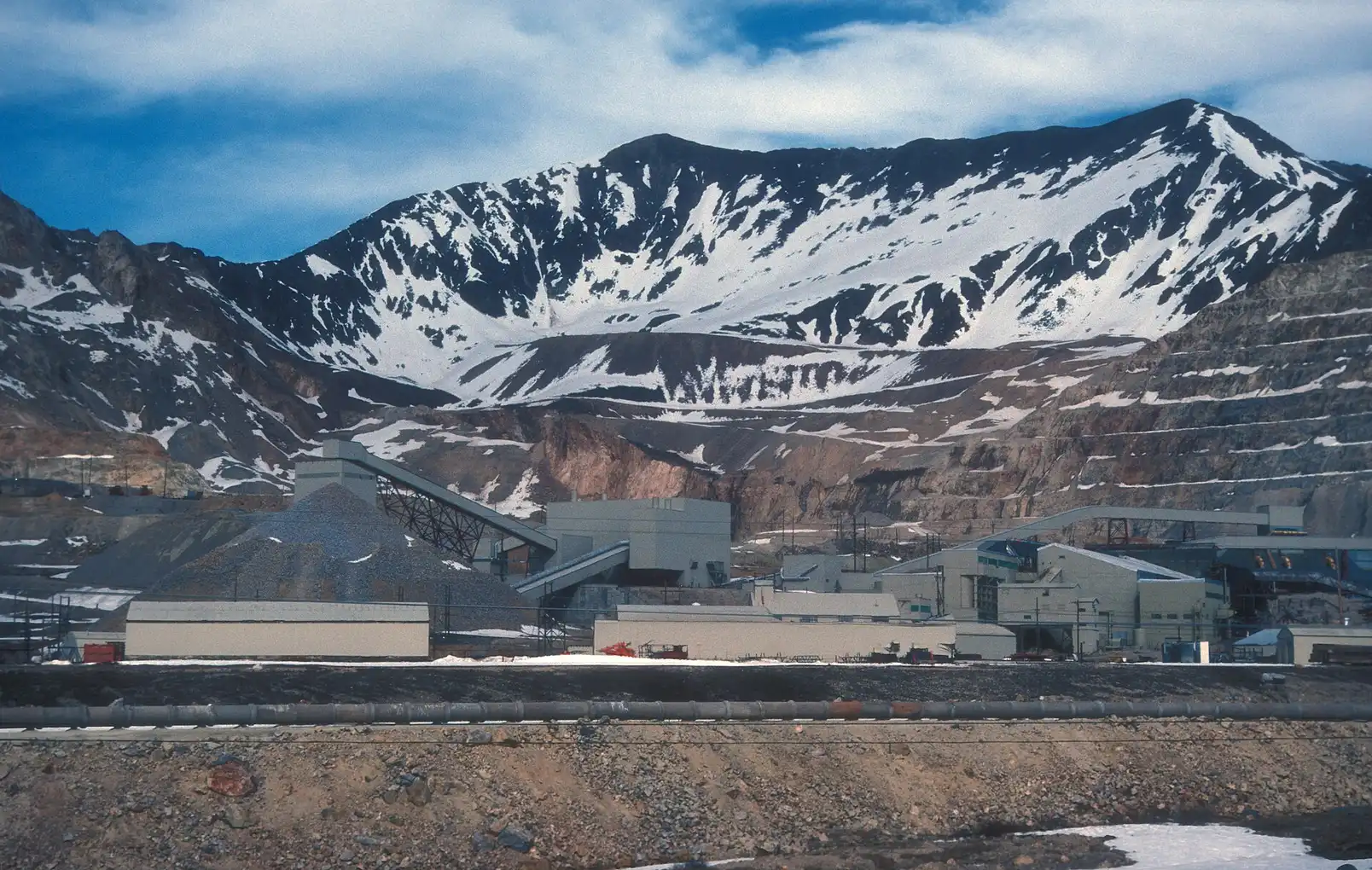
PICTURED ABOVE: The Climax Molybdenum Mine, one of two primary moly mines in the US. PC: Jerrye and Roy Klotz MD via Wikimedia. CC BY-SA 3.0.