 0
0
 0
0

Armenian Prime Minister Nikol Pashinyan watched as his party comfortably won parliamentary elections with a hair short of 50% of the vote.
In a country where the most-trusted politician has a 13% approval rating, turnout was strong at 59% including strong shows of support for 2 parties that prefer closer relations with Moscow than with Brussels. A total of 16 political parties and 2 political alliances competed for the 101 seats in the Armenian parliament.
Seen as a test of his two key platforms of a spot in the EU and a lasting peace with long-time bitter enemies Azerbaijan and Turkiye, the victory for Pashinyan’s Civil Contract party was nevertheless insufficient to grant it the supermajority needed to directly amend the constitution.
That’s an important detail, since the current and so-far successful normalization of relations with Azerbaijan will presumably only progress to the farthest stage if Armenia can amend its constitution and remove what Baku sees as a direct claim to the territory of Nagorno-Karabakh, the disputed land Azerbaijan captured and ethnically-cleansed of Armenian-origin residents in September of 2023.
June’s elections were the first since this brief war, and observers were curious to see how Pashinyan’s unprecedented swivel towards making peace rather than war would resonate across society. Broadly speaking, his vision of “New Armenia” one at peace with its neighbors and west-ward looking, seems to be preferable to “Historic Armenia” Pashinyan’s counterfactual and hypothetical society raging against the Turkish powers around it.
“The Armenian people voted for regional prosperity and cooperation and I hope this will draw a positive response from Turkey and Azerbaijan,” the Prime Minister said in the aftermath of his victory. To that end Turkish President Recep Erdoğan extended “heartfelt” congratulations.
“I am fully convinced that your strategic vision regarding the establishment of long-term peace and stability in the region, as well as ensuring the necessary cooperation in that direction, will be successfully brought to completion,” the aging Turkish head of state wrote in a statement.
Beyond words, Pashinyan told reporters that a major Armenian-Turkish railway link—the Akhalkalaki–Kars line—is open in terms; that President Erdoğan assured him personally it’s open in practice, and that he hoped this would become the reality as soon as possible.
“I also discussed this issue with the Prime Minister of Georgia, and he assured me that no problems will arise in either direction. I also spoke with the President of Türkiye on this matter, and he also confirmed that these routes are open,” the PM said, according to ArmenPress.
All important detail
Already, Prime Minister Pashinyan is planning a referendum on changing the constitution, as clarified by his Justice Minister Srbuhi Galyan. She made it clear that there will have to be a democratic process in the clearest sense of the word in terms of consultations with partners and others outside the Civil Contract party, as well as the public.
“We will need one or two weeks to collect and consolidate those opinions, and we will hold one or two more discussions. Only then will we decide whether we are ready to publish the text or not,” Galyan said. “We will do our work, measure the level of public demand, and make an appropriate decision”.
For Azerbaijan, it is not the constitution that the PM needs to change, but just a section of the preamble derived from the 1990 Declaration of Armenian Independence, which reads “Based on the December 1, 1989, joint decision… on the ‘Reunification of the Armenian SSR and the Mountainous Region of Karabakh…”
In a way, that makes the process easier for Pashinyan, as it has nothing to do with any rights of law or governmental organization, and was drafted in the wake of the collapse of the USSR, when Yerevan’s political sphere was substantially different than it is today. Still, Pashinyan will need outside votes to see it done, and that will involve getting support from parties whose members were arrested in advance of voting day.
Reuters reported that 78 opposition figures, including 6 parliamentary candidates for the Strong Armenia party were arrested in the days leading up to the vote.
Zaur Shiriyev, a non-resident scholar at the Carnegie Russia Eurasia Center, told the British outlet that it was unclear whether Azerbaijan would want to move forward with the current peace process if Armenia failed to amend the constitution.
“The (Armenian) government would then face a very difficult domestic situation,” Shiriyev said. “Cooperation with the opposition on such a sensitive issue is almost impossible”.
Turkish media, reporting on Pashinyan’s election, quoted him as saying in regards to a lasting peace that “We must sustain this momentum to achieve the ultimate breakthrough,” but to do that it would require that Azerbaijan take the final steps towards implementing the peace agreement made last August.
Key to Yerevan being able to align more closely with the West and away from Moscow lies in getting access to fuel from the Azeri petrostate. A trade embargo since 1990 has meant that Armenia has relied mostly on imported Russian fuel projects, which have to be brought via train over the Caucasus through Georgia. Already, Azerbaijan is allowing goods to be transported into Armenia—including 12,000 tons of fuels, but it’s unclear if Baku would continue this policy if the constitutional referendum failed.
Ilham Aliyev, the leader of Azerbaijan, recently addressed the 8th annual summit of the European Political Community in Yerevan. He touted the fuel and other exports, as well as the lowering of trade restrictions on Armenia, and thanked Pashinyan for supporting his own bid to host the next EPC summit in Baku.
This is a clear indication that peace between Azerbaijan and Armenia is a reality,” Aliyev said. “We live in peace for only nine months and we are learning to live in peace”. WaL
Consider Following the link here to see all the ways, monetary and non-monetary, you can support this work and more like it.
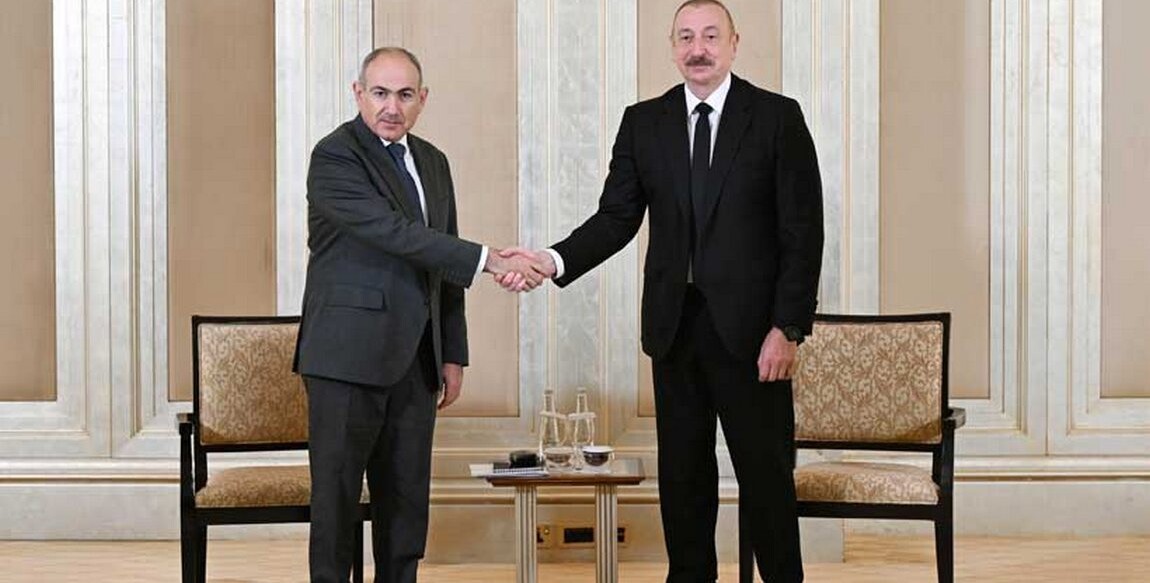
PICTURED ABOVE: Prime Minister Nikol Pashinyan (left) shakes hands with Azerbaijani President Ilham Aliyev. PC: Azerbaijani Presidential Press Office.