 0
0
 0
0

In the press conference following the Federal Reserve Open Market Committee’s (FOMC) July meeting, a journalist asked the new Chairman Kevin Warsh if he would follow his predecessors of using the Chairman’s speech at the Jackson Hole Economic Symposium in August as an opportune moment for a “policy reset”. His response was that he hadn’t started writing the speech.
There was certainly nothing resembling a reset in his speech last Friday. To the contrary, according to many Fed watchers, it was almost predictable in its familiarity.
He reiterated much of what he has remained adamant about following his appointment in May: inflation is too high, and a 2% target is a fixed goal; a quieter Fed, referring to his new policy of no forward guidance about monetary policy decisions, is a more effective Fed; and the market remains surprisingly resilient with private credit markets showing few if any signs of lending restraint.
It may seem overly-simple, even narrow-minded to distill the entire purpose of the Fed’s existence to questions about the interest rate, but as multiple economists told WaL, the interest rate is the price of money—the most important price of any in an economy, and with so much of the stock market’s current valuation and America’s GDP growth anchored by the massive debt-financed spending of a select few US tech firms, the price of money is more critical than at any time in recent memory.
Warsh has taken charge of America’s central bank with new ideas and big changes, and used his speech at Jackson Hole as a chance to reiterate them. One is his removal of the almost 4-decade-long practice of forward guidance, or a briefing to the market about how the Fed sees its interest rate strategy in the short and medium term—something one economist said was part of a long “evolution” towards greater transparency.
“A quieter Fed is a more effective Fed,” Warsh said in the speech on this point, later stipulating that remarks he made about inflation should explicitly not be taken as either “forward guidance” or “reaction function”.
Brian Cubellis, an economist from the University of Virginia and Chief Strategy Officer at a bitcoin financial services firm Onramp, was pessimistic about Warsh’s chances of convincing the market of his sweeping changes.
“A quieter Fed is a coherent idea in a world where the central bank is one input among many, which is the world Warsh remembers from before 2008; that world is gone,” Cubellis told WaL. “Silence does not restore price discovery. It converts a guessing game about the Fed’s words into a guessing game about the Fed’s silences, and markets are perfectly capable of playing either one”.
Managing Director and Chief Market Strategist at Bannockburn Global, Marc Chandler, has been a Fed watcher since he started his career, back when the Fed didn’t even make an announcement to accompany their rate setting decisions. Chandler said that the Federal Reserve was one of the last central banks to hold press conferences after meetings, and at first they only did them quarterly. The move to monthly announcements, and eventually, to forward guidance, was a long, worldwide trend towards demystifying central bank policy.
“The Fed is not just a referee, it’s also a huge market participant,” Chandler told WaL over the phone. “I think it’s politically naive and economically naive from a market perspective to think the markets could ignore what central banks say, even what they hint at. I think what Warsh in effect was saying was that the evolution that central bankers around the world have been going on for the last 20 years is wrong”.
Another change Warsh has made since taking charge is the insistence that the FOMC will use new data sources to make determinations on the state of the economy, and this was a notion he reiterated at the symposium. Yet again, Cubellis argued that this change is one which either isn’t being implemented or cannot be, and that the markets are right to continue pricing in Fed decisions along more traditional lines as job numbers and CPI index prints.
“The tell is in what he refused to accept as the trigger,” he suggests. “In July, asked directly whether bond yields already pricing higher inflation were the signal he needed to hike, he declined to say so and pointed to other data. The bond market had rendered its verdict on inflation, and he did not want that verdict to be the ‘reaction function,’ because if the market’s own inflation pricing sets policy, the Fed is already behind and has to hike into a debt-financed economy it would rather not disturb”.
The bottom line
At July’s FOMC’s meeting, the decision, split 9-3, to hold rates rather than raise them was clearly interpreted by everyone: the journalists, the bond market, and markets in general, as being outwardly against the notion of taking cues from the markets, something that the Chairman has readily reinforced he wants to do, including at Jackson Hole.
With Treasury bond yields sitting between 100 and 150 basis points above the Fed Funds rate, the market was seemingly giving a flashing red cue: it’s time to get serious about inflation. Yet a rise in the interest rate did not materialize. A similar scenario had occurred in June, and though Chandler recounts it being felt at the time as a “hawkish hold,” annualized inflation had been above 2% for 5 years in a row, and not everyone was convinced that Warsh would do what was necessary to get it within the target range. President Donald Trump’s insistence on lower rates throughout his second term hasn’t helped Warsh’s case.
“He talks a tough game—he’s a great speaker,” said Chandler. “He says inflation is too high, it’s intolerable, we have a dual mandate to protect. And what did he do in July? He did not vote in favor of a rate hike… He’s come back with the same message at Jackson Hole”.
“On the one hand you’ve got Warsh saying he wants a clean signal from the market, and on the other hand you’ve got [Treasury Secretary] Bessent saying he’s going to double the bond buybacks beginning this week. In my mind, the markets reacted, they understood what Warsh said at Jackson Hole to be a clear hawkish signal, but people like me don’t see it as a done deal, we see how economic data could still throw a wrench in the works”.
“On Friday, we’re going to get the US jobs report, and if we remember, the July report unexpectedly showed a loss of jobs. The next Friday we’re going to get the Consumer Price Index. CPI, headline and core, year-over-year has fallen for the past 2 months. It’s statistically possible that the core rate falls again and we have another month of loss of jobs; and so the question becomes, given that in July you had 3 members of the FOMC who dissented in favor of a rate hike, have they been able to convince a majority to their side”.
The similarities across Warsh’s 3 public appearances were not lost on Cubellis, who called it a “dance”. He also said that—like Chandler mentioned—Treasury’s announcement of yet more new money being pumped into the system proved that inflation fighting is more than just talking tough.
“With interest expense already the second-largest line in the [federal] budget and the Treasury actively suppressing the long end, the system needs lower short rates far more than it needs 2% inflation, and the debt structure is being deliberately shortened to make those lower rates matter more when they come. So the sequence is hold, hold, hold, then ease, dressed each time in the language of data dependence,” Cubellis said, suggesting it will indeed be a hold at 3.5 – 3.75% interest rates.
“Warsh talks like a hawk at Jackson Hole, the market prices a hike, gold sells off, credibility gets banked, and then the meeting arrives and the committee finds a reason to wait. One hot energy print argues for hiking, one soft labor number argues against it, and the honest data on money and the long bond get looked past because acting on them is too costly”. WaL
We Humbly Ask For Your Support—Follow the link here to see all the ways, monetary and non-monetary.
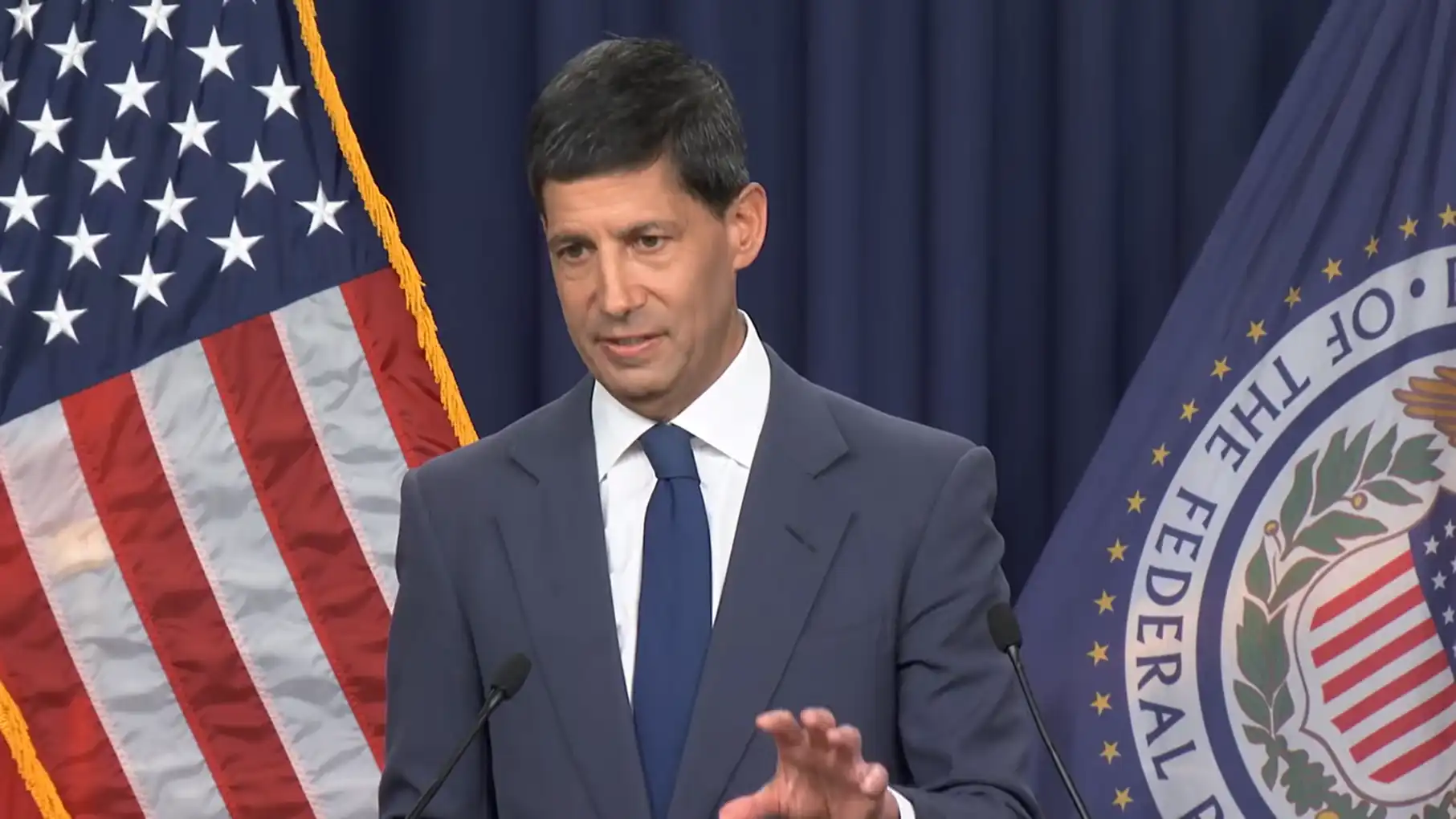
PICTURED ABOVE: Federal Reserve Chair Kevin Warsh at the July 29th press conference. PC: Screengrab via Federal Reserve official YouTube.



[…] his recent speech at the Federal Reserve Economic Symposium at Jackson Hole, Wyoming, newly-appointed Federal Reserve […]
The tension between Warsh’s call for a “quieter Fed” and the market’s need for clearer signals is striking. As Chandler notes, withdrawing forward guidance may not reduce speculation—it could simply shift attention to bond yields, speeches, and every perceived pause in action.