 0
0
 0
0

President Trump announced on Wednesday that his administration was preparing the “most crushing economic operation” for Iran, and that any country whose financial institutions collaborated with Tehran would face “tremendous economic consequences”.
Both he, and Treasury Secretary Scott Bessent, due to reveal details about this crushing operation today, described it as “economic D-day”.
Iranian Foreign Minister Abbas Araghchi, however, did well to compare it to a similar statement made under President Barak Obama, with the caption “same bull, difference bullies”. His point was that Persia has seen and heard it all before.
And not just Persia, but Russia too, quite recently was supposed to have been hit by an “economic nuclear weapon” by the Joe Biden Administration, meant to turn “the ruble to rubble”.
In a Bloomberg featured story published a year after Russia launched its so-called special military operation in Ukraine, then-US National Security Advisor Jake Sullivan is described as a denim-wearing, sleep-deprived mess, waiting, as if during the Cuban Missile Crisis, for his boss President Biden to give the call which would see him launch an “economic nuclear weapon”.
Already heavily sanctioned by the West at large, the weapon so-called was the freezing of $300 billion worth of Russian bank assets held around the world; an act of “shock-and-awe” that was kept a carefully-guarded secret from potential discovery by Russian intelligence.
What was intended to be an H-bomb over the ruble was more like a firecracker, as the ruble varied in value during the post-invasion period from a brief tanking, to stronger than before the sanctions were implemented. Russia’s oil was quickly devoured by energy-hungry countries like India, while natural gas was too valuable for Europe to abandon and continued to be sold in large amounts.
In a research report published in June 2023, companies in 17 different NATO nations were recorded as having imported over $130 billion worth of goods from Russia, circumventing the heavy sanctions placed on Moscow by Western countries. Some of the largest importers were or were located in some of the Kremlin’s harshest critics, including Lithuania, Poland, and the Netherlands.
It has always been the state’s desire to control the market, yet the market is an uncontrollable force, capable of introducing supply and demand dynamics into any environment now matter how tightly controlled. Biden and Sullivan’s economic nuclear option is a case study for this failure, and one which gives an idea as to how difficult it will be for economic D-day to take Iran’s Omaha Beach.
Sanctions don’t work
Sanctions don’t work because all governments, as political philosophers define it, have a monopoly on the use of force and violence. If the power of the gun is consolidated, it becomes very unlikely for economic hardship to impact sanctioned individuals in governments.
Sanctions have in fact never worked, apart from one unique occasion. They are purported to be an important tool in the American strategic policy toolkit between war and peace, but suffer the same failures time and time again. The failures include the phenomena that sanctioned countries can still work with others that are sanctioned, the effectiveness of black and grey markets for evading them, and the “rally around the flag effect” that comes when sanctions are seen as the hostile act of an enemy power, which is certainly the case in Iran.
In July of 2024, The Washington Post reported that the United States has sanctioned a third of the world’s nations, that 60% of all states classified by the World Bank as low-income countries are under some form of sanction, and that the US maintains more sanctions than the UN, EU, UK, and Switzerland combined.
Many of these have been in place for decades, Iran most of all, but particularly in the last 8 years, Iran has been under what Donald Trump called in his first administration a sanctions campaign of “maximum pressure”.
Al Jazeera was quick to publish analysis on how Iran can evade whatever pressure beyond maximum Trump seeks to apply now in his second term.
“Trump is trying to unilaterally assert the kind of coordinated sanctions that traditionally has taken multilateral coordination, and that means getting on board China, Russia, the P5 of the UN Security Council,” Paul Musgrave, an associate professor of government at Georgetown University in Qatar, told AJ.
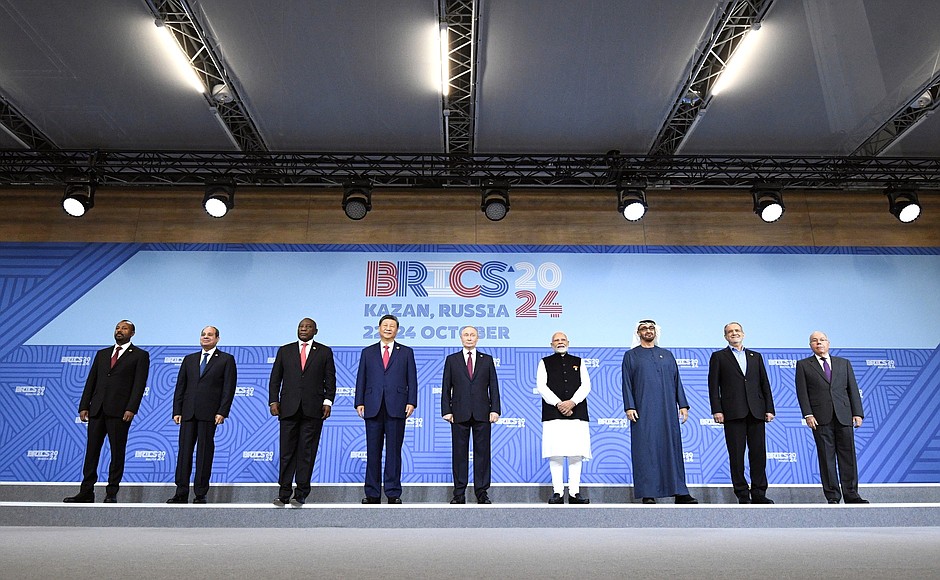
In China and Russia, Trump and Bessent face the biggest challenges to their D-day sanctions. Russia has been heavily sanctioned for years and has responded by shifting eastward and southward, strengthening alliances it has through the BRICS+ alliance, and removing itself from the US-controlled SWIFT bank communications system. China, a routine flaunter of America’s sanctions on it, and anticipating much the same fate as Russia eventually, has already developed its own cross-border, international and totally digital payment system called CHIPS.
There’s nothing that Treasury’s Office of Foreign Asset Control can do to stop cross-border payments between China and Iran conducted in RMB over CHIPS apart from deliberate cyber warfare. Since 2025, China has been buying 80% of all Iran’s oil, through sanctions. Furthermore, Trump is currently engaged in an attempt at warming relations with China. He may be desperate to ensure Iran capitulates to his pressure, and serious sanctions on Chinese banks may sting for some time, but given how often he doesn’t carry out his threats, the risk of a Chinese counter measure might cause him to reconsider sanctioning them, and immediately Iran has a lifeline.
In January 2025, Russia and Iran signed a 20-year partnership treaty, helping boost their trade volume to $4.8 billion in the first 11 months of 2025, according to Russian Energy Minister Sergey Tsivilev. The two countries, driven into each other’s arms through necessity of avoiding sanctions, have routinely swapped military equipment and energy through the Caspian Sea.
Last week, Iran’s Central Bank governor Abdolnaser Hemmati said Iran planned to join the BRICS New Development Bank (NBD), which would open more doors to financing outside Western markets. It requires an accession vote by the other permanent members, which might be secured at the upcoming BRICS Summit in India. WaL
We Humbly Ask For Your Support—Follow the link here to see all the ways, monetary and non-monetary.
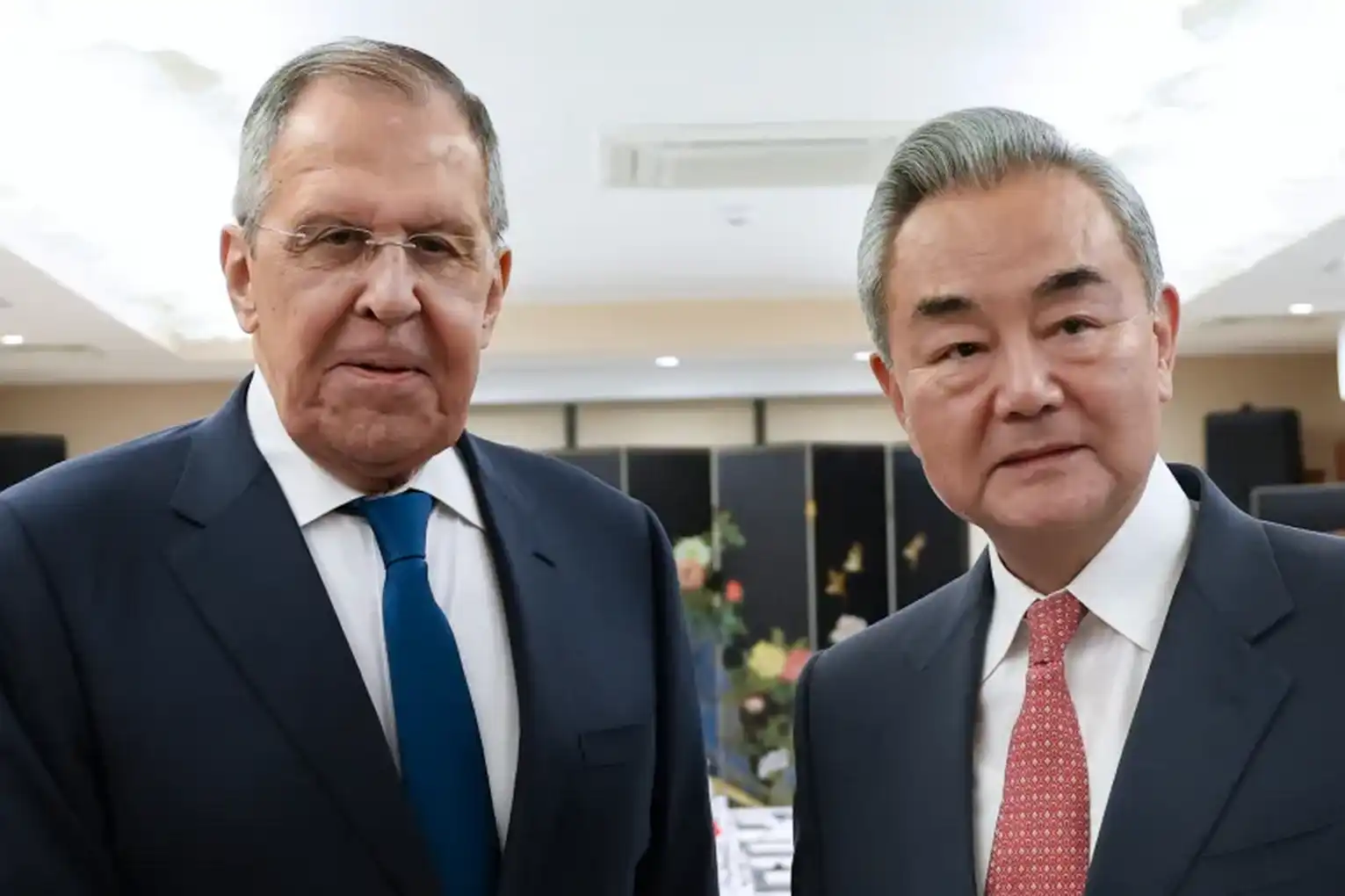
PICTURED ABOVE: Russian Foreign Minister Sergey Lavrov and Chinese Foreign Minister Wang Yi. PC: Russian Foreign Ministry Press handout.