 0
0
 0
0

India holds the rotating presidency of BRICS (Brazil, Russia, India, China, South Africa) this year, and following last year’s summit in Rio de Janeiro, speculators will be curious whether New Delhi will take the lead on advancing the organization’s long-discussed potential to disrupt the current Western-dominated international order.
The outcome will almost inevitably disappoint, however, as any keen BRICS observer over the last 5 years must admit: the organization is nothing if not indecisive.
Even though little of substance changed last year, BRICS and their new members (coalesced as BRICS+) now gather and operate for the first time under the gaze of an openly hostile US Administration. Last year, by the time the annual BRICS summit kicked off in Brazil, President Donald Trump had already labeled the group an “anti-American” alliance, and threatened economic punishment on any BRICS nation that engages in such activities.
India has long been an important American foreign policy conundrum. Long-standing support and reliance on Pakistan never allowed relations to be as warm as they perhaps could be, and New Delhi’s support of Russia’s oil economy during the Ukraine War directly flouted Joe Biden’s attempt to isolate Moscow in 2022. At the same time America considers India an important counterweight to China in Asia. India’s current government under the now-3 term PM Narendra Modi recently inked a free-trade agreement with the EU which could positively affect some $130 billion worth of annual trade. It was signed amidst President Trump’s tariff-wielding antagonism against the EU over Greenland’s sovereignty, and was interpreted as a bilateral rebuke of the President’s weaponization of trade.
Off the back of Modi’s “mother of all trade deals,” India’s BRICS presidency will also look to build consensus on opposing unilateral actions to weaponize trade, advancing technology for the good of a multipolar world, and critical minerals supply chains.
“The previous US administrations under Obama and Biden were cautious but not openly hostile toward BRICS,” said David Monyae, director of the University of Johannesburg Confucius Institute (UJCI) and the Center for Africa-China Studies. “However, Trump has identified BRICS as ‘an attack on the US dollar’. He has even threatened to impose 100% tariffs on the BRICS countries”.
“US tariffs could backfire, strengthening the BRICS’ resolve to deepen economic cooperation and reduce dollar dependency. The tariffs were intended to coerce BRICS members into abandoning these policies, but their implementation risks hardening the BRICS’ resolve and accelerating efforts to build alternative economic frameworks”.
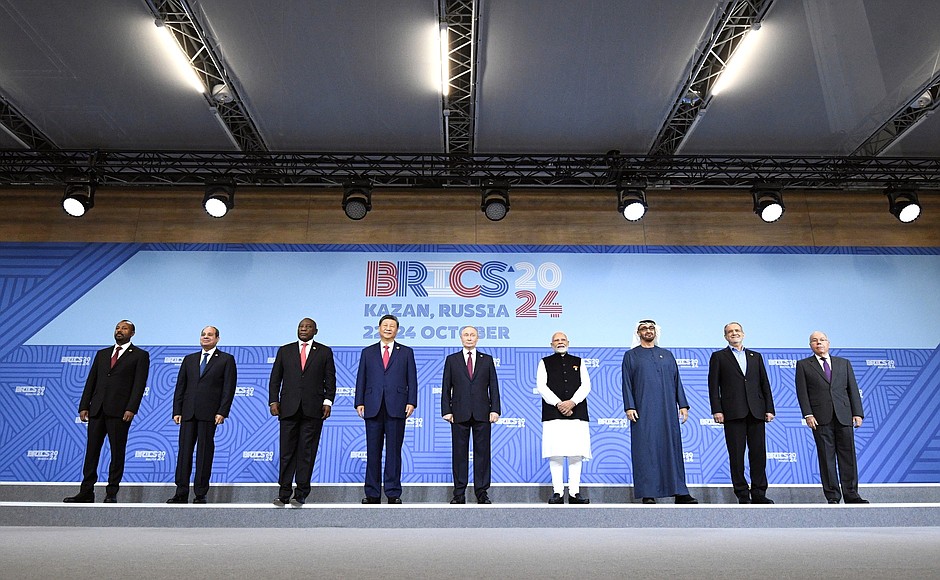
Indeed, following the summit in Rio, Indonesia joined BRICS as a full member, the fifth since the group began welcoming new members (Egypt, UAE, Iran, and Ethiopia have also joined). Nine nations—Belarus, Bolivia, Cuba, Kazakhstan, Malaysia, Nigeria, Thailand, Uganda, and Uzbekistan—are currently the BRICS’ partner countries, while Senegal, Saudi Arabia, and Kenya, are attempting to negotiate their ascension. Any one of these might have been scared away from joining the group by threats from the US, but Trump’s April 2025 “Liberation Day” tariff regime was probably as close to a worst-case-scenario as could be imagined, and it was incurred without any conditions, against allies and adversaries alike.
“The trade war with the United States is pushing Indonesia to align more closely with the BRICS,” said Bhima Yudhistira Adhinegara, executive director of the Center of Economic and Law Studies (CELIOS), in Jakarta.
Indonesia was facing one of the steepest tariff rates, and made the decision to negotiate the rate down with the US as part of a trade agreement that Adhinegara called “highly detrimental to the Indonesian economy,” as it forces the country to accept both 0% import duties on US imports and a 19% tariff on exports to the US.
And the BRICS currency?
WaL has covered previous BRICS summits, and the takeaways are always fairly insubstantial, with significant questions left unanswered. In 2018, BRICS proposed a cross-border clearing and bank communication system called BCBPI, often simply called BRICS Pay shorthand. In 2022 and in 2024, the value and importance of developing this potential-alternative to the SWIFT international payment system were reiterated, and China, a previously tentative supporter of BRICS Pay, came out in full support, yet the initiative still hasn’t been advanced.
There’s long been speculation that at any time the BRICS countries will announce the creation of a new trading currency, backed by a basket of commodities, as a challenge to the dollar’s status as the world reserve currency. On this above all, the largest share of BRICS-related speculation falls, but besides a bizarrely direct quote from the Russian embassy in the non-BRICS member Kenya in 2023, no proposal of such a currency has ever been introduced.
In a long form interview piece at the Stimson Center following last year’s BRICS Summit in Rio, a trio of experts continually responded to questions with answers like “there were no concrete outcomes,” or “a strategy has not been explicitly elaborated,” really typifying what BRICS has come to embody in world affairs: a lot of hype, with little substance.
Indeed for anyone who has followed the activity of the BRICS organization closely, there is a striking degree of inaction on what seem to be the headline reasons for the group’s hodgepodge existence.
This can’t be said, however, to apply to the BRICS member states’ long-standing dissatisfaction with the World Bank and International Monetary Fund. Back when it was just BRIC—sans South Africa—the creation of the New Development Bank in Shanghai probably lent much of the credibility that BRICS has come to be seen as possessing.
On behalf of the Global South and its multilateral partners in the north (Russia, China) the NDB has backed $42.9 billion in loans to both member states and partner states that lack the privileges of being a full member. The loans have underpinned 139 different projects that include 2,400 MW of renewable power resources, over 1,400 kilometers of road and rail infrastructure, and over 35,000 housing units.
BRICS has long levelled accusations that the Global South needs a different sort of development financing landscape beyond the IMF and World Bank, and the NDB seems to have succeeded in providing this. Beyond loans for development projects, a recent bond auction with a 4% coupon saw $6.7 billion in issuances to over 100 accounts—8% of which were asset managers and institutional funds, perhaps the most noteworthy fact of the whole exercise.
In general though, the BRICS+ experiment over the last 18 years has been widely viewed as unimpactful. This is sometimes attributed to the innate differences of priorities and values among the members. Brazil is a socially-liberal and liberalized economy, while Russia is a conservative society that suffers from economic recalcitrance and concentration. India and China have an occasionally-violent ongoing border dispute. India’s government has been substantively accused of inciting anti-Muslim violence, yet BRICS+ also contains the center of world Shi’ite faith (Iran) and may soon contain the custodians of the Two Holy Mosques (Saudi Arabia).
What brings these nations together at the highest political level every year, and sometimes twice a year, is likely the shared belief that a world divided by multiple regional powerbases is preferable and safer than one over which Washington, DC, attempts to dominate. It’s why many have felt that BRICS+ can only succeed, and also why so many are surprised the group has produced so little meaningful change. WaL
Consider Following the link here to see all the ways, monetary and non-monetary, you can support this work and more like it.
PICTURED ABOVE: Official BRICS logo India