 0
0
 0
0

“In coordination with the Federal Government of Somalia, US Africa Command (AFRICOM) conducted an airstrike targeting ISIS-Somalia on Nov. 8th. The airstrike occurred in the vicinity of the Shikaalo Valley, approximately 65 km southeast of Bossaso”.
“AFRICOM, alongside the Federal Government of Somalia and Somali Armed Forces, continues to take action to degrade ISIS-Somalia’s ability to threaten the US Homeland, our forces, and our citizens abroad”.
It was all an interested party would have to read from the United States’ military arm on the African continent—short, vague, and unsatisfying.
It has come to typify the language used in the bombing of largely undescribed targets in one of Africa’s poorest countries for years, even in 2025 when the scope of that bombing has dramatically widened.
“The US backs local security forces in Puntland, as the US-backed Federal Government, which is based in Mogadishu, doesn’t control the territory,” wrote award-winning war reporter Dave DeCamp for Antiwar. “In 2024, the Puntland government withdrew from the federal system in response to President Hassan Sheikh’s move to amend the constitution”.
Where’s Puntland; what was President Sheikh trying to amend in the constitution? They are questions that drown in a yawning void of media coverage that would leave any American completely unaware as to their government’s military involvement in this far away country, of which they may know exists only through a pair of Hollywood thrillers, Black Hawk Down, and, released a decade later, Captain Phillips.
DeCamp is one of the only American journalists covering the subject of AFRICOM’s war in Somalia, and reports that this strike in the Shikaalo Valley is the 90th air and drone strike this year.
“For context, President Biden launched a total of 51 airstrikes in Somalia throughout his four years in office, and President Obama launched 48 over eight years,” he wrote, detailing a recent spate of bombing that lasted three days in Puntland’s Caal-Miskaad mountains, where local forces are battling an offshoot of al-Shabaab, called ISIS-Somalia.
Al-Shabaab (The Boys) was something of an offshoot itself—the armed wing of a tribal government called the Islamic Courts Union which governed large parts of the country before a US-backed invasion by Ethiopia in 2007 deposed the governing wing and left only the fighters.
On July 28th, al-Shabaab took the “strategically important” town of Maxaas in central Somalia north of Mogadishu with an operation consisting of heavily-armed fighters preceded by car bombs. A mixture of Somali military and militias held the town before retreating to a pre-prepared position beyond the outskirts. Maxaas is one of several towns and villages captured by the terrorist group this year.
In 2024, The Intercept obtained a classified study commissioned by the Pentagon that showed “a failure to define the parameters of the conflict or its aims, and an overemphasis on military measures without a clear definition of the optimal military strategy,” in AFRICOM’s attempts to battle al-Shabaab.
The study, published by the Institute for Defense Analysis, was rife with findings typical of war reporting during the Global War on Terror, for example that operations in Somalia were lacking “an organizing principle,” that agencies were often “in conflict over ends, ways, and means,” and the dual strategies of counterterrorism and counterinsurgency were “competing rather than complementary”. WaL
We Humbly Ask For Your Support—Follow the link here to see all the ways, monetary and non-monetary.
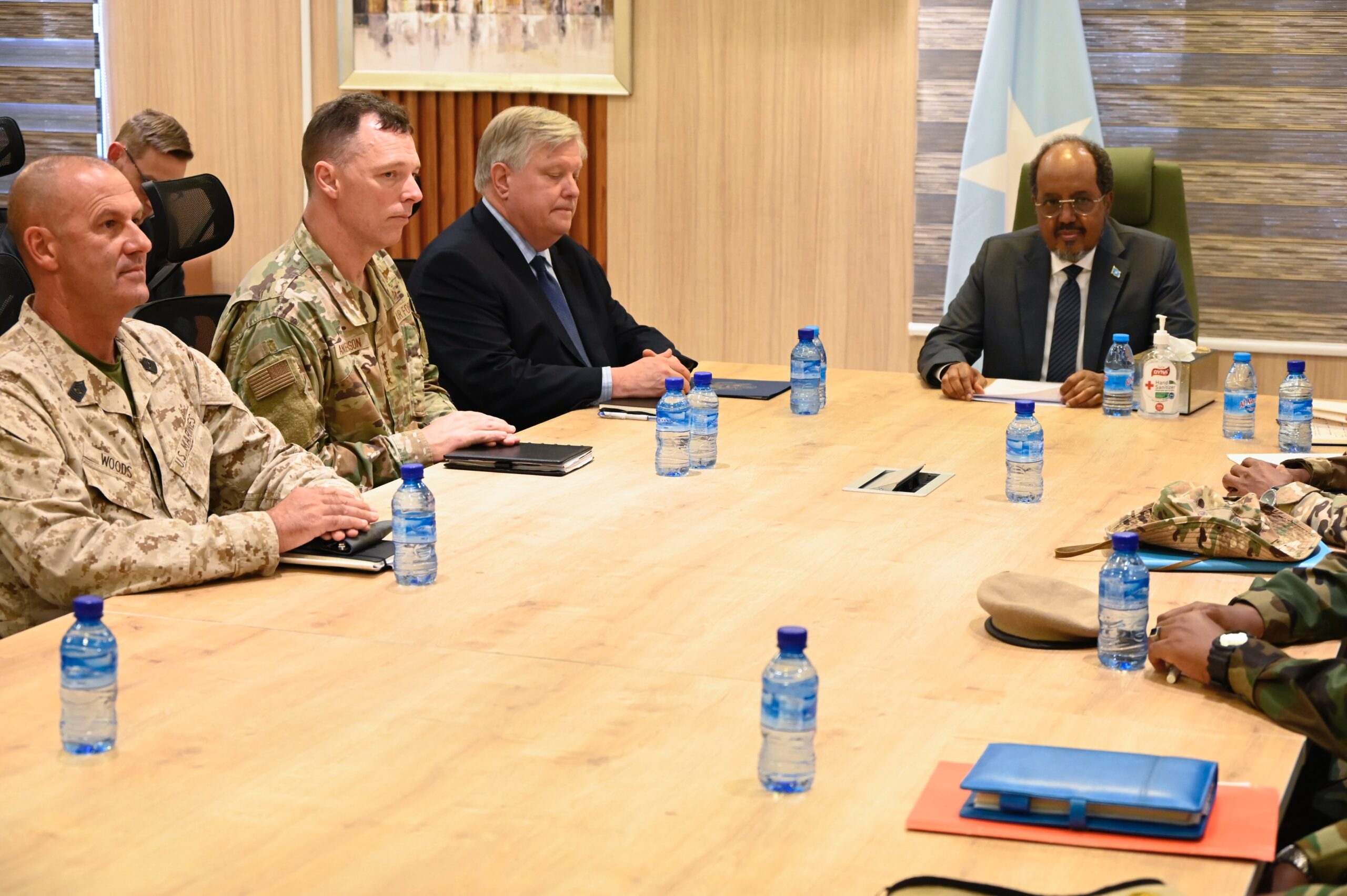
PICTURED ABOVE: General Dagvin Anderson, AFRICOM commander, meeting Somali military leaders and President Hassan Sheikh in Mogadishu. PC: AFRICOM via X.