 0
0
 0
0

America’s media physicians are hitting the airwaves to denounce the flipping of the food pyramid as directed under the medical/agriculture sector of the Trump Administration.
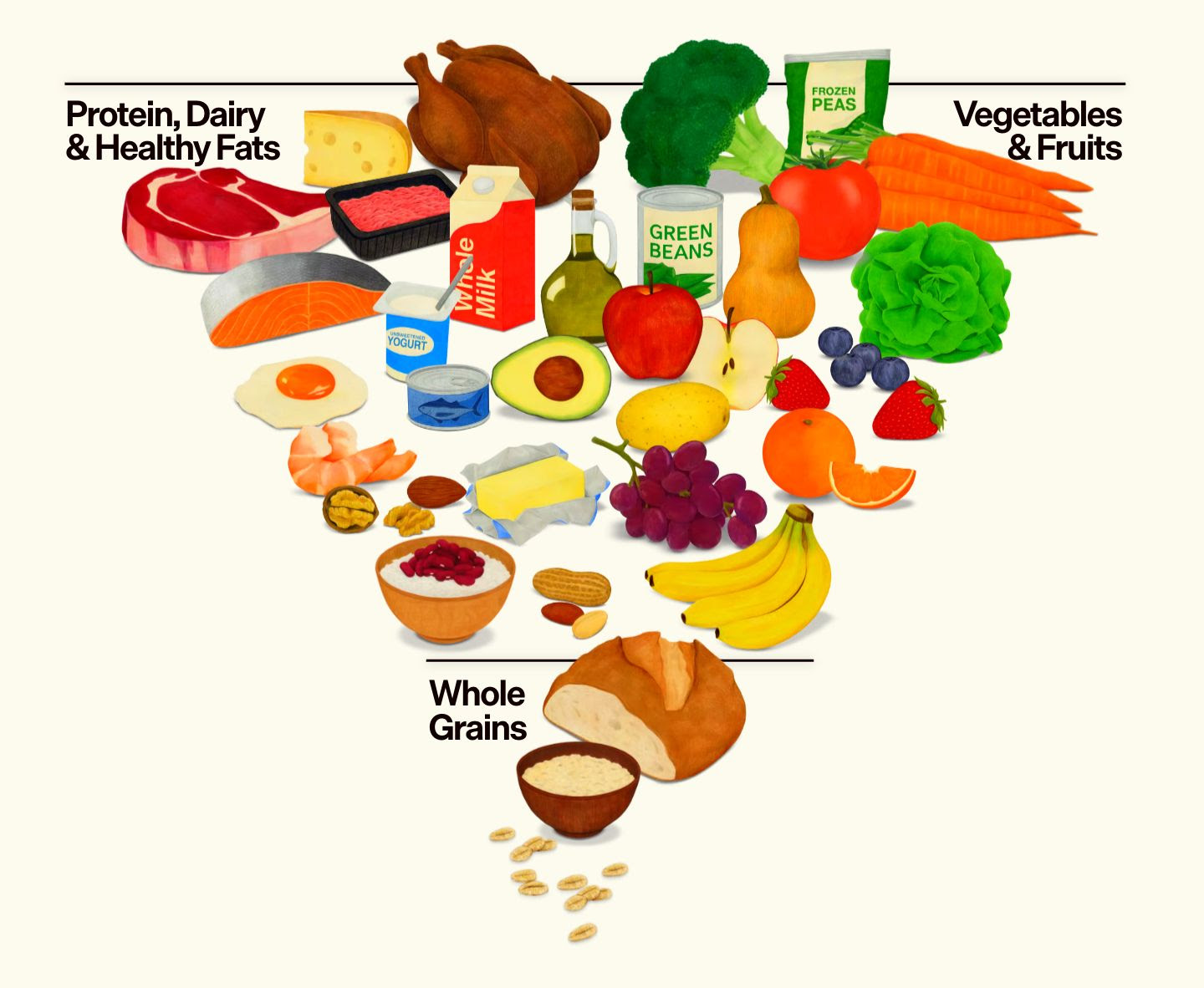
When sugars and sweets are removed and the image is flipped, the classic and lethally-inaccurate food pyramid places animal products such as meat, eggs, and dairy in left-hand corner of importance, and vegetables, fruits, and naturally-pressed oils in the right hand corner.
The bottom of the pyramid is made up of grains, which according to the old pyramid were to be eaten at the scale of 6 to 11 servings per day, driving an intergenerational obesity crisis not seen in any other country of similar wealth and diversity to the US. Despite this, and despite the American adult obesity rate standing at 50% when Robert F. Kennedy Jr. took office, this reversal of strategy has provoked sharp rebukes from America’s medical establishment.
“Promoting saturated fat and increasing the amount of protein goes against all nutrition and cardiology science,” Dr. Kim Williams, chair of the department of medicine at the University of Louisville in Kentucky, told CNN in an article that has more hyperlinks than you have ever seen in your life.
“We’ve been researching this for decades, and we definitively know saturated fat—such as butter fat, beef tallow, red and processed meat—are all closely associated with more deaths from cardiovascular disease,” said Williams, a past president of the American College of Cardiology.
Note the language—”definitively know” becomes “closely associated,” in other words, they definitely know that there’s an uncertain association.
That kind of language is just as appropriate to be used in this perfectly factual statement: recommendations of avoiding saturated fat in meat and cooking oils and using vegetables oils and low-fat dairy were in place for a period of 50 years during which America became the sickest country on Earth by virtually every metric—health service spending, chronic disease burden, obesity and diabetes rates, and rates of heart disease.
In fact, a recent analysis published last October in JAMA Open Network, revealed that if in addition to the Body Mass Index, one includes waist-size as a measure of obesity, then roughly 70% of Americans in a sample of 300,000 could be classified as obese. That’s almost 3 in 4. That’s the report card for the world where health messaging and nutrition guidance offered by women like Dr. Williams is heeded.

Eat real food
“This represents a significant shift in our understanding of obesity,” said Chris Kresser, MS, a popular health influencer, author, and founder and director of the California School of Functional Medicine. Kresser points out that waist size may even be a better marker for obesity than BMI, because abdominal fat disproportionately affects our metabolic and cardiovascular health compared to body fat located in other places.
“It’s not just about the number on the scale; where you carry that weight profoundly affects your health. When we include these more comprehensive measures, we see this is nothing short of a national health emergency that should be treated as such”.
US Food and Drug Administration Commissioner Dr. Marty Makary said at the briefing where Secretary Kennedy revealed the flipped food pyramid that the US had suffered under the previous dietary guidelines, and that it was time to change strategy.
“For decades, we’ve been fed a corrupt food pyramid that has had a myopic focus on demonizing natural, healthy saturated fats, telling you not to eat eggs and steak and ignoring a giant blind spot — refined carbohydrates, added sugars and ultra-processed food,” Makary said.
CNN just barely managed to include in its report that physicians applauded the direct criticism of these three unhealthy components left in the old pyramid and rarely attacked in the old USDA Dietary Guidelines for America, which were released recently carrying a single guidance: “eat real foods“.
“The 2025-2030 Dietary Guidelines for Americans represent the most significant reset of federal nutrition policy in over 50 years,” Kresser said. “For the first time, the government is telling Americans what I’ve been saying all along: prioritize whole, nutrient-dense foods and dramatically reduce highly processed products”.
The best-selling author of The Paleo Cure added in an email that “I never thought I’d see this in my lifetime”.
CNN declined to note any of this, and instead focused exclusively on the notion that saturated fats are bad for you. However this isn’t what the realfood.gov guidelines state. Instead one finds the following: Every meal must prioritize high-quality, nutrient-dense protein from both animal and plant sources, paired with healthy fats from whole foods such as eggs, seafood, meats, full-fat dairy, nuts, seeds, olives, and avocados.
Hardly the portrayal of “beef is back” that CNN makes it seem. If the Cable News Network can use foolish comments from everyday Trump supporters as a judgement on the work done by Kennedy and Makarty, than it’s certainly fair to attack women like Dr. Williams for suggesting that everyone who eats more saturated than is recommended never exercises—the main determinant in whether saturated fat is dangerous to heart health.
By 2020, the only meta-analysis ever conducted on the extremely few randomized controlled trials on red meat and processed meat consumption found no evidence to suggest recommending limitation would improve health outcomes, since indeed no such evidence was found. That should have been on Dr. Williams’ mind when she spoke to CNN, but media physicians are rarely so nuanced.

The dividing line
Saturated fat is often a dividing line between the medical establishment in America and a new generation of health influencers that are dominating narratives about diet and health in America. Kresser is firmly on the latter side, and Dr. Williams, by her comments, can be inferred to be found firmly on the former.
With so many years of failed health policy both in the realm of diet and in that of chronic disease prevention, more and more Americans are willing to listen to convincing alternative arguments, and the popularity of podcasts has certainly propelled this trend. Dr. Rhonda Patrick, a medical researcher and other popular health influencer, also released a point-by-point review of the dietary guidelines and was equally moved that one of the largest health influencers in the country—the government—was adopting a “whole food” focus.
“I support the shift away from demonizing all saturated fat,” Dr. Patrick wrote recently. “The old framing was too simplistic, and it nudged people toward low-fat, high-sugar, ultra-processed ‘health foods’ that made metabolic health worse, not better… But this is not a license to mainline butter. The right way to interpret this update is to stop treating saturated fat as inherently toxic, but don’t pretend it’s irrelevant”.
Saturated fats come in many forms; some like stearic, lauric, and palmitic acids are outrightly linked to reductions in disease risk. Dr. Williams didn’t bother explaining this, nor did she explain that the way saturated fats are prepared also affect their pathological potential, with saturated fats liquified at high temperatures becoming more harmful through oxidation than when consumed in a solid form such as in dairy products. On a broader level, saturated fats are embedded in food items, and when studied as such, their association with adverse health effects sometimes diminishes, such as with the case for full fat dairy, which time and time again has been shown to have the opposite affect of saturated fat when viewed in isolation, even though few if any Americans eat saturated fat in isolation.
Dr. Patrick praises how the guidelines address quality of grains consumed, the recommendation for 0 grams of added sugar, and the update on the recommended amount of protein: 1.2 to 1.6 grams per kilogram of body weight per day.
“The old 0.8 g/kg/day recommendation was never intended to be an ‘optimal health’ target, it was a deficiency-prevention floor,” Dr. Patrick writes in an email newsletter. “And in the real world, most people do better with 1.2–1.6 g/kg/day for building and preserving muscle mass, improving satiety, and supporting metabolic health”.
That’s borne out by recent research as well. Less protein triggers overeating, one Virginia Tech study found, while another one from Rutgers found that participants undergoing 6 months of caloric restriction for weight loss did better with higher levels of protein in the diet.
CNN quotes preventive cardiologist Dr. Andrew Freeman, director of cardiovascular prevention and wellness at National Jewish Health in Denver, as saying that “protein deficiency almost does not exist in the United States,” proving somewhat Dr. Patrick’s claim that old guidelines were for deficiency-prevention rather than optimal health.
Lastly, the CNN article includes a long pitch for the Mediterranean Diet. WaL has reported that the American version of the Med Diet claims to explain health outcomes in European countries while simultaneously presenting a diet plan that no one in those countries adheres to. Both Dr. Makary and Dr. Williams accuse the other side of relying on dogma and flawed science. The best way to see who’s more correct, since America has already seen the report card of cardiologists like Dr. Williams, is to wait and see the report card of the Make America Healthy Again team—will obesity rates and chronic diseases go down or won’t they. WaL
We Humbly Ask For Your Support—Follow the link here to see all the ways, monetary and non-monetary.
PICTURED ABOVE: The new Food Pyramid. PC: Realfood.gov.



The discussion of waist circumference adds useful context to BMI, but the 70% estimate should not by itself prove that older dietary guidance caused obesity. I appreciated Dr. Patrick’s caution that moving away from demonizing saturated fat is not a license to consume unlimited butter; food quality, overall dietary patterns, and individual risk still matter.