 0
0
 0
0

This is part 2 of a 2-part series on the changing use-cases for gold and silver in the modern economy. You can read part 1 here.
Since ancient times, gold and silver have been monetary commodities. While each have had various markets such as craft, dentistry, and jewelry, their value over the millennia has been rooted in their monetary properties.
But could that finally be about to change? Silver’s emergence as a hotly-demanded industrial commodity for manufacturing solar panels, data centers, batteries, and other technology has overtaken more than half its market share away from its long-held position as a precious metal. Gold on the other hand has become so expensive relative to fiat money that its other-millennia-old use case—jewelry—is struggling to keep margins manageable.
The parabolic climb in the price of gold since 2024 needs no introduction, and even though the yellow metal lost it’s 5,000 handle back in February, it has remained consistently elevated above $4,500 per ounce in the last 3 months. Driven substantially by monetary inflation, gold is more than ever being seen as a portfolio necessity to protect purchasing power as all major economies continue to see prices rise faster than normal off the back of unsustainable central bank money creation.
Broadly speaking, the West is only just now regaining this instinct. For many in Turkiye, India, and China, though, this necessity never needed to return; gold never stopped being the citizen’s guardian against monetary debasement.
“Our currency depreciates in India, right? So you need a store of value,” says Sidhi Singhvi, who works at a sort of crossroads between traditional money and fintech with Unvault, a wealth-management app that uses AI to appraise jewelry and build an active portfolio based on the metal the pieces contain and the added resale value they may have. With a long career in the jewelry business, FX markets, and crypto options trading, Singhvi’s definition and understanding of real wealth is broader than most.
“This isn’t the case in the US. The dollar has always been so strong so it makes sense that gold is not that popular as a source of value or wealth. But things are changing”.
WaL reported recently that 6 of the 10 largest economies in the EU carry public debt burdens equal or greater than 100% of their gross domestic product, a value measure of the whole economy, while Japan, the UK, China, and the US are all on that list too. Since the tax burdens in these countries haven’t gone up 100% over the same time period, it means that government spending was financed either with borrowed money or with newly-created money. Since honestly borrowed money would also come with a requisite, if delayed, tax increase—which also hasn’t occurred—it’s safe to say almost all of this debt was financed with pure money printing.
Just looking at M2 money supply in India, Singhvi’s home, lends substantial credence to her case. The supply of available rupees has doubled over the last 6 years, and almost quadrupled when measuring back another 6. The Indian economy has not quadrupled in size over that period, meaning that there are more and more rupees chasing fewer and fewer goods.
“I grew up in India, and in India, gold is just seen as a source of wealth, it’s something that people of varied socio-economic levels think about because that’s how they save and grow their wealth. Very pervasive,” she told WaL over a telephone interview. “That’s how it exists in China, in India, in everywhere else. In large parts of Latin America, large parts of Asia, it has utility as jewelry but then it is also a way to save”.
Recent data coinciding with the massive upward pressure on gold prices, however, show that this utility seems unable to continue to convince consumers to choice gold instead of other options.
The jeweler’s dilemma
“9 karats. Some firms now are trying to make products with 9 karats,” said Silvana Perino, who runs Gioielleria Perino with her brother about, 1 hour from Milan. “In Italy, there was 18 karats — .725 gold — and that was it. So it’s now half of that, so more than half is copper. If you’re a young person buying a wedding band, that’s likely going to be your only reasonable choice, that or silver”.
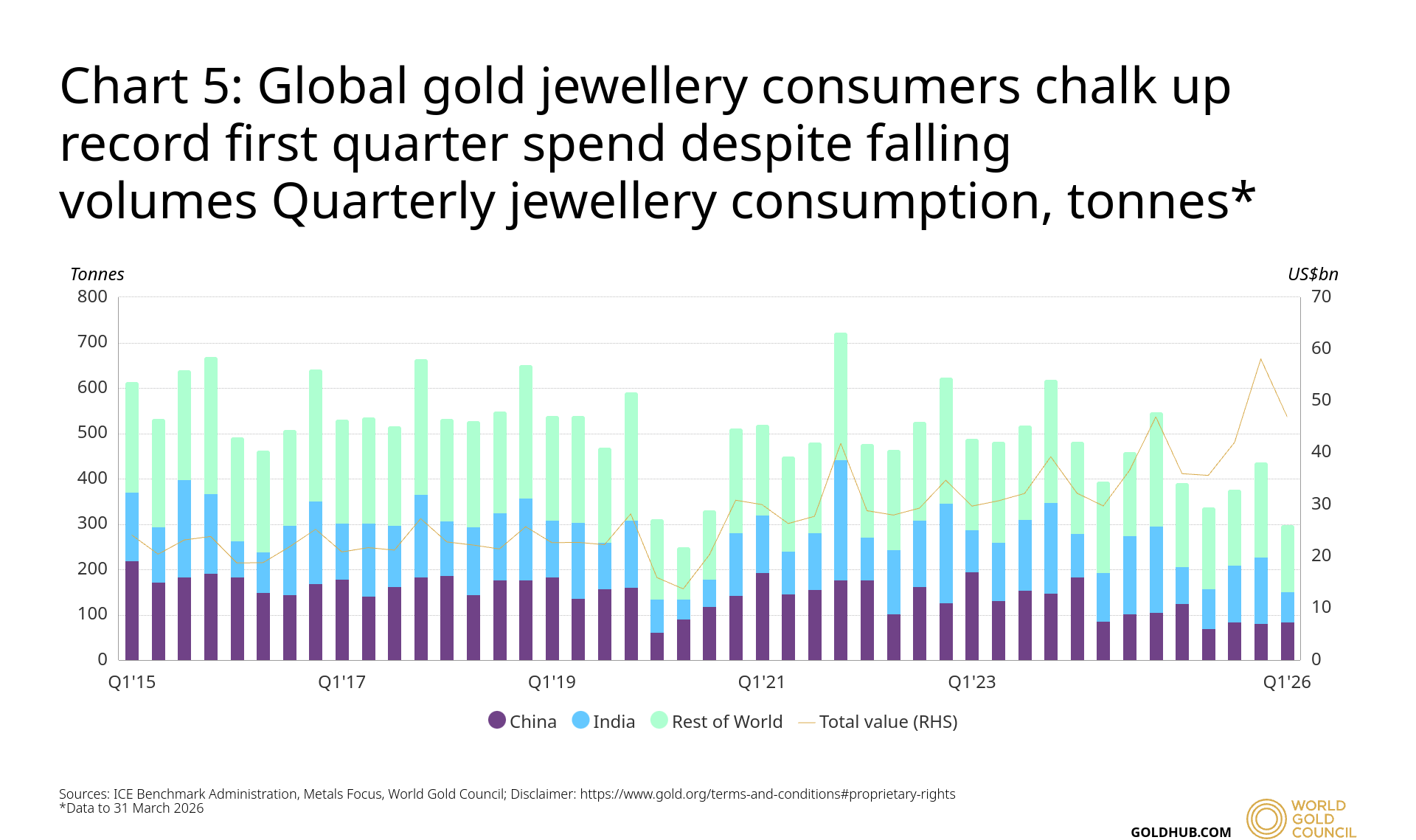
Indeed, as demand for investment-grade gold has increased, demand as ornamentation has fallen—in some cases dramatically. In China, sales of gold jewelry collapsed 37.9% between January and March of this year and the same period last year, even while sales of bars and coins increased more than 40%.
This decline was seen across the world, even while total demand value increased—reflecting the increased price of the gold pieces being bought—in almost all jurisdictions. The fall in sales could only be rivaled with Q2 2020—the height of COVID lockdown measures worldwide when almost all jewelry stores were closed.
True to Singhvi’s prognosis, India’s demand for gold jewelry, though down, was labeled as “robust” by the World Gold Council, while the US was one of the few places where both sales volumes and total value both fell, reflecting a withdrawal from the market altogether. Declines in the gold-hungry Middle East and Turkiye were also steep, again despite overall increases in total dollar values of purchases.
In most of Asia, physical gold and gold jewelry is extremely liquid—far more than in the West, with sources confirming to WaL that the premium on investment-grade gold in Turkiye can be as low as €9.00 for a 7 gram national coin at .917 grade gold.
“Just from a market perspective in India, in Asia basically, the market is very transparent: you know what you’re paying for the gold and for the design charges,” confirmed Singhvi.
Perino’s Italy experienced in implosion of 77% in sales compared to Q1, the single largest decline worldwide, and a 39% drop in sales year-over-year. She offered WaL her thoughts on changing consumer trends.
“We lost the ‘culture’ of gold. Back awhile, a woman would leave the house with a gold necklace, a gold band, and a gold bracelet, but now people spend €1,000 on a smartphone or other technologies, and so priorities changed. We are more likely to stock items that brands do a lot of publicity for, and these are made with different alloys, resin even; and if they are gold, they’re so thin or made in new styles”.
“For a pair of wedding bands, without buying the thinnest possible option, it’s going to be €2,000. Who can afford that? We’re going to a jeweler’s conference where they will discuss gold at €200 per gram”.
At that price, we agreed, wedding bands will just have to be silver moving forward, though when the question was put to Singhvi, the former owner of an investment-grade jewelry business pushed back.
“In India, most jewelry is investment grade, high karat,” she says, comparing the purchase of a gift for a spouse like any other investment. “We all buy a car or a house thinking that it has value. So if you just think of it in the form of the asset that it is, I think, then, those purchasing decisions are still easy. And it’s not like a car, it won’t depreciate if you scratch it. So I think that there’s a little bit of education that the market needs and the jewelers need to be there for that”.
A question of value
There is evidence from Spain of Paleolithic people including gold flakes along with their possessions in caves 40,000 years ago, suggesting that gold was the first metal that humans ever interacted with. Since then, gold and personal ornamentation have never been far from one another.
For the pressure of the gold price to effectively sever that connection, it would likely have to climb higher, but perhaps not that much higher. Already, smaller weights, lower karats, opting for gold plating, and ‘vermeils’—a sort of thicker, more sophisticated form of gold plating, are strongly overtaking the jewelry market.
“That’s unfortunate because customers are paying very high prices for gold plated jewelry which will have no resale value,” said Singhvi.
In high-price environments, economists often warn of “shrinkflation,” a phenomenon of producers trying to resist raising prices by reducing product volume. In these environments, customers often trade down, moving from beef to chicken, or from a car to a moped—or gold to silver, in this case.
A Q1 report on silver jewelry sales found that the sector saw production and volume growth such that it reached 248 million ounces consumed globally. Predictions (albeit at a gold price of $3,500 per ounce) from November of 2025 summarized at the Silver Institute saw silver jewelry falling 4% in 2026, driven by demand reduction in India. The predictions got wrong that there’d be a massive shedding of demand for gold jewelry which would be picked up by silver.
Continued pressure of inflation on the price of gold may indeed see the yellow metal cede virtually all of its market cap in jewelry to silver, since as Perino pointed out, every decade that goes by, wearing gold in public puts one at a bigger and bigger risk of theft.
JP Morgan Chase currently has a price target for gold of $6,000 for 2026. One can argue either way if it keeps such a high valuation, but gold’s been decoupled from fiat currencies for a long time now, and there’s no question whether or not it will go back to the price it was in 1981, 2009, or 2020, because it won’t.
Historic ratios of the Dow Jones to the gold price would suggest that with the Dow at 50,000, gold could perhaps should be $17,250 per ounce. Who’s going to buy a gold wedding band then? WaL
We Humbly Ask For Your Support—Follow the link here to see all the ways, monetary and non-monetary.
Editor’s Note: Nothing in this story should be construed as investment advice. Due diligence should always be performed when making any investment decisions. This story contains affiliate links, which may contain offers for financial products and services.