 0
0
 0
0

This is part 1 of a 2-part series on the changing use-cases for gold and silver in the modern economy.
Since ancient times, gold and silver have been monetary commodities. While each have had various markets such as craft, dentistry, and jewelry, their value over the millennia has been rooted in their monetary properties.
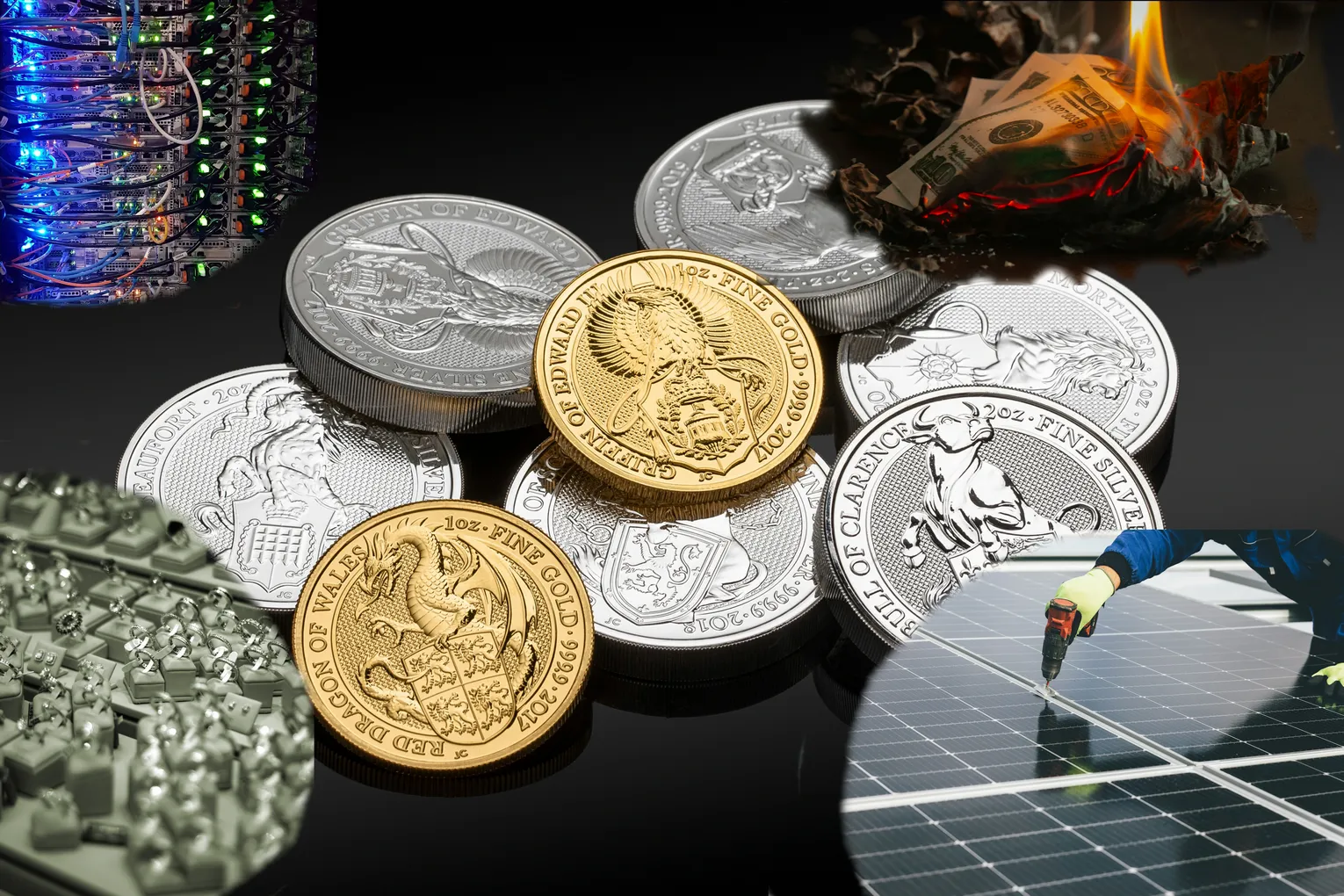
But could that finally be about to change? Silver’s emergence as a hotly-demanded industrial commodity for manufacturing solar panels, data centers, batteries, and other technology has overtaken more than half its market share away from its long-held position as a precious metal. Gold on the other hand has become so expensive relative to fiat money that its other-millennia-old use case—jewelry—is struggling to keep margins manageable.
We know from ancient Egyptian hieroglyphs and Babylonian cuneiform tablets what the exchange ratio between gold and silver was before the Common Era, and many civilizations from the ancient to the pre-modern have fixed that ratio at different amounts to reflect both the cultural value and the scarcity of the metals.
It’s been as low as 2 to 5 in Ancient Egypt, and at times this year it’s been as high as 1 to 120, a sign some traders see as signaling that silver is currently undervalued, even as it swims around within its record-high price quartile. But all these ratios have factored in silver only as money and a product to make jewelry, never as an industrial commodity. Now, 65% of silver is used in manufacturing, and this demand has risen so fast, the yearly supply deficit compounded since 2020 has reached 1 billion ounces while at the same time being expected to continue growing.
“With such constant structural demand, silver is effectively becoming a mixed metal these days. The industrial element will simply take over with the advent of the green economy,” Steve Maitland, founder of Maitland Wealth and an independent research analyst specializing in precious metals investing and Gold IRAs.
“Silver moves with manufacturing activities; if there is confidence in manufacturing, silver will move up. Gold, on the other hand, will not show such a correlation. It is still the metal of choice for investors and is highly correlated with interest rate fluctuations”.
This perspective isn’t limited to people analyzing manufacturing trends, but real Americans buying physical ounces of silver. Here’s Jose Gomez, co-founder of Summit Metals, a national silver and gold bullion investment firm.
“We are based in Utah, and many are buying silver because of the potential AI data center being proposed,” Gomez told WaL in an email. “This facility would use up around 2-3 days worth of global silver production, on just one data center. It’s just a mindset shift of ‘silver is currency,’ towards ‘silver has productivity value too'”.
Gomez says he has noticed his investors buying copious amounts of silver and storing it in their vaults for the express purpose of speculating on industry-driven price increases.
“Investors are buying on the hopes that it would be used not as a currency but as a resource to create items,” he explained. “The reason they store at vaults such as ours, is that when they want to “sell” we are able to move it into a refinery the same day to convert silver into cash value at the time of sale”.
In other words, the structural shift, as Maitland called it, has made that biggest of all leaps in investing—from being merely a piece of technical analysis to something driving cash purchases of physical assets; doubtless the most substantial piece of evidence to suggest that silver’s days of being just money and a craft material—going all the way back to pharaohs—are behind it.
The weak sibling no longer
Silver has always tagged along at various exchange rates with gold that have reflected the two metals’ availability and demand. Data demonstrate that since 1971, every time gold prices sharply increase, silver at first lags, then overtakes gold’s performance, reflecting these historic ties and a very instinctive part of customer/investor psychology—that gold costs x, while one can buy silver for less for the same overall defensive investment purpose.
“Silver historically has been a weak sibling to gold,” said John Ohanesian who has since 2017 been President and CEO of Lear Capital, the precious metals dealer that specialize in gold and silver-backed IRAs. “In the US, silver is purchased much more frequently than gold by US residents. Silver’s here to stay, and in a different way that it has been in the past. It’s never been more in demand industrially”.
Back in 2010, industrial demand for silver maybe totaled 10% of all ounces produced, said Ohanesian, but in today’s technologized economy it’s nearly 65% of above-ground silver. This skyrocketing demand, famously, has created a shortage which was recently confirmed by the World Silver Institute as extending into a 6th consecutive year.
On January 29th, silver prices capped a ferocious breakout move by setting an all-time-record high of just under $160 per ounce. On the next day, it dropped close to 30%. Ohanesian offered anecdotal evidence of the industrial demand for silver—recounting that he saw physical silver being packed and shipped from a US supplier to China for an order that was settled at $120 per ounce after the price had already fallen below $90 on US markets.
“There’s a place for silver today and going forward for a variety of reasons,” said Ohanesian. “Debasement, industrial purposes, unit cost, the appetite of the consumer… silver’s got a lot more respect in the last 12 months”.
Back-to-back sour and sticky inflation reports paired with the high energy costs resulting from a war and a record American debt burden across multiple sectors have shaken investor confidence that the Federal Reserve will lower interest rates. April’s 3.8% annualized CPI is more than double the Central Bank’s official, though oft ignored, 2% target, as well as being higher than the current Fed funds rate. By all their own standards and data, interest rates should be increasing, not decreasing.
Yet that’s not what Wall Street is betting on, it seems. Following an overwhelmingly-positive earnings season, the S&P 500 continues to enjoy record high valuations and the Dow Jones seems poised to resummit 50,000. Why the optimism? Investors will feel that record-low consumer confidence, month-after-month of stagnation in the job market, and a drop in real wages, as well as the ascension Kevin Warsh to Chair of the Federal Reserve, will lead to lower rates and another Fed Put—easy credit that will benefit the hyper-scaling tech firms dragging the rest of the economy along.
Industrial by name, industrial by nature?
Traditionally, industrial commodities suffer if industrial demand and activity falls. During the 2008 Financial Crisis, copper prices experienced a devastating crash of approximately 67-70%, falling from record highs in mid-2008 to multi-year lows by year-end. US steel production fell 37.2% between January and November 2008, with raw steel output dropping 59.3% year-on-year, and capacity utilization falling to 36.2% from 90%.
Without making any predictions of financial collapse, 2008 was the last traditionally-defined recession suffered by the US economy, and it raked base metal investors over the coals. Even still, Ohanesian does not predict that similar calamity would befall the silver market if the US entered recession or an industrial downturn.
“I don’t see any time soon—three, five, seven years out—where you’re going to have a lack of need for silver. Even if we hit a recession, you’re going to find a need for these critical minerals, silver being one of them, for these industrial purposes like AI, like data centers, like solar, etc. I don’t see a significant drop off in the price of silver forthcoming”.
That sentiment was echoed by long-time gold and silver bull Matthew Piepenburg, a partner at the physical gold and silver investment firm Von Greyerz, in a recent interview on Kitco News.
“You could see industrial demand weaken for silver at the same time that there’s this supply and demand mismatch, which is really 5 years of supply deficit, but that mismatch is extraordinary and stronger even than the impact of lower demand from industry if we see a recession,” he told Kitco’s Jeremy Szaffron. “I think the military’s needs for silver alone would keep a natural demand for silver despite a recession. It’s not just US markets either, you’re going to see it in Asia—certainly in China—with solar panels, with EVs. I think the supply and demand mismatch will be greater, bottom line, than any industrial demand slowdown in a recession”.
However true these assessments prove if the US economy does encounter headwinds this year, it’s a testament to how far silver’s destiny has shifted that investors are suggesting silver could be a good buy even in a downturn—but not because it’s a precious metal. WaL
We Humbly Ask For Your Support—Follow the link here to see all the ways, monetary and non-monetary.
Editor’s Note: Nothing in this story should be construed as investment advice. Due diligence should always be performed when making any investment decisions. This story contains affiliate links, which may contain offers for financial products and services.