 0
0
 0
0

Infighting has broken out between two Gulf nations united in their attempts to oust the Houthis from the capital of Yemen. It started when Saudi Arabia ordered the United Arab Emirates to withdraw their forces from parts of southern Yemen, and command their locally-armed militia to yield to the Presidential Leadership Council (PLC), considered the internationally-recognized government of the country.
Passing a deadline, Tuesday morning saw Saudi air forces launch a series of attacks on a shipping vessel bound for the southern port of Mukalla, after “it became clear” that the two ships were carrying more than 80 vehicles and containers of weapons and ammunition to a local military position without Saudi consultation.
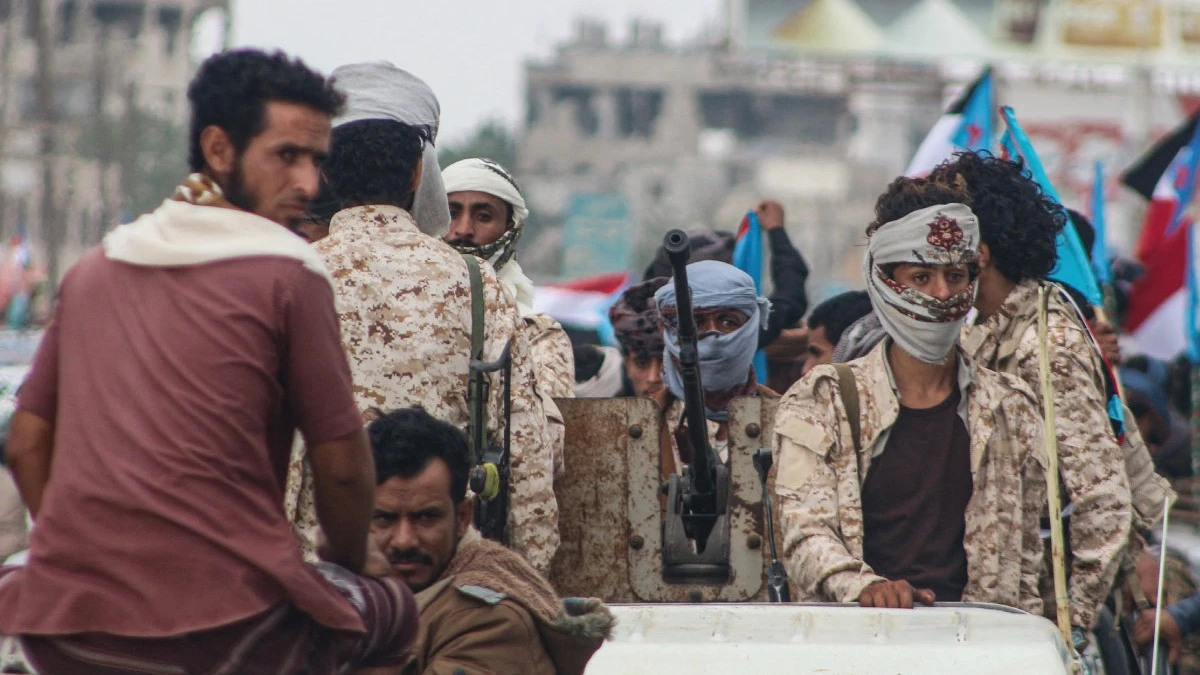
In response to the strike, the UAE ordered an end to its “counterterrorism mission” in the country, but the primary militia it has spent the last 10 years arming and supporting, the Southern Transitional Council (STC) has defied the order. An armed Saudi-backed company, called the Hadhramaut Protection Forces, have fought STC before, and captured positions in the Wadi Nahb area from the group.
Critics have accused both Saudi Arabia and UAE of seeking to divide Yemen to control its natural resources and strategic ports within their respective spheres of influence. The Ansar Allah movement which controls the capital—known shorthand as the Houthis—described the recent infighting as “a crisis between two occupiers”.
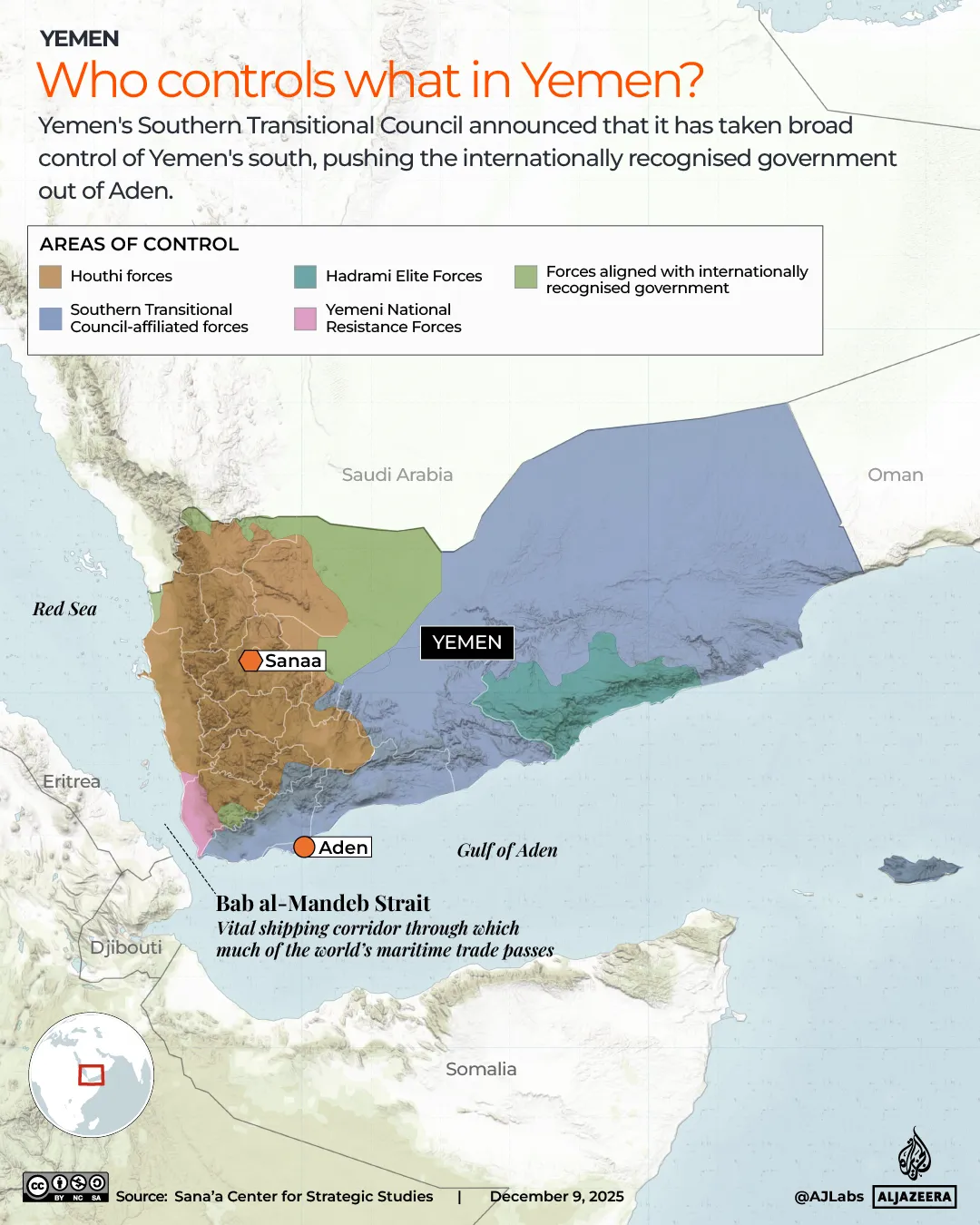
STC have seized large swaths of territory across the south of the country; virtually the entire area the successionist group hopes it will turn someday into another South Yemen, saying that the country will never be unified again. This has included attacks outrightly against forces under the control of the PLC.
Al Jazeera reports that Saudi defense authorities believe the offensive march was encouraged by UAE, and that it considers it a national security threat, since STC-controlled areas rub up against the Saudi borders.
“In this context, the kingdom stresses that any threat to its national security is a red line, and the Kingdom will not hesitate to take all necessary steps and measures to confront and neutralize any such threat,” a national spokesman said in a statement.
It’s the first headline moment in Yemen in several years that doesn’t involve the US or Israel. Following Saudi Arabia’s invasion and blockade of the country in 2015, the south, from the port city of Aden to the west, to the borders with Oman in the east, has seen a concentration of foreign and domestic forces armed and supplied through UAE.
These include not only the STC and the Giants Brigade—a front for AQAP, al-Qaeda in the Arabian Peninsula.
Estimates from The New Arab back in 2019 that these militias—known as the Southern Transitional Council—could number as high as 52,000 based on plans which were ongoing at the time. Houthi forces were estimated at 200,000.
Switching sides
In 2015, Wall Street Journal reported that the Pentagon under then-President Obama had recruited the Houthis to “maintain its fight against a key branch of al-Qaeda, the group which bombed the USS Cole in 2000 and killed 17 seamen and injured 37. Dug into the fractious environment of southern Yemen, that had only 20 years before been an entirely separate country, the Houthis from the north were seen as a key ally in that fight after the Zaydi Shi’ite militia took control of the country during a brief civil war in 2015.
But only a month after the WSJ report, the Obama government announced it was switching sides to back Saudi Arabia in its intervention in the country which turned into the world’s worst humanitarian disaster, killing hundreds of thousands of Yemeni civilians.
Saudi Arabia’s chief regional ally in the effort was the UAE, but by 2019 the New Arab had reported that Abu Dhabi was withdrawing its troops and building an “army” out of militia factions located in the south under the banner of the STC. Included among them are the Salafist Giants Brigade, and, as the BBC reported in 2019, members of AQAP, including Nasser al-Shiba who planned the Cole bombing himself, and who received a commanding role within the STC.
In 2022, the man whom Saudi Arabia intended to install in power in Sana’a, Abd Mansour Hadi, announced he was abdicating his presidential authority to a Presidential Leadership Council that would form a new government inside the nation, as Hadi lived in Riyadh. The Giants Brigade commander Abdulrahman Abu Zara’a Al Muharrami is a member of the Presidential Leadership Council. WaL
We Humbly Ask For Your Support—Follow the link here to see all the ways, monetary and non-monetary.
PICTURED ABOVE: Fighters from the Southern Transitional Council. PC: retrieved from STC via X.