 0
0
 0
0

Senior Kremlin officials have applauded Belgium’s stance regarding the seizure of some €215 billion in frozen Russian assets held in Europe.
Belgian authorities warn that to do so would put them both personally and as a nation in the firing line of the repercussions, something they do not want to do, said spokesman Dmitry Peskov.
“The Belgians are quite wise saying, ‘listen, we will have both the country’s legal responsibility and personal legal responsibility for these steps,'” he said in an interview with Tass.“No one wants to share responsibility with them, but everyone wants this money very much”.
The European Commission’s current plan is the expropriation of Russian sovereign assets to fund a “reparations loan” to Ukraine, payable at the time of the war’s ultimate conclusion, or even before it.
As WaL has at times reported, regardless of the war’s devastating and ultimate consequences for millions of people, the conflict raging in eastern Ukraine has been the closest in modern times to that old chestnut of ‘civilized war’. Life has gone on largely undisturbed for people in large parts of western Ukraine, while unlike in World War II, American interventions in Korea and Vietnam, the war in the Sudan, the Iran-Iraq War, the War on Terror theaters and others, there has no outright bombing of cities or civilian areas beyond the areas of confrontation.
Semi-precise strikes on infrastructure have occurred, and civilians have died as a result, particularly when targeting is wrong or guidance systems fail, but by and large there has been no mass targeting of civilian areas. Foreign property is often taken in wartime as a sort of pre-emptive reparations payment, but this is illegal under international law unless it can be demonstrated that the property’s owner has knowingly conducted business with the aim of facilitating war crimes by his national government during the conflict.
In the US, earlier judicial decisions have ruled against the power of the President to seize assets of American companies and American nationals in times of war, but never against the property of foreign nations. The Biden Administration was strongly in favor of freezing, then seizing Russian assets.
European Central Bank president Christine Lagarde has warned that “moving from freezing the assets, to confiscating them, to disposing of them [could carry the risk of] breaking the international order that you want to protect; that you would want Russia to respect,” according to the Financial Times, which also reported that at a meeting of finance ministers from the G20 in Brazil, both Italy, but particularly France, pushed back on whether any legal justification existed.
Saudi Arabia and Indonesia, whose representatives were present at the meeting, warned the bloc to consider the downstream effects of their actions. It would test major foundational structures of international law, including things like whether or not countries enjoy state immunity, the principle that no country can be sued by the courts of another if it does not agree they have jurisdiction over it. The mood was uniform bar the US, Canada, and UK—and it pertained to fear; fear for money held by states all over the world that might be confiscated under the invocation of any number of disputes and grievances.
“The risk is that if we just start ignoring these principles, they can equally be used against us by other states and that we set a precedent that can have unintended effects down the line,” Philippa Webb of King’s College London, author of a European parliament study on the legality of confiscating Russia’s assets, told FT.
That was in 2024, and as has occurred continuously throughout the war, its duration has flipped the European opinion, seen in the question mostly over whether or not to provide this or that weapon system previously-considered a provocation. Now, the European Commission is eagerly looking at Russian assets as a way of funding Ukraine’s reconstruction and defense.
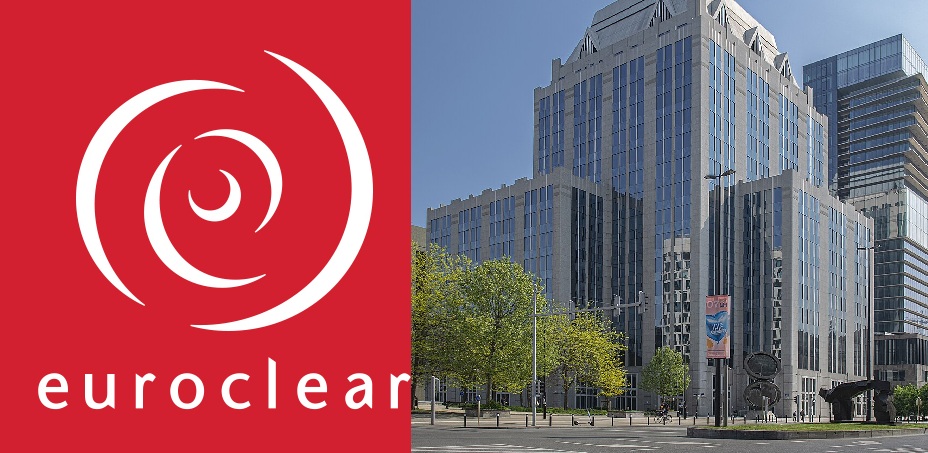
There are about €210 billion worth of immobilized Russian assets in Europe, including €185 billion held by Belgium’s financial infrastructure corporation Euroclear. Euroclear depository head Valerie Urbain said in an interview with Belgian television channel RTBF that funding Ukrainian reconstruction with those assets would not only bankrupt the depository, but result in an unknown outflow of deposits from other entities and nations, and almost guarantee the organization’s insolvency.
Urbain has said that Euroclear stands ready to challenge any seizure of Russian assets in court. Aside from the opinion blob of bullish DC foreign policy think tanks, the case for seizing Russian assets hasn’t become any clearer since France’s Foreign Minister said it had no legal basis in Sao Paolo back in 2024. WaL
We Humbly Ask For Your Support—Follow the link here to see all the ways, monetary and non-monetary.
PICTURED ABOVE: Euroclear logo and its headquarters in Brussels. PC: Gertpete and Marek Śliwecki. CC 4.0. BY-SA