 0
0
 0
0

A fear of overt control by China over supplies of rare earth elements needed for advanced technologies have driven the US government under Donald Trump to deploy a new form of market intervention—ordering executive departments to invest tax dollars in direct equity stakes in companies that mine these minerals, or turn them into magnets, in the US or in allied countries.
But market enthusiasm that government subsidy might bring about a boom in the price of the few companies in the West involved in extracting these niche materials, seems to have dried out fairly rapidly. When explorers, developers, and producers of rare earths are isolated from their publicly-traded mining peers of the sometimes interchangeably used “critical minerals,” their 52-week performance leaves much to be desired.
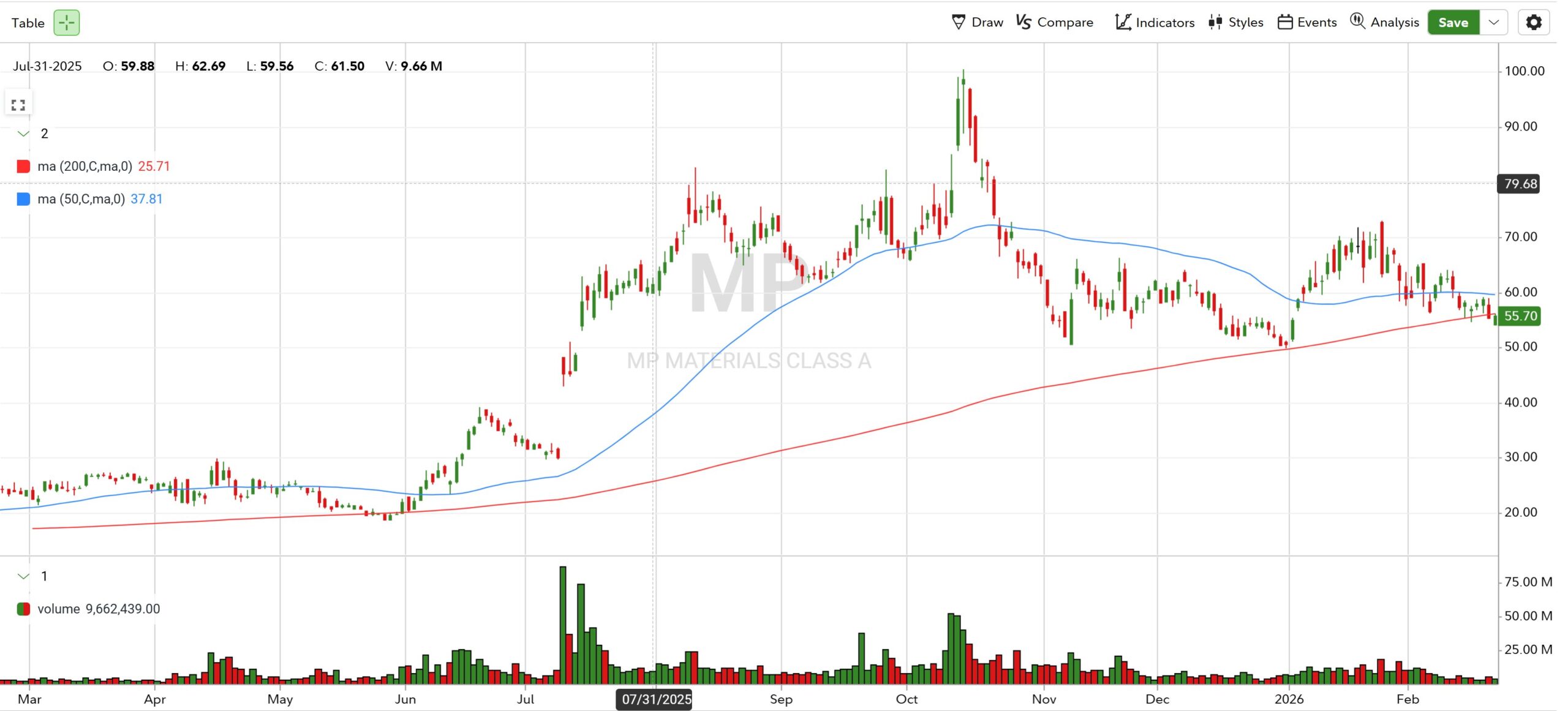
MP Materials, (MP) the operator of a neodymium and praseodymium mine in California, surged on the NYSE to over $100 per share in October, before sliding a slope of hope down to $50 in the same month. Trading sideways since then, it recently fell below both its 50-day and 200-day moving averages.
Other established rare earth-linked equities are on similar trajectories, Apex Critical Minerals, (APXCF) which was just accepted into the US Defense Industrial Base Consortium on February 23rd, has also burned believers on its way down from an October high of $3.50 to its current price below half that. 100% owners of the Rift Rare Earth project, located within the Elk Creek Carbonatite Complex in southeastern Nebraska, Apex is currently undergoing exploratory drilling into a niobium-rare earth deposit. Though not technically one of the 17 rare earth elements, niobium is an important addition to high-strength low-alloy steels, and is used in the assembly of superconducting magnets.
USA Rare Earths, another firm the Trump Administration took a direct equity stake in, followed a near-identical trajectory as MP and Apex.
Other rare earth-related equities Idaho Strategic Resources (IDR) which owns claims on an Idaho deposit of rare-earth oxides including praseodymium, samarium, neodymium, terbium, and dysprosium, and Energy Fuels (UUUU) which sells vanadium pentoxide, and some rare earth elements, are trading closer to their recent highs than their lows. These firms, however, also mine gold and uranium respectively, two commodities with widely-bullish outlooks this year.
Interest in rare earths have grown considerably over the last 6 years or so, after the foreign policy establishment in Washington, DC, began to realize that China not only accounts for virtually all of the production in rare earths, but all the refining and even the global benchmark prices for them as well. The alarm bells routinely ring over this, and mining policy has been advanced by the Trump Administration arm-in-arm with foreign policy, as seen in early draft agreements to end the war in Ukraine, a now-broken ceasefire in east DR Congo, in the deafening saber rattling over Greenland, and quite possibly in the capture of Venezuelan President Nicolas Maduro.
Why, then, have these stocks not held onto the highs seen last October, when they all surged on news that the Administration was taking an equity stake in MP Materials? Why couldn’t they hold onto the spike in price following President Trump’s announcement of Project Vault—a deliberate $12 billion in funding for stockpiling critical minerals and rare-earth elements?
Diana Rasner, a senior lead at the Material & Chemicals division of the Cleantech Group, told WaL that these companies, and MP more than the rest, represent a single link in a supply chain that is currently not linked up.
“If I were an investor looking into these different players, I eventually want to see return, and it’s all those little steps in between that if I just did a little due diligence, I would just see isn’t there. The refining and production side is absolutely missing”.
Playing catch up
While all governments are inefficient allocators of capital, Rasner points out the Chinese have certainly proved that persistence has a quality of its own.
“If you look at the industrial base of how they’ve managed to move and capitalize on the opportunities in the mining sector, it’s very much because they’re state-driven,” she suggests. “The government supports the infrastructure, the training, the jobs, all of that. You’re competing against folks who’ve been in that industry for 40 years who know how these markets work; they’re already vertically integrated in it”.
By contrast, says Darren Bahrey, Founder, President & CEO of junior critical minerals exploration company StrategX Elements Corp., mining and refining of things like nickel, vanadium, cobalt, and the 17 rare earth elements North America lacks not only experience, but integration of any kind at all.
“I would have to say that there hasn’t been a market,” he told WaL. “In terms of giving you a map of refineries right now, I mean, there’s a couple, right? That’s about it”.
StrategX owns the exploration rights for a presumed large, polymetallic deposit containing a basket of critical minerals in Canada’s Nunavut. Containing nickel, cobalt, copper, and also vanadium, an ingredient needed to manufacture steel alloys, Bahrey and his team are at the very beginning of their explorations into the ore body, and can’t know even how much of the contained minerals will be recoverable in their current forms.
Bahrey’s hope is to go examine a similar deposit located in Finland to better understand resource recovery rates, but StrategX isn’t there yet.
Rare earth elements are used to create permanent magnets that are needed to make motors in electric vehicles, wind turbines, and steam turbines, and Rasner says that advocacy and awareness raising, particularly on the part of the government, involves rare earth elements’ role in military manufacturing, but that this is actually a much smaller component of the overall demand, which is really powered by next-generation energy and mobility technologies.
Though using an argument that these minerals are needed for national defense is likely to make a policy of supporting the industry gather more bipartisan support in Washington, Rasner says there isn’t a lot of material overlap in the finished products made with rare earth elements, and that for this reason she doesn’t see a risk that the Pentagon will become the inevitable destination of everything MP Materials or any other business pulls out of the ground.
Actually creating value
While many former penny stocks for junior mining companies of gold and silver are sitting at their 52-week highs, these related to rare earth elements routinely find it hard to attract investment. Bahrey offers his two cents…
“I believe in the market, and I believe there should be positive market movement, but on the back of material news, right? On the back of actually doing something that is really creating a lot of value,” he said, adding that there are so many unanswered questions about producing and refining these materials.
“Pueblo Viejo is one of the few world-class polymetallic deposits in the world, and I played a role in that at the very beginning,” said Bahrey, adding that a given project’s future earnings potential can look different even for those involved in advancing it. “I remember metallurgists saying, “you can’t do it,” and then another says, “no, we can do it”.
Generally speaking, polymetallic deposits, such as gold-copper, or silver-zinc-lead, will have lower recovery rates and more complicated refining procedures than pure gold or pure copper deposits; all the more difficult when a rare earths deposit might have four, five, even seven different elements present. That not only complicates the project itself, but is part of the reason why there are so many links missing in a North and South American supply chain.
“Great, you have a source. You still need to get that source out of the ground; you still need to process it; you still need to manufacture it into the very products that you’re trying to compete with,” said Rasner. “MP is transporting all that material from California to Texas, and that’s not a trivial thing, it actually takes a lot of collaboration with the industry leaders who actually need to use those magnets that you’re producing, and that takes a lot of time, and R&D, to get to that point”. WaL
Consider Following the link here to see all the ways, monetary and non-monetary, you can support this work and more like it.
PICTURED ABOVE: MP Materials’ released this graphic alongside news that the Pentagon would be investing over $1 billion into the company. PC: MP Materials newsroom.