 0
0
 0
0

This is part 2 of a 2-part series on the so-called Sell America trade. You can read part 1 here.
After a particularly nasty selloff in the dollar in late January, the greenback is recovering some of its juice amid a Fed decision to keep interest rates at 3.5% and the announcement by Donald Trump of his official nomination to the upcoming vacancy at the Federal Reserve, Kevin Warsh.
The dollar index has regained about half of what it lost since the turn of the year, while its value against the Swiss franc has also picked itself up off a 52-week low of $0.77.
This may be inferred to be a result of Warsh’s stance as an inflation hawk—someone willing to keep money and credit tight when price inflation is high—which some economists and virtually all major news outlets have noted in their coverage about his nomination. If it is, it’s a surprising reaction, since President Donald Trump has been haranguing the current Fed Chair Jerome Powell for exactly that position, calling him “Too Late Powell”.
Powell went as far as to allege that Donald Trump had launched a kind of lawfare campaign against him by opening an investigation into wasteful spending in the construction of the Fed’s new building in Washington, all to get back at him for keeping interest rates higher than usual for longer than expected.
Both Trump’s single FOMC board appointee Stephen Miran and his Commerce Secretary Howard Lutnik have said that there’s a case for a 1.5% interest rate this year (which under most recent inflation data would be negative by 1.5%) and so it leaves one to wonder why Trump would pick a strong-willed inflation fighter when he’s been doing nothing but calling for easy money since he was elected.
This struggle is at the heart of the “Sell America” trade, a phenomenon that’s manifesting in different ways around the world. In part 1 of this series, WaL detailed that these ways included the success in emerging equity markets compared to Wall Street. With around 15% growth in 2025, the S&P 500 had perhaps a better year than might have been expected when the “Liberation Day” tariffs were announced by Trump in April. But it returned just half of what the MSCI Emerging Market Fund (EEM) and a third of the Euro-Pacific International Value Fund (EPVIX) managed. This marked the first year since 2020 that emerging market equities outperformed developed markets, with winners like the South Korean flagship index, Kospi, rising 76%.
Another manifestation has been the eye-watering performance (tear-jerking depending on your portfolio composition) of precious metals like gold and silver, and related equities, as well as copper, as they leveraged their reputation as safe havens, record buying by world central banks, and a convergent increase in demand from their industrial use, to grow over 100% last year.
Yet more evidence of the “Sell America” trade in full swing is the fall in US Treasuries as a share of global reserve assets to both 40%, and below gold, for the first time in decades, and a sharp fall in value against the Swiss franc, a perceived safe-haven fiat currency.
The heart of the matter is what American central bankers will do to provide value with government Treasury sales while also managing inflation. Investors know that if rates fall much further, Treasury bills will yield negative rates, and the US knows that if it can’t entice people into buying those T bills, it can’t continue to fund its current government debt burden. Furthermore, both the Fed and equity investors will know that if rates don’t go lower, GDP growth and market valuations will lag, as seen last year when the AI component of the US economy was the sole reason GDP rose at all. Yet if rates do fall, some investors argue it will accelerate the process of de-dollarization and divestment from the US.
The matter with Warsh
Some other economists have seen in Trump’s nomination of Warsh the simple appointment of a political animal.
Robin Brooks, senior fellow at Brookings, said in an X post that Warsh “is a really good pick for Fed Chair and known as a hawk,” yet pointed out that “markets are asking themselves what was promised to get the nod, which is why the Dollar… isn’t managing to rally on what should be good news”.
Indeed, the dollar has remained sluggish since the announcement, and Brooks suggested more weakness could soon come. On Wall Street, the news was also quite muted, and managed to push neither the DOW nor the S&P beyond the major milestones of 50,000 and 7,000 respectively which they’ve both been so tantalizingly close to reaching for weeks. For nigh on the month, the latter has been within 50 points of 7,000, reaching it during the highs of the day last Friday, but falling below it before the close. Like the S&P, on Jan 7th the DOW came to within 500 points of 50,000, but has failed to overtake that valuation in the nearly 30 days since.
Nobel Prize winner Paul Krugman noted Warsh’s record of being an inflation hawk seems to coincide nicely with political alignments. “Warsh is a political animal. He calls for tight money and opposes any attempt to boost the economy when Democrats hold the White House”.
In contrast to other reporting on Warsh, The Hill noted that he called for much lower interest rates in October, and criticized the Fed for “working at cross-purposes with the President’s policies”.
“We can lower interest rates a lot, and in so doing get 30-year-fixed-rate mortgages so that they’re affordable, so that we can get the housing market going again,” Warsh said in an interview with Fox Business. He called for lower rates again in November.
Yet again, the shadow of $10 trillion in refinancing costs amid a falling interest in the dollar and Treasuries more broadly should worry the Fed and Americans. As written in part 1, two of America’s largest creditors, China and Japan, will have several reasons to sell and decline to buy Treasuries this year. At the same time, in response to the threat over Greenland, Denmark’s national pension fund announced it would be offloading $100 million in long-term Treasury bills, a move which US Treasury Secretary Scott Bessent called “irrelevant… just like Denmark”.
The fund said the decision was over “poor US government finances, which make us think that we need to make an effort to find an alternative way of conducting our liquidity and risk management,” chief investment officer Anders Schelde told AFP.
Indeed $100 million is small potatoes compared to a $10 trillion refinancing quest, but as Jim Nelson, Chief Financial Officer at Euro-Pacific Asset Management recently outlined, it shows there is a limit to geopolitical risk even for the T-bill, which has at times backstopped 80% of global banking and investment.
Re-election pressures
It doesn’t take a political strategist to see that Trump is likely to face political headwinds in the November midterm elections. Controlling both houses of Congress by slim margins, a Red retreat in the face of the President’s plummeting popularity could see that control relinquished and either complete legislative gridlock, or impeachment proceedings.
“In our view, we’ve switched from the old regime to the new regime,” Nelson explained during a recent investor webinar. “There’s a generational change that’s driving a major structural rebalance in the markets. Regimes that dominated and drove markets for decades are reversing, for example politically we’re moving from centrism to populism. Economically, the focus is shifting from capital to labor”.
“Financially, policy is favoring spenders over consumers. Inflation-resistant, real assets and non-US equities are those that do well in an environment of high inflation and volatile growth. The old mainstream strategies that thrived when inflation was low and liquidity was ample could lag in this new regime”.
That’s not the only volatility that investors and managers see in this “new regime” as Nelson described it. Monaco-based hedge fund manager Eric Knight said his fund, Knight Vinke Asset Management, cannot invest in the United States under President Donald Trump because the risks have become too great, citing the Administration’s repeated attempts to shut down offshore wind energy projects on America’s Atlantic seaboard managed by Norway’s Equinor and Denmark’s Orested, citing national security concerns. The ban has been blocked by judges on 5 separate occasions, ruling that the companies (Orested has spent $7 billion building the wind farm) are at far greater financial risks with the projects stalled than the Administration is while preparing its appeal to the decision.
Nevertheless, Knight told Reuters in an interview that the risk has become too great, and as a result he’s sold all his US holdings in his firm’s flagship energy fund.
“It’s become uninvestable because the rule of law is not applied uniformly,” said Knight, “the headwinds are too strong”.
Political pressures are also a chief concern for Nelson. “Trump faces an existential political risk. If he loses control of the house, we know what will happen: gridlock and impeachment proceedings. It happened before in the 2018 midterms, and in 2026 it could happen even faster. So Trump is highly motivated to keep the economy and markets roaring into this election”.
By Nelson’s considerations, that means Trump will need 3 things: growth up, interest rates down, and inflation down. Having passed the One Big Beautiful Bill Act late last year, the economy could enjoy a tailwind to prop-up growth to the start of the year, and with Warsh’s rate cuts an even more likely development, the President should probably achieve two of his three aims. Trump has already spoken about a tariff dividend check—vote buying in its most essential description—which would boost spending and therefore increase growth in the short and medium term. But the problem he will have is that all of this stimulation and money printing is likely to increase inflation, which for months has seemed sticky, anchored at 3% by government metrics.
“Trump fired the head of the BLS when he didn’t get the inflation print he wanted last year, so we don’t even know if that gauge is accurate anymore”.
The parallels, Nelson said, between Trump’s current and proposed growth pumping mirrors that of Richard Nixon under re-election pressures in 1972, when he rose Social Security payments, froze wages, and passed the Revenue Act to boost the economy and kill inflation ahead of his campaign. The S&P 500 rose 20% that year, only to fall some 30% in the year that followed, while gold and gold mining stocks climbed some 400%. Many will feel that at 40x, 70x, or 140x earnings, today’s headline US equities are overvalued, and a 30% correction in some names is probably overdue. At the same time, last year’s enormous increase in the price of gold has largely endured, recovering half its value already since last Friday’s incredible decline of almost $1,000 per ounce.
The likelihood that Trump, with Warsh at the Fed, will make a Nixon-like trade-off to maximize his party’s election chances seems high, and the risk that entails will for many investors, both private and public, will be—and indeed already have been—too great. WaL
Multi-part series require substantial hours of research and work—Considering Following the link here to see all the ways, monetary and non-monetary, you can support this work and more like it.
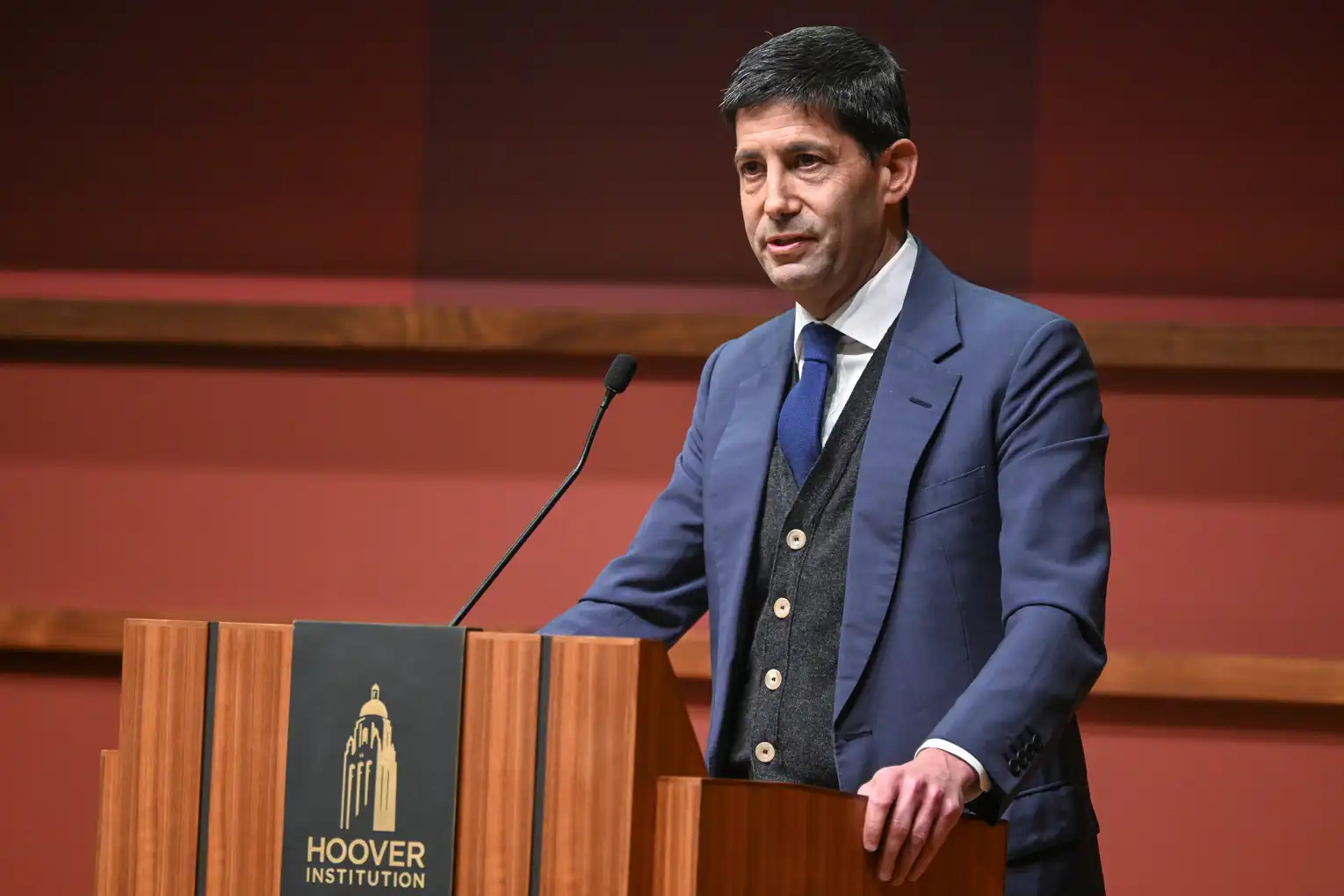
PICTURED ABOVE: Kevin Warsh at a Hoover Institution event, where he is a Distinguished Visiting Fellow. PC: Hoover Institution, via a release.