 0
0
 0
0

Story at a glance…
-
Saudi-backed groups have retaken control of south and east Yemen from a separatist group backed by the UAE.
-
Along with straining political relations in the country, it’s also rattled relations between the Gulf states.
-
The southerners want independence, while both the Houthis and Saudis want a whole country under their control.
When Saudi Arabian air forces bombed areas of southern and eastern Yemen while backing a large ground push by their local militias to recapture the south of the country from separatists backed by the UAE, it did nothing to address the demands of tens of thousands of Yemenis across the south still dreaming of an independent state.
Yemen, located on the southwestern hills of the Arabian Peninsula, was once divided between a state in the north, the heartland of an ancient kingdom, and the south, a Marxist revolutionary state born in 1967 and which collapsed at the end of a brief civil war when the Soviet Union, its prime benefactor, dissolved.
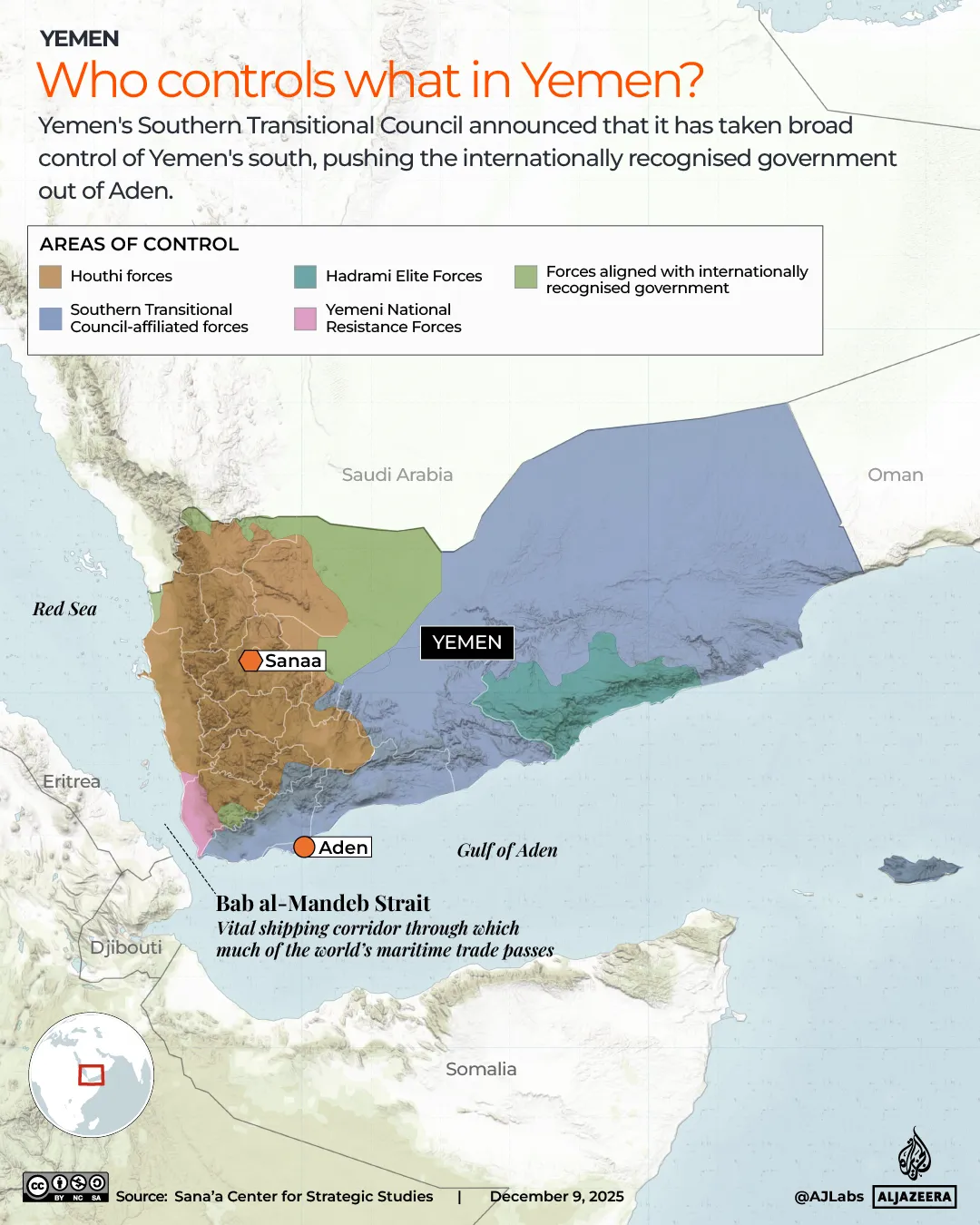
That preference for independence remains, and it was reflected in the popularity of the UAE-backed Southern Transitional Council (STC) group which held large portions of the south and east in an uneasy ceasefire with the Houthis to the north.
“With the leadership of President Zubaidi, toward a new southern federal state,” reads a commonly-seen slogan on posters and billboards around the southern port city of Aden, historic capital of South Yemen, where the flag of the old Marxist nation—red, white, black—and blue, once hung from every flagpole.
The STC had held Aden since its founding in 2017, but recently its forces, armed by the UAE, began taking regions bordering Saudi Arabia, triggering a massive retaliation on January 2nd that has rattled relations between the two Gulf states.
Rashad al-Alimi, chief of the Saudi Arabia-backed Presidential Leadership Council (PLC) of Yemen, said last Saturday that it had asserted full control of the Hadhramaut and al-Mahra provinces through its own paramilitaries, the Giant’s Brigade and the Homeland Shield Forces (HSF), giving it jurisdiction over practically every inch of ground not held by the Houthis.
At the same time, Middle East Eye reported, STC fighters in Aden seem to have defected when the Saudi militias took the city on the 7th of January, and were largely left alone. As far as the local residents interviewed in the report, they were more or less happy with the change because it represented another potential end to conflict for a time.
Heavy handed
Shortly after the capture of Aden, leader of the STC and the man whose face is routinely seen on those billboards and posters mentioned above, Aidarous al-Zubaidi, fled to his home and the home of many of the STC members, al-Dhale governate, which was subsequently bombed by the Saudis. Report suggest he was spirited away to a UAE military installation via aircraft.
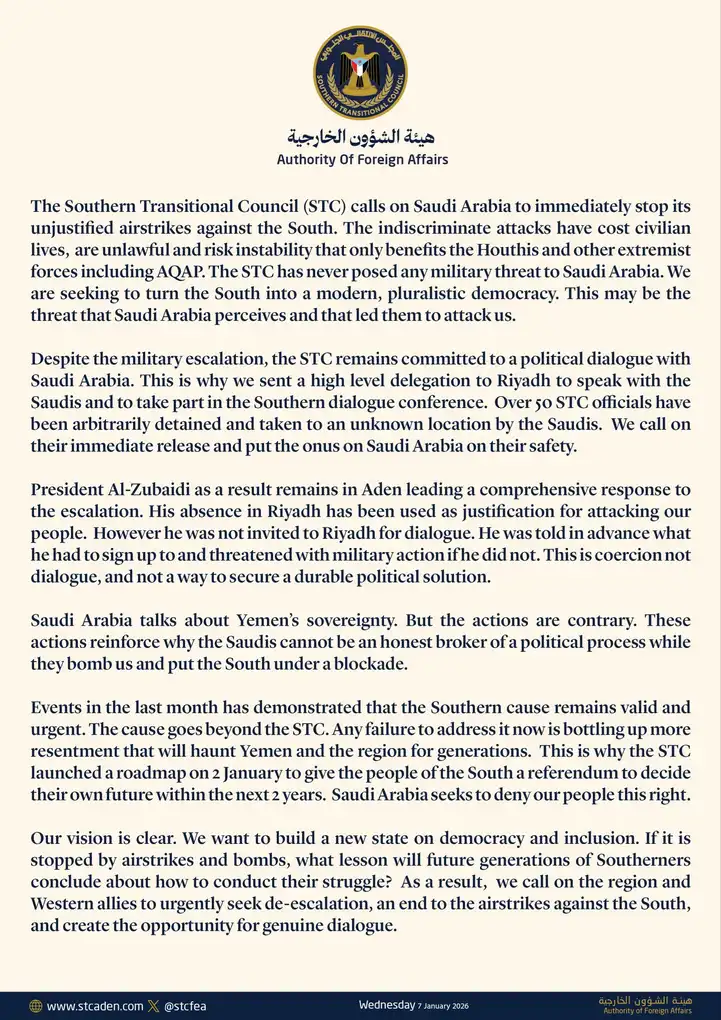
A statement from the STC demanded Saudi Arabia cease its bombing campaign.
“The STC has never posed any military threat to Saudi Arabia. We are seeking to turn the South into a modern, pluralistic democracy,” the statement read before suggesting that it was this very act of secession that perhaps caused the Kingdom to attack them.
“Despite the military escalation, the STC remains committed to dialogue with Saudi Arabia,” the statement read.
Saudi Arabia’s foreign ministry had said earlier that the kingdom was ready to hold a diplomatic conference in Riyadh to discuss the future of southern Yemen, bringing together different factions, including the STC. Some 50 members arrived as part of a delegation from the group, but the statement claims that they were “arbitrarily detained”.
New York Times reported that after landing in the country, communications between 3 of the delegation and one of their reporters were interrupted, and that the ministry had not responded to comment. The Eye reports that they were loaded onto a bus and taken into captivity, their phones confiscated.
Then on Saturday, the delegation, speaking from Riyadh, announced the STC’s formal disbandment in an effort to ensure peace in the south of the country, which an STC spokesman told AFP it was “ridiculous”.
In a post on X, the spokesman said decisions related to the STC could only be made by the council in its entirety and under its president, who had not gone to Riyadh.
The streets in Aden today speak for themselves. Power may reside in Riyadh’s decrees, but physical authority and popular mandate clearly remain on the Southern street. Any durable settlement for Yemen must reconcile these two divergent realities. pic.twitter.com/H5Ge4kuNDU
— Fatima Alasrar (@YemeniFatima) January 10, 2026
“This will be done immediately upon the release of the Southern Transitional Council delegation currently in Riyadh,” he wrote. “The Council will continue its positive and constructive engagement with all political initiatives in a manner that enables the people of the South to determine their future”.
It’s reminiscent, wrote The Times, of a Saudi action in the 20th century when it kidnapped the Lebanese head-of-state and tried to force him to resign on Saudi TV.
Thousands are reported to have answered a call from the STC and taken to the streets of Aden to demand independence in what seems to be peaceful protest, despite threats from PLC security forces that disrupting public order would result in ” swift strikes”.
“Today, the people of the south gathered from all provinces in the capital, Aden, to reiterate what they have been saying consistently for years and throughout the last month: We want an independent state,” protester Yacoub al-Safyani told the AFP.
Houthis and al-Qaeda AP
WaL has previously reported that the Houthis, which ousted a one-man one-party one-choice would-be dictatorship installed by Saudi Arabia in 2015, considered the fighting between UAE/STC and Saudi/PLC as “a crisis between occupiers,” but in a statement issued by the group on Sunday, the faction in control of the capital Sana’a said that “any Saudi or foreign interference in the Yemeni affairs is a flagrant violation of national sovereignty,” while adding “that any political settlement must be subject to a comprehensive popular referendum for all the people of the country”.
“The statement emphasized that a peaceful solution depends on uniting national ranks and fostering internal dialogue, free from foreign guardianship, manipulation, and mercenary agendas, while urging all national forces to confront external schemes targeting Yemen’s sovereignty,” the group’s information ministry wrote.
The group clashed with STC and other foreign-backed groups, such as the al-Qaeda-formed Giant’s Brigade, during the Saudi-US led intervention “to restore democracy in Yemen,” which killed hundreds of thousands of civilians through rampant bombing, disease outbreaks, and an effort to bring about starvation. The last official death toll was 377,000 people, military and civilian, but it was made before the worst of the famine and another cholera epidemic struck the country.
Multiple efforts to try and end US involvement in the Congress were defeated by party loyalty and presidential veto, and the world’s worst humanitarian crisis came to an end largely by the intervention of the UN.
The negotiated ceasefire and end to the blockade is still maintained, while the Giant’s Brigade commander, former al-Qaeda fighter Abdulrahman al-Mahrami, now controls security in Aden. WaL
We Humbly Ask For Your Support—Follow the link here to see all the ways, monetary and non-monetary.
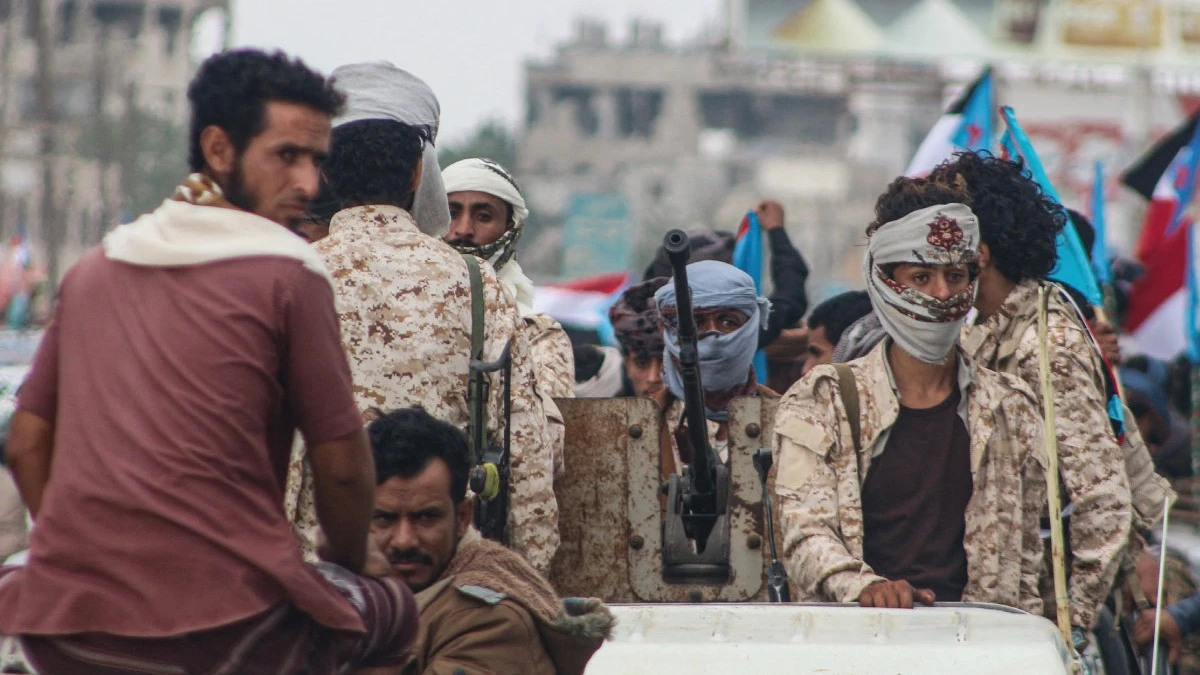
PICTURED ABOVE: Fighters from the Southern Transitional Council. PC: retrieved from STC via X.