 0
0
 0
0

This is Part 1 of a 3-part story on the advent of critical minerals on markets and national security policy.
Over the last 10 years, the terms “rare earth minerals” and “critical minerals” have had one of those famous 21st century zeitgeist transcendencies in which they punched out of their niche and spilled out onto front page news and government press releases.
They describe a third class of material elements that are neither precious metals, like gold and silver, nor base metals, such as copper and iron. They consist of things like gallium, barite, cobalt, nickel, and rubidium, and are used to build smartphones, EV batteries, missile guidance systems, and industrial magnets needed to power nuclear fusion.
These minerals and products were of course always valuable and ‘critical’ to modern nations’ economies and supply chains, but the continual deterioration of relations between the world power blocs, particularly since the first Trump Administration, has catapulted these commodities into a limelight they always should have inhabited.
Export controls of the higher order goods these minerals create were largely expanded and seriously tightened under the Biden Administration, who had taken Donald Trump’s lead in eyeing China as a key threat.
“Critical” doesn’t tell the whole story of these minerals; the word ‘neglected’ might summarize that better. Mining is a high-risk activity that often takes 5-10 years to see the first product, all while demanding substantial initial capital investment. With niche industrial demand, and ever-increasing influence from the environmentalist movement, prospective mines for these various minerals simply couldn’t get off the ground. Even copper, considered a base metal and generally thought to rise and fall in line with production growth in manufacturing countries, was serially neglected.
“The interesting thing with rare earths is that it was a great marketing ploy to call them that, but they’re not rare, they’re everywhere!” Chief Capital Officer and financial analyst Rowan Parchi, told WaL. “Sure, it’s a little bit harder to find the heavier elements, but I could name multiple mines in America that have rare earths, even small, prospective operations. I could name multiple in Australia and I’m sure there are heaps in Africa and South America I just don’t know if they’re looking for them”.
“Everyone’s saying ‘Oh—Greenland’s got tons of rare earths, oh Ukraine’s got rare earths!’ Everywhere seems to have this stuff, but that’s not the problem, the problem is the focus [on them] wasn’t there, and no one was willing to refine this stuff”.
While hundreds of investors, speculators, and indeed national security analysts, will have long known of the importance of critical minerals, their appearance in the public eye may have begun in earnest with lithium, and that began in earnest with the Toyota Prius and Tesla. A report from 2012 from the US Geological Survey, the same agency that recently declared a bevy of minerals as “critical to national security” spoke modestly about lithium without ever using the term “critical”.
It points out that if the demand for EVs and plug-in hybrids expands, the US might need 22,000 tonnes of lithium per year by 2030. The most recent data—again from the USGS—coming from 2023 shows that the US imported 3,400 tonnes which accounted for 25% of the national consumption. That suggests that less than half of the supply which USGS predicted would be needed has come online since 2012, despite the US containing an estimated 231 million tonnes of the stuff.
“Most people think we had a lithium shortage, and that’s why the price went up: that’s wrong,” said renowned commodity investor Rick Rule in a recent interview with Mining Network. “We had a shortage of lithium processing capacity. In that so-called shortage, both Alba Minerals and SQM had 80 to 85 years of reserves. There wasn’t a shortage of elemental lithium. When the price went up, people piled into lithium and they found a lot: probably 150 deposits, but probably four are viable”.
Processing capacity is as much a part of the story of why these minerals, that are more available than they’re perceived, have become “critical minerals”.
Seeing red
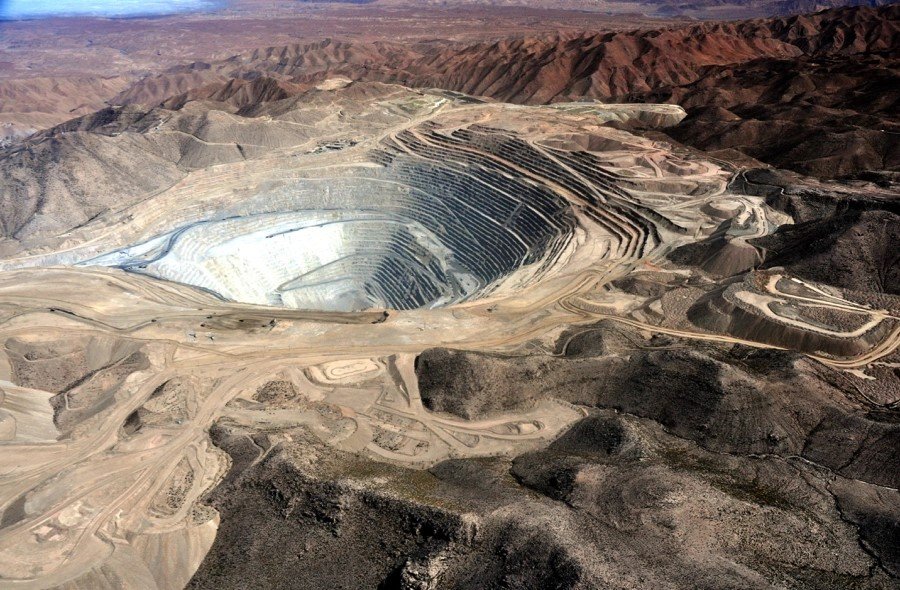
Copper, as mentioned above, has been at the heart of the base metals trade for decades, but has been labeled critical by the Trump Administration, launching it on an upward trajectory to an all-time record-high price of $6.00 per pound recently.
“The US today is heavily reliant on the import of many of these critical metals, the refinement of many of these critical metals, and many of these are controlled outside of the US, specifically, by China,” says Rahul Sen Sharma, President and Co-CEO of Indxx, which recently debuted a critical minerals index fund of over 30 names from global mining giants to explorations stage companies.
“If you look at copper, the US imports 45% of its copper, and that’s expected to increase. Even though China controls just 8% of global copper mining, it controls more than 50% of the refining, and has 4 of the 5 largest smelters in the world”.
China’s mere existence is a big component of the critical minerals hype, and research indicates that while the US and the West more broadly were lagging behind in the investments needed to explore, extract, and refine critical minerals, China was leaping ahead. Again, does that mean the metals are rare, or are they just rare in the West?
The largest known undeveloped copper deposit in the world, Pebble Mine, is in fact in the West—Alaska specifically. It was blocked from production for its discharge plan, which would have seen mine waste and water dumped into a sockeye salmon fishery. Whether one agrees or disagrees with that, a December 2017 minerals assessment calculated the measured and inferred copper resources at 60 billion pounds, with the small addendum of 70 million ounces of gold. Well over $500 million was sunk into exploration and development capital before legal challenges shut the project down.
Beyond that, none of the 5 most productive copper mines in the world have opened in the 21st century. Two of the five have been open for 100 years or more. A third is 52 years old, another is over 30 years old, and the last is 27 years old. It’s one metric that shows how investment in exploration and development of minerals of all kinds slowed down as society neared the 21st century. The most productive US-based copper mine is one of those that has been in operation for over a century.
“You can almost look at it from a larger perspective as the ‘not in my backyard’ phenomenon,” says Sharma. “People understand there’s a problem, but they don’t necessarily want the solution to be down the street from them”.
Sharma and his indexing team expects the price of copper to rise in the coming years because of the increase in demand for it mixed with this aging supply. Much of the copper in the world is mined in South America, and US regimes may consider those nations ‘key’ allies in the future, even though much of the refining of their copper is done in China. WaL
We Humbly Ask For Your Support—Follow the link here to see all the ways, monetary and non-monetary.
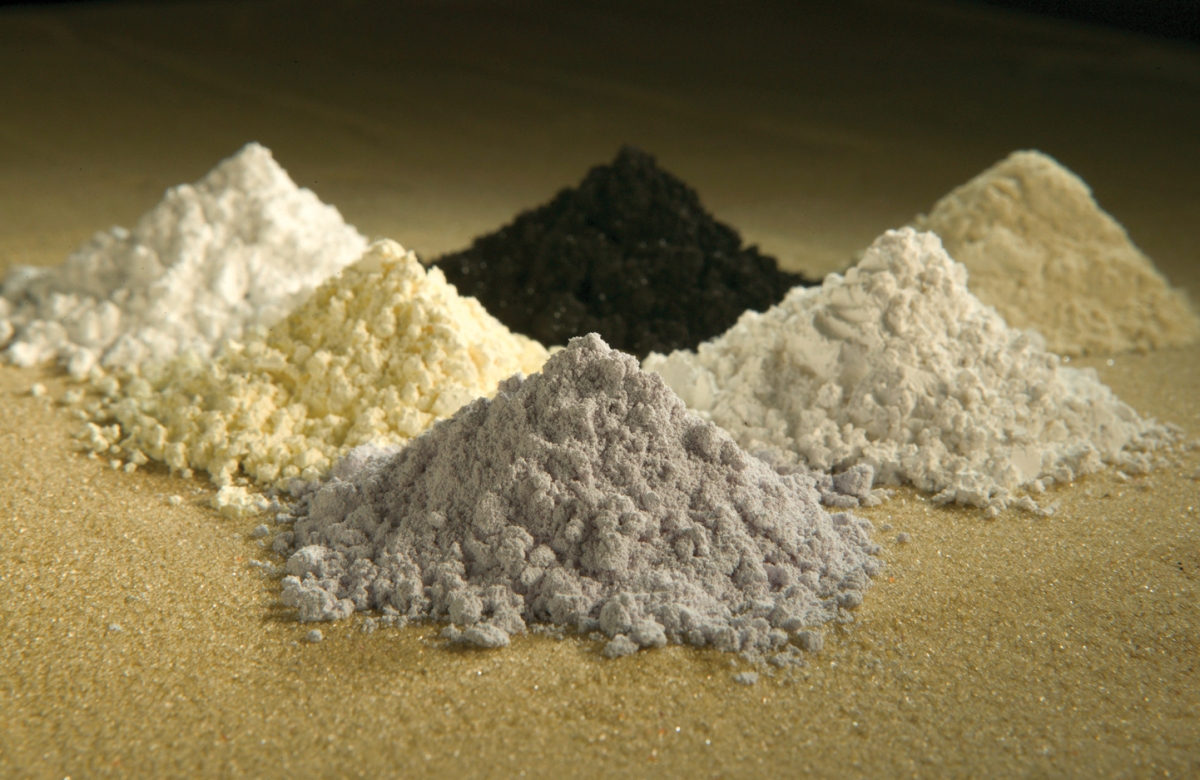
PICTURED ABOVE: A selection of rare earth oxides, all designated as critical. PC: Peggy Greb USDA