 0
0
 0
0

End of the Empire is a once-monthly feature on all news relating to the transition from the unipolar world of the US Empire to a multipolar world.
With a $900 billion military budget sent to the President’s desk to help tot up roughly $1.7 trillion in total war-related spending for 2026, Donald Trump is set to close out his first calendar year of this stint in office by making the Military Industrial Complex’s Christmas dreams come true—and how: with a pair of absurd future weapons programs that will provide no additional security to the average citizen at a cost almost certainly to rival the biggest military boondoggles in history.
Space defense policy experts spent the summer ogling over the concept of a “Golden Dome” missile defense system that they laughably believe will cover the entire continental United States and render it nuke-proof.
Then, on Monday, the President announced his delusional plan to return the battleship to the US Navy’s arsenal 80 years after it was decisively rendered entirely useless in the Pacific Theater of WWII. With his “Trump Class” battleship, the President has again demonstrated his now-infamous inability to learn from mistakes: his own, President Reagan’s or Imperial Japan’s.
There’s no point in attempting to predict the scale of tax revenue robbery that will ensue in the coming years as these two unworkable systems attempt to be manufactured. Each one is, however, inconveniently burdened by the presence of a similar system development in years past, the remarkable failures of which should be enough to sanction the Golden Dome and USS Trump to the dustbin of history yet unmade.
The Golden Dome’s predecessor not only failed, without ever coming anywhere near deployment, but had created such an addiction to the financing for it, that its proponents removed the possibility of a world without nuclear weapons, as was discussed between President Reagan and Premier Gorbachev.
That predecessor was the Strategic Defense Initiative, aptly named “Star Wars” for both its function and level to which it ever became reality. The idea was that lasers and some kinetic weapons mounted on satellites could detect and shoot down ballistic missiles before they reach their reentry point. Reagan called for a system that would end the strategic parallel of Mutually Assured Destruction (MAD) and render nuclear weapons obsolete. Running for about 9 years, Star Wars was never deployed, and estimates have placed the cost of it at anywhere between $100 billion and an eyepopping $400 billion, a number that can be easily adjusted for inflation by multiplying it by three.
The proponents of Golden Dome say exactly the same thing and use exactly the same logic as those who advocated for the SDI—that it would render the threat of MAD null and void, and allow for complete neutralization of nuclear first strikes or “dead hand” second strikes. This deeply disturbed the Soviets, who were willing to erase their entire nuclear stockpile if they could only guarantee the US would join them at that parity without the SDI. Reagan, meeting his opposite number at Reykjavik, famously asked “Can we do that?” The answer, it’s generally believed, is that the SDI prevented Reagan from removing the threat of MAD by removing nuclear weapons, simply because there were too many benefactors from the make-believe space project that violated America’s treaty obligations anyway.
Nuclear weapons theory holds that deterrence, more quickly than with other weapon systems, can became an offensive tool. The ability to protect oneself from nuclear devastation is perceived by nuclear powers as creative an increase in the risk that the protected power will act belligerently with their nuclear arms—a fact which saw the Russian innovation of its nuclear arsenal beginning in 2008, and culminating a decade later with nuclear-powered cruise missiles with unlimited range and nuclear-powered torpedoes.
Already several companies have received contracts from the Pentagon for space-based interceptors, a violation under the Outer Space Treaty, but since when has the US followed international law when it didn’t suit her? Space journalist Sandra Erwin reported early this month that Gen. Michael Guetlein, the Pentagon official running the Golden Dome program, rejected criticism “that the initiative is unfolding behind a curtain of secrecy while companies are being asked to invest in advanced technologies with limited insight into program goals”.
In a May press conference, Trump announced the project would cost $175 billion, but secrecy has shrouded it since the initial fanfare, with the outlet Breaking Defense musing that the first thing we know about Golden Dome is “that you don’t talk about Golden Dome”. That seems well enough for an American population uninterested in attempting to limit the military spending of the last 5 presidential administrations’ and all the Congresses in between, as well as for the Pentagon itself, which fresh off of failing another audit, will prefer not to be bothered by those few pesky Representatives who want to know whether the money is being spent wisely, or whether the system is holding to a vague 3-year timeline.
Battleship Boondoggle
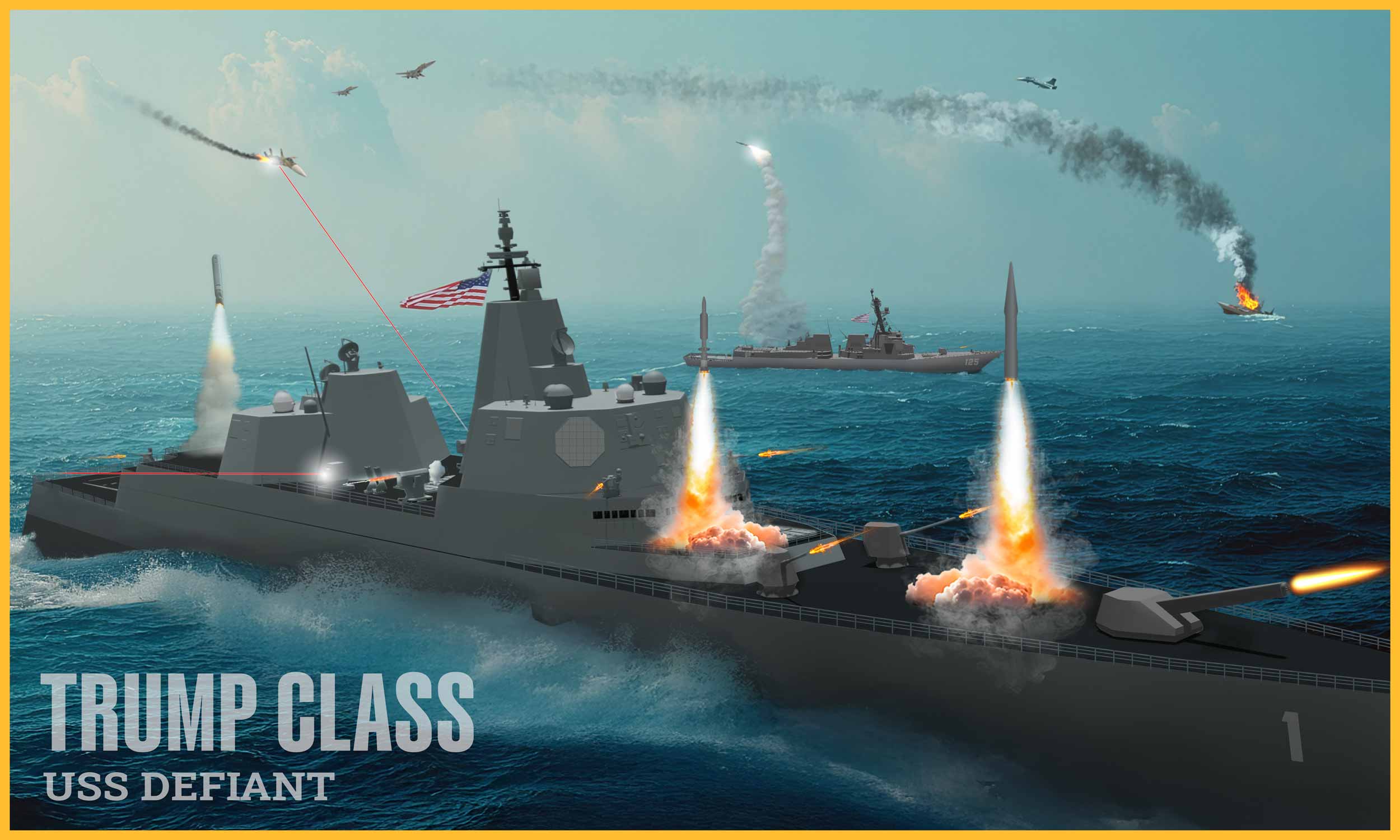
By pulling ideas out of the Pentagon’s scrapyard, challenging an 80-year-old established naval doctrine, and with seeming ignorance to the US shipbuilding industry’s famed incapacity to meet deadlines, Trump presented a piece of concept art for a 40,000 ton battleship bristling with weapons.
Described here as concept art because that’s all they’re ever likely to become, the “Trump-class” battleship will have “the most destructive firepower of any surface ship to ever sail,” said the Navy in a statement; “100 times more powerful than those World War II-era battleships,” Trump said.
“The Golden Fleet is the Navy’s bold investment to revitalize America’s maritime industrial base,” said the statement, announcing the battleship’s specifications. At 880-feet long and capable of 35 knots, the ship’s main battery will be 12 vertical-launch bays for nuclear-capable hypersonic cruise missiles, 128 cells for a variety of offensive and defensive missiles of various ranges, 2 lasers of either 300 kW or 600 kW, and a railgun, an as-yet hypothetical weapon that uses electromagnetism rather than combustion to launch a solid projectile far faster than existing methods.
Estimates have placed each ship’s cost at $15 billion, with a total of 20-25 slated to be built, and construction beginning in 2030. Firms such as HII’s Ingalls Shipbuilding in Pascagoula, Mississippi, and General Dynamics Bath Iron Works in Bath, Maine, have both worked on systems for Navy warships that would be featured on the Trump-class battleship.
The feasibility of building one, much less its feasibility in combat, seems highly suspect. At 40,000 tons it would be more than double the size of the existing Zumwalt class destroyer, the largest surface combat ship in the US Navy’s fleet.
The railgun program was cancelled in 2021 after little progress was made delivering the kind of power needed to generate the electromagnetic force, while several US shipbuilding projects for next-generation warships have either long overrun their budgets and timelines, or been cancelled like the railguns. Navy Secretary John Phelan cancelled the Constellation-class frigate program this year after its most recent assessments found it 3 years behind schedule. Considering the tens of billions in taxpayer dollars wasted on the program, this mercy kill should inspire more relief than rage, because history shows us such failures can be far worse.
The aforementioned Zumwalt program began in 1990. It was supposed to deliver 32 stealthy, superfast cruisers, but was eventually cut to just 3, the third of which hasn’t even been finished yet; and won’t be, CNN reported, until 2027.
“I think our best (ship build) is six months late and 57% over budget … That is the best one,” said Secretary Phelan, seemingly suggesting that this merits a revolution in shipbuilding that doesn’t result in mass firings, cancelled contracts, humbler plans, and maybe a big apology letter to the American taxpayer.
Instead, Phelan and his Pentagon partners have embarked upon the largest and most ambitious ship build in decades to construct a warship that’s 7-times more costly than the ship it’s meant to replace, the Arleigh Burke-class destroyer.
Admiral Daryl Caudle, 34th Chief of Naval Operations, was quoted in the Golden Fleet statement as saying the Navy’s responsibility in planning for future combat missions is to make “intellectually honest assessments about the requirement to effectively deter and win”.
Those assessments deserve real scrutiny, as every year that’s passed since the Battle of Midway has seen large capital ships become vulnerable to a point of uselessness from smaller, cheaper, mass-produced systems like aircraft, guided missiles, and more recently, drones. Under the Biden Administration, Pentagon officials spoke of creating a “hellscape” of small, unmanned boats to sink Chinese vessels attempting an encirclement of Taiwan. Russia’s effective use of hypersonic, “multiple independent re-entry vehicle” missile, or Chinese demonstrations of “carrier killer” missiles that fly at very low angles of trajectory, have already led military theorists to believe that the US aircraft carrier is actually already obsolete, or at least that their role and the strategy involved in their use must be adapted.
The issue is not that carriers, and indeed even a battleship, would have no ability to successfully engage enemy land, air, or sea-based forces in combat, but that a ship that takes 3 years and $15 billion at least to build can be destroyed by something that costs a fraction of the time and money. A case study in this would be the shootout between the USS Harry Truman aircraft carrier group and the armed faction in control of Yemen’s capital, Ansar Allah, which successfully landed hits on the carrier, destroyed one or two of its aircraft, and eventually saw it leave the Red Sea altogether when it was relieved and sought maintenance estimated to require up to a year.
If an aircraft carrier can’t decisively defeat what the US labels a terrorist group armed with previous generation missile tech and drone boats, how long could one even survive in a fight against a near-peer competitor like China or Russia? On the subject of drones, WaL reporting into the Chinese 6th generation warplane suggests that it, and the US attempts to produce something similar, will work in tandem with a swarm of drones that operate in clouds in advance of the warship’s arrival. The effectiveness of all this in systems rather than infantry warfare is highly speculative, but it suggests the continuation of a trend that began following the destruction of the Yamato-class battleships of the Japanese and the British Prince of Wales, that naval warships ought to become smaller, cheaper, and less focused on capital weapons platforms, all of which the Trump class is and is being designed to be. WaL
We Humbly Ask For Your Support—Follow the link here to see all the ways, monetary and non-monetary.
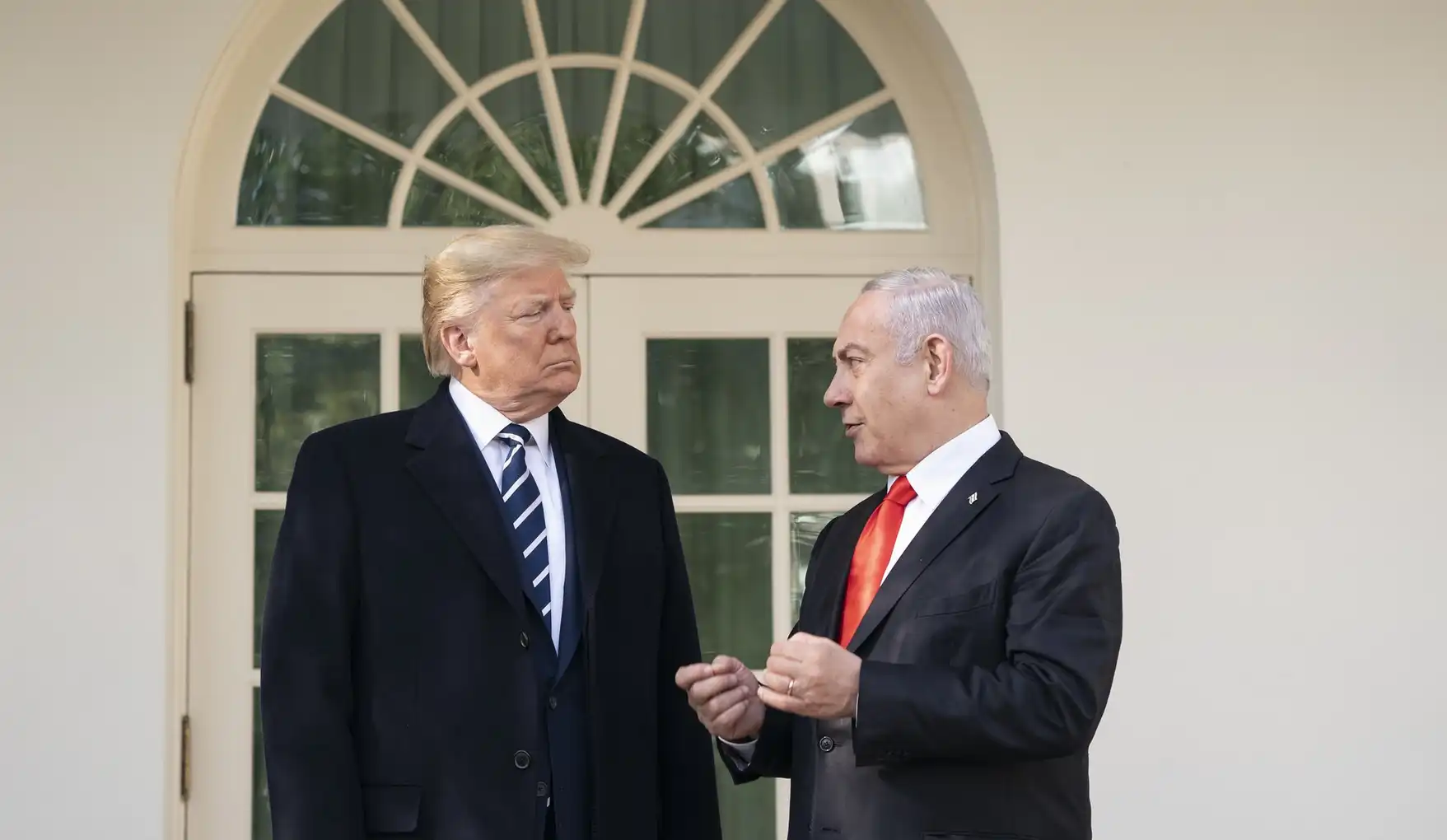
PICTURED ABOVE: President Donald Trump unveiling the Golden Dome missile defense system in the Oval Office in May 2025. PC: White House.