 0
0
 0
0

In recent comments, President Trump said he had narrowed his shortlist for the next Federal Reserve Chairman “down to one”.
Barring force majeure, that will mean Kevin Hassett, a long-time political economist and supply-sider will take the helm at the central bank when the current chair Jerome Powell finishes his term in May. Currently, Hassett resides on Trump’s Economic Advisory Council, a position he was confirmed for with overwhelming support from the Senate.
He had previously held the same role for the President during his first term, where he is supposed to have played a significant role in designing the corporate tax cuts for Trump’s Tax Cuts and Jobs Act of 2017. That role reflects Hassett’s origin as a Chicago School economist who firmly believed that lowering corporate taxes stimulates growth in such a way as to pay for the cuts through productivity growth.
However, some question whether or not that belief is maintained by the man who has spent too much time than could be healthy working within the halls of Washington, DC.
CNBC, in their recent Fed Survey, found that of all the financial professionals questioned, 87% believed Hassett would be the next Fed Chair, but only 11% felt he should. In the aggregate, their reservations lie in the perception that those long years in Washington have eroded Hassett’s training and identity as an economist, and that he will take the position as an agent of a President who has not only spoken openly about his desire to see interest rates lower, but about his intention to fill the central bank’s Open Market Committee (FOMC) with people who share his view.
Speaking for himself at an interview at the New York Economic Club in November, Hassett, who held a position at the Federal Reserve as a business investment analyst, said that while working closely with previous Fed Chair Alan Greenspan, at times he saw “what’s good and bad about the way the Fed people think—and there’s a lot of bad”.
He defined the bad as the persistence of outdated thinking among Fed staff members, and a reliance on outdated models that produce inaccurate economic forecasts.
As is almost entirely the case currently with the American economy’s relationship with the central bank, however, few Fed watchers are interested in whether Hassett will create better ways of determining what the GDP growth rate will be two years into the future, and will be mostly concerned over whether or not a proven Trump loyalist will compromise the Fed’s vaunted independence, and implement monetary policy to facilitate the current Administration’s goals.
To cut, or not to cut
Returning to the CNBC survey, 76% of respondents said they believed the next Fed Chair will be more dovish than Powell. In financial terms, that means more likely to adopt accommodative monetary policies like lower interest rates. Accordingly, 51% of respondents believe the next Fed Chair is likely to fulfill the President’s desires for lower rates.
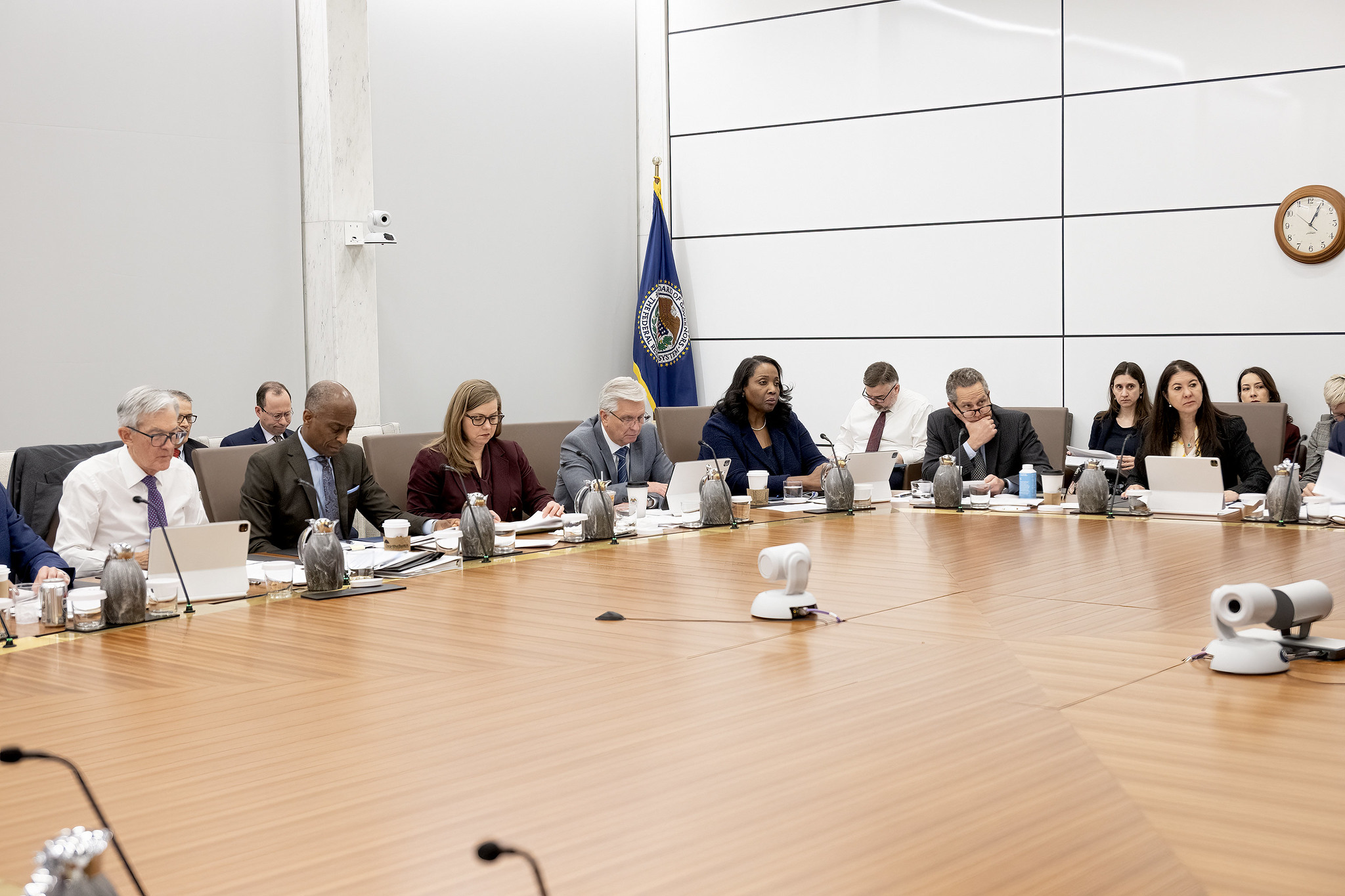
At the most recent FOMC meeting, rates were lowered a quarter of a percent to a range of 3.50 to 3.75%, drawing sharp criticism from the President who opined it might have been half a percent.
WaL’s last report on Trump’s attempts to influence the Fed followed the appointment of a new FOMC board member Stephen Miran, who was confirmed in a rush the morning of the September meeting where he immediately argued for a 50 basis point interest rate cut over a 25 basis point cut.
According to the American Enterprise Institute’s Desmond Lachman, the principal challenge of the incoming Fed Chair “will be to maintain investor confidence that the US is committed to keeping inflation under control and has no intention to inflate away the public debt,” but Hassett seems predisposed to future interest rate cuts which would typically be seen antagonistic to these challenges.
“There’s a lot of room for doing something like making the interest rate lower, which would increase aggregate supply and aggregate demand,” Hassett said at a Wall Street Journal event on Tuesday, adding there was “plenty of room,” to lower interest rates.
Jason Furman, a previous Chairman of the White House Council of Economic Advisors from 2013 to 2017, wrote in a recent op-ed at the New York Times that Hassett, if confirmed, will be taking over an institution infamous for “groupthink,” a trend it now might be departing from after long years of unanimity.
“In 2021, as inflation soared past 6%, there was an enormous public debate about monetary policy, but you would not have known it from the committee’s unanimous votes at eight consecutive meetings that year in favor of keeping rates at zero,” Furman comments, highlighting just how entrenched the FOMC can be at times. Those rates had been zero or close to zero for the previous decade.
It also shows how reluctant the Fed can be to raise interest rates once they’re lowered. The credibility of the Fed following that period increased along with the interest rates: the adults were taking away the punch bowl, as the saying on Wall Street often goes. Raising the costs of borrowing is seen by by political economists as a necessary damper on economic growth in order to lower price inflation. Powell oversaw that cost rising to its highest level in over 40 years, and then keeping it there for more than 12 months.
Disavowal
Hassett’s capacity to make decisions on interest rates is believed to be down to whether or not he has maintained his principles of economics, or whether he was become over-politicized after serving in 3 presidential administrations (George Bush Jr., Trump, and Trump) and 2 presidential campaigns (McCain and Romney).
“You give up a lot of your autonomy when you go to work for a presidential administration. It just becomes a question of degree, like, how far do you want to go?” James Glassman, a former journalist at co-author of the book Dow 36,000 alongside Hassett, told Barron’s in a featured piece about Hassett’s suitability as a potential Fed Chair. Others Barron’s spoke to had more dire estimations.
“It’s been sad to see the disavowal of every policy position he ever stood for,” said one former senior White House official from Trump’s first term who worked with Hassett.
At the Journal event, Hassett said his only loyalty is “to my judgment, which I think the President trusts, and the firm commitment to not being partisan”.
“Conducting monetary policy is not easy at the best of times,” Lachman, from the AEI, wrote in his article. “However, it is particularly difficult when the country is saddled with a high public debt and is recording large budget deficits. Yet this is precisely the situation that Powell’s successor will be inheriting”.
That inheritance includes conditions that have seen US Treasury paper fall to its lowest share of global banking reserves in history, alongside the absolute necessity that foreign bond holders continue to finance US deficit spending, which has routinely exceeded $1 trillion annually.
If even a fraction of the $8.5 trillion in foreign-owned bonds are not renewed at current interest rates, or sold off entirely, interest rates on those bonds would naturally and have to go up to make them more desirable to other buyers, or the government’s deficit would dramatically increase. This has the damaging, sometimes bank-destroying effect of putting Treasuries issued at lower interest rates in the red. It would mean that billions in commercial bank reserves would be wiped out if the Treasures were marked to market, like in a situation where a commercial bank might need higher liquidity—exactly the situation that caused the runs on Silicon Valley Bank and First Republic Bank which put the pair in receivership.
If further commercial banks were to fail, it might lead to one of the several investment bubbles to burst.
“Powell will be thanking his lucky stars that he will not be the one to deal with the Herculean task of having to steady the economy when the various financial market bubbles burst,” Lachman concluded by saying. WaL
We Humbly Ask For Your Support—Follow the link here to see all the ways, monetary and non-monetary.
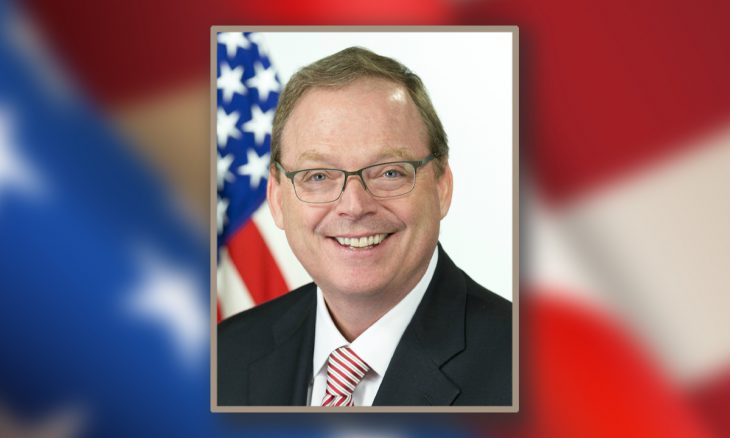
PICTURED ABOVE: Kevin Hassett, the potential future Fed Chairman. PC: White House official photo.