 0
0
 0
0

The UN climate summit in Belém has closed with what many leaders describe as an “uneasy” compromise: a package that triples adaptation finance and launches new initiatives for a “just transition” and forest protection, yet sidesteps any firm commitment to phase out fossil fuels, which are the main driver of the climate crisis.
For France and the European Union, which had arrived in the Amazon pushing for explicit language on the end of coal, oil and gas, the result amounts to a relative failure. At the very moment when water crises, pollution, droughts, and falling groundwater levels are already stressing European and global resources, the world’s governments once again stopped short of touching the heart of the problem.
COP30 negotiators spent two tense weeks arguing over climate finance, the future of fossil fuels, and the path to keep global warming as close as possible to 1.5°C. The talks nearly broke down over one phrase: any reference to a “phase-out” of fossil fuels.
More than 80 countries, with many climate-vulnerable states, EU members, and a coalition of Latin American governments, pushed for explicit language on ending fossil fuel use. More than 80 others, led by major producers like Saudi Arabia, opposed it. Under UN rules, every COP outcome must be adopted by consensus, giving a small group of holdouts an effective veto.
In the end, the final decision text does not mention “fossil fuels” at all. References to “deforestation” are reduced to a single, vague mention. Proposals for a formal fossil fuel phase-out or even a “phase-down” did not survive into the last draft.
“Keeping 1.5°C alive means phasing out fossil fuels and slashing deforestation this decade,” said Dr. Nathan Johnson, Research Associate in Sustainable Energy Systems. “The COP30 text doesn’t mention ‘fossil fuels’ and refers to ‘deforestation’ just once. Without a clear plan to wind down coal, oil and gas and stop forest loss, this deal sidesteps both the causes of and solutions to the crisis”.
On social media, Dr. Robin Lamboll of Imperial College London called COP30 “deeply disappointing,” noting that comments on fossil fuels and most language on forest protection had been removed from the final document. “Being literally on fire at one point was a fitting metaphor,” he wrote, referring to scenes of burning forest and record heat that formed the backdrop to the summit.
Belém was meant to be a milestone for updated national climate plans, known as Nationally Determined Contributions (NDCs), which define each country’s emissions cuts up to 2035.
Since the Paris Agreement in 2015, updated pledges and policies have lowered projected warming from roughly 4°C to around 2.3–2.5°C by 2100. It is progress but not nearly enough according to scientists modeling warming patterns in the future with data from the past and present.
“COP30 leaves us between a rock and a hard place,” said Professor Joeri Rogelj, Director of Research at the Grantham Institute, Imperial College London. “These NDCs have come in hesitantly, inadequately and unambitiously. They move the needle, but insufficiently to confidently avoid 1.5°C or even 2°C of global warming”.
Recent legal developments make this gap more than just a moral issue. Earlier this year, the International Court of Justice (ICJ) issued an advisory opinion clarifying that NDCs are not simply political pledges; they are legal obligations under the Paris Agreement and must represent the “highest possible ambition.”
“While NDCs have improved, ambition falls short of the 60% reduction by 2035 required for 1.5°C,” said Dr. Alaa Al Khourdajie, Research Fellow at Imperial. “Crucially, per the recent ICJ opinion, NDCs aren’t voluntary suggestions. Setting targets that knowingly fail to align with temperature goals may constitute internationally wrongful conduct”.
Against this backdrop, one line in the Belém decision stood out. Namely, that countries reaffirmed the importance of limiting warming to 1.5°C, even if it is temporarily exceeded. For some, that was a relief; fears had circulated before COP30 that 1.5°C would quietly be abandoned.
Dr. Lamboll welcomed the reaffirmation, but recognized how fickle this is. “It is good, but relatively toothless. The need for more on how and who would pay for this is essential going forwards”.
COP30 reveals how leaders overestimate what can be done in the future and underestimate what needs to be done now.
COP30 took place after the world’s average annual temperature exceeded 1.5°C for the first time in 2024. That reality reframed this year’s discussions: rather than solely focusing on preventing 1.5°C of warming, negotiators debated the idea of “overshoot”, temporarily surpassing 1.5°C, then returning below it later through rapid decarbonization and carbon removal.
“Our only remaining chance for 1.5°C is likely through overshoot,” said Dr Al Khourdajie. “The concern is that without immediate action, we’re either abandoning this overshoot-and-return possibility entirely, accepting 2.3°C as permanent or making any future overshoot unnecessarily deep and prolonged.”
Higher peak warming brings greater risks of crossing irreversible tipping points: ice-sheet collapse, large-scale forest dieback, or the destabilisation of monsoon systems and ocean circulation. For regions already hit by water stress and pollution like the Brazilian Amazon or Mediterranean Europe, each tenth of a degree can translate into more intense droughts, floods, and ecosystem loss.
If the fossil fuel chapter of COP30 disappointed many, climate finance delivered at least one headline: Countries agreed to triple funding for climate adaptation to 120 billion dollars per year by 2035. The commitment sits within a wider financial framework that includes a previously agreed target of 300 billion dollars per year for adaptation by 2035 and a longer-term aspiration to mobilise 1.3 trillion dollars annually for combined mitigation and adaptation.
The COP30 decision also links this finance to the Loss and Damage Fund, created to assist countries that face irreversible climate impacts, from disappearing islands to destroyed harvests.
“For countries in the Global South on the frontlines of its worst impacts, scaling up adaptation finance is fundamentally a matter of climate justice,” said Dr Emily Theokritoff, Research Associate in Climate Damage Attribution. “While adaptation limits are real and increasingly being reached, many harmful outcomes can still be avoided if we work to close the persistent adaptation gap.”
Still, civil society groups point out that the numbers remain far below estimated needs, and that much of the promised finance risks being delivered as loans instead of grants – increasing debt burdens for already vulnerable states.
Though fossil fuels vanished from the official decision text, they did not disappear from the political stage in Belém.
Faced with a blocking minority in the UN process, the Brazilian COP Presidency announced that a “fossil fuel transition roadmap” will move forward outside the formal COP decision, as part of a broader initiative backed by willing countries. The plan is framed as a pathway toward “a fossil fuel–free economy in a just, orderly and equitable manner” but participation remains voluntary, and each country is invited to proceed “at its own pace.”
For Dr Al Khourdajie, that phrase illustrates the core tension of climate politics: “While establishing a roadmap is positive for planning, ‘each country at its own pace’ presents a fundamental conflict with physical reality. The carbon budget is fixed and rapidly diminishing. Delay doesn’t provide options; it eliminates them. If national pace is determined by economic convenience rather than physical constraints, every year makes a return to 1.5°C less feasible.”
A similar story unfolded around forests. Despite being held in the heart of the Amazon, COP30 ended without a binding reforestation roadmap. Instead, countries endorsed a “Forest and Climate Roadmap” in principle, intended to halt and reverse deforestation, but with few concrete enforcement mechanisms.
One of the summit’s most visible political outcomes was the creation of the Belém Mechanism for Just Global Transition, a new instrument meant to ensure that the shift to low-carbon economies is fair and inclusive.
For many climate justice movements, this was a long-awaited recognition.
However, negotiators failed to attach any dedicated funding to the new mechanism. For now, its implementation will rely on existing streams of climate and development finance – and on political will that has so far been slow and uneven.
Recycling ideas from the Paris Agreements, but including new initiatives
Alongside these thematic outcomes, COP30 also approved what the Brazilian Presidency called a “Global Implementation Accelerator”. This is essentially a framework designed to prioritize high-impact actions such as methane reduction, nature-based carbon removal, renewable deployment, and reforms of multilateral development banks.
Other decisions include voluntary indicators to track progress on resilience under the Global Goal on Adaptation, a Technology Implementation Program (TIP) to help developing countries deploy climate technologies. There will be dialogues on trade and climate, and a two-year work program on climate finance focused on the predictability of public resources. Finally, we will witness stronger recognition of the role of cities, regions and municipalities in climate action.
Collectively, these measures are presented as the beginning of a new phase of the Paris Agreement, which is moving from three decades dominated by complex negotiations to a period focused on “real transformations in economies and societies”. The Belém conclusions also highlight the role of subnational governments. Hosting COP30 in the Amazon region was meant to show the link between climate and nature, with initiatives like the Tropical Forests Forever Facility and a reinforced focus on oceans.
The next summit, COP31, will be hosted by Turkiye after a compromise that saw Australia relinquish its bid in exchange for the presidency of the negotiations. By then, countries are expected to submit a new round of NDCs outlining their climate actions through 2035, informed by the Global Stocktake of progress under the Paris Agreement.
As of mid-November, more than 100 countries representing over 70% of global emissions have already submitted updated plans. Online trackers like Climate Watch are following each new NDC as it’s lodged with the UN.
“Although the challenging geopolitical and economic context cast a shadow over the COP in Belém, the final agreement shows that countries are still committed to working together to tackle the climate challenge,” said Dr. Caterina Brandmayr, Director of Policy and Translation at the Grantham Institute. “Calls for further ambition should provide much-needed momentum for coalitions of countries and non-state actors to go further and faster on crucial issues such as the transition away from fossil fuels”.
For now, COP30 will be remembered as a summit of contradiction. WaL
We Humbly Ask For Your Support—Follow the link here to see all the ways, monetary and non-monetary.
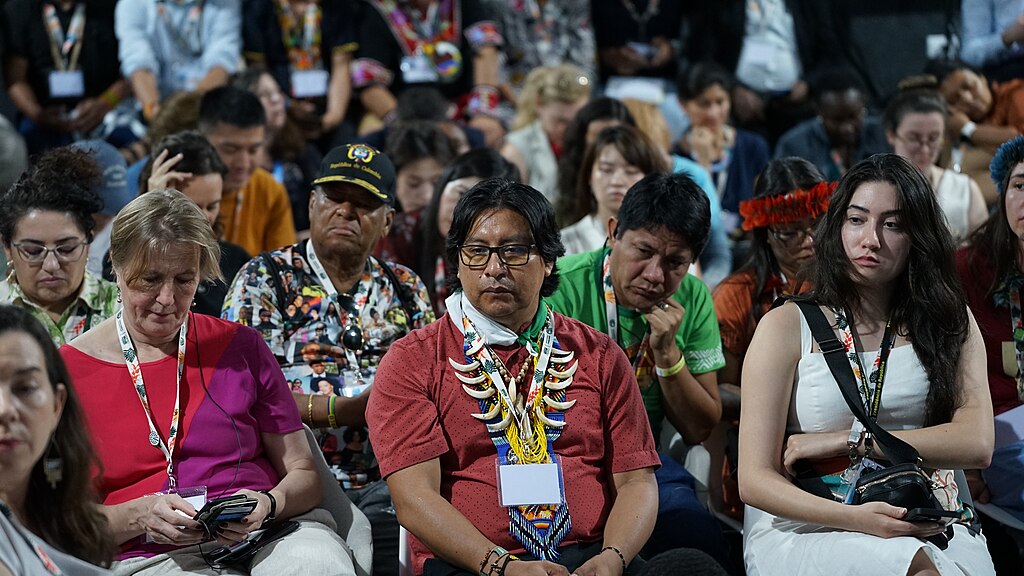
PICTURED ABOVE: Indigenous event at COP30 in Belém (Nov 17, 2025). PC: Xuthoria.