 0
0
 0
0

This is Part 2 of a 3-part story on the advent of critical minerals on markets and national security policy, you can read part 1 here.
In late summer and early autumn of 2025, the Trump Administration took out large positions in several mining companies, including a 15% stake in MP Materials Corp., $670 million in exchange for a stake in magnet producer Vulcan Elements Inc., a 10% stake in Canadian minerals explorer Trilogy Metals Inc., and a stake in Lithium Americas Corp. that would act as a restructuring agreement for a loan the company had with the Dept. of Energy.
As the year wound to a close, a White House official said the Administration planned to take more equity stakes in critical minerals companies.
“We’re literally buying equity, getting equity in companies to give the backing of the US, because that’s the only way we’re going to catch up with China on these things,” Jarrod Agen, executive director of the National Energy Dominance Council, said in his closing remarks at the American Growth Summit, which was sponsored by companies such as Citigroup Inc. and NVIDIA.
Aside from whether that’s legal or not, it highlights the urgency with which Washington feels it needs to secure so-called critical minerals supply chains, after having woken up to the fact that most of them are imported from overseas. That’s not usually a problem for a normal country, but modern US presidents style themselves very much as the role of world policeman, and with an empire of over 800 military outposts and plenty of perceived enemies, all these little colorful rocks suddenly seem so much more important than they used to.
Evidently however, the private sector didn’t agree. It’s difficult to know exactly how much capital expenditure went towards mine exploration and development during the 1960s, ’70s, ’80s, and ’90s, because the data from those years includes oil and gas development and extraction, and doesn’t include the production and investment in refining capacity.
A period of higher commodity prices in the 80s—a period which also saw the first silver and gold bull market since the closing of the gold window, must have led to higher capex in the mining sector, reflected in totals exceeding $52 billion in nominal terms in 1982—which again included oil and gas, but was nevertheless the biggest year in the century for the sector.
It would be another 20 years for mining (plus oil and gas) to see such valuations again, and they rose as high as $131 billion before the Great Recession. Adjusted for inflation to 1982, modern mining and oil/gas investment annually hovered around $60 billion, and as a share of total US capex decreased between 2010 and 2019, when oil and gas was separated in the data, from 11% and 8%.
By contrast, China’s fixed-asset investment in mining, refining, and petroleum doubled between 2006 and 2012 from around $90 billion to $187 billion. This isn’t anyone’s fault, although it’s easy for national security hawks to look at it that way. This was a revolutionary period for both countries. The US market had gotten a hand of the internet, while China was in the midst of its legendary and long-awaited industrialization. Obviously, investment priorities would be different, just as they’re different today.
“Mining is a dirty old industry with no innovation,” says Australian financial analyst, investor, CCO, and occasional commentator with personal experience in the mining industry, Rowan Parchi. Parchi’s own experience informs the analysis that decades of underinvestment have made these metals critical, and points out that environmentalism also had a hand in the phenomenon.
“It’s not like mining didn’t happen in Canada, the US, or Australia,” he says. “There definitely was an underinvestment in mining, but to me, even more is the next step: the processing”.
Parchi points out that while a mine is often found tens or even hundreds of kilometers from city limits, refining and processing capacity, which China dominates even more than just mining, is usually done closer to metropolitan areas, which in turn attracts the attention of environmentalists and those who’d like to see emissions reduced. China, which has incredible refining capacity and no environmental lobby, didn’t suffer from these drawbacks, “that’s the bit that really shows up to me as the bottleneck”.
Cliques of gamblers
In this series, WaL spoke with Rahul Sen Sharma, co-founder of the financial indexing services company Indxx. Sharma oversaw the recent launch of a critical metals index fund with dozens of mining names, excluding China whenever possible. Throughout his research into the industry, Sharma gathered that the White House is clearly looking to shore up domestic sources, “and also ‘friend shoring’ to secure a supply chain that’s not necessarily completely in the US but at least among its allies”.
High among those allies will be Australia, a mining powerhouse in its own way, which Parchi confirmed as being flush in “huge uranium deposits, huge rare earth deposits; I think some of the largest in the world”.
While American mining investment remained lean and niche for years, Australian industrialization put substantial amounts of capital into iron and coal production—a far easier and less refining-sensitive market.
“It’s not labor intensive, and Australia is a really expensive labor market,” says Parchi. “But you’re not doing much with it; they’re just these bulk commodities, [sic] shipping dirt to China to fuel their industrialization process. That was the most productive thing Australians could do and it quickly became dominated by a few majors, and that’s been what Australia has been focused on even though it has amazing uranium and rare earths and all kinds”.
Indeed in theory, anything that can be pulled out of the ground in China can be dug up in Australia, but Parchi described the local environmental movement as stronger possibly even than its equivalent in the US.
“I’ve been involved before in a metallurgical coal operation, and that’s ‘critical’ for virgin steel, you can’t make it without met coal, and the guys that were doing it were Australian. Why were Australians setting up a mine in Virginia, USA? They said in Australia you just cannot get a new coal mine approved”.
He admits it’s an anecdotal example, and doesn’t discount that private investment had other priorities and interests at the time, top of the list being America’s decades-long love affair with tech of all kinds, starting with the Dot com bubble and continuing on to crypto and AI. Meanwhile, majors like BHP and Rio Tinto accumulated enormous market share—some 65-75% of the entire Australian mining sector, became global companies, and there was a major consolidation of mining talent within them.
Both in terms of talent and resources, Parchi says, the small-cap segment of the industry was left with table scraps and angel investors.
“The Australian institutional financial sector [sic] who’s investing in small, start-up, junior mining companies? It’s like, little cliques of gamblers you know, private people, and there’s little networks of them,” Parchi joked.
Mining DC
Parchi sees risk of various sorts in the President’s decision to start taking equity stakes in junior mining companies. Recalling the comments made by Rick Rule on Mining Network quoted in part 1 of this series, it’s difficult to know just from exploratory drilling or mineral assessments how viable a mine or mining company can be. Typically, that can only be ascertained when the company has time to conduct thorough metallurgical studies on the ore in the ground and how a given mineral can be extracted from it at high enough purity to be economical.
If high enough percentages of metal are proven to be recoverable, the exploration company may move to the development phase, where many mining outfits go bankrupt. A developer will release a Preliminary Economic Assessment, or PEA, in which the total cost of building the mine and bringing it into production are presented. If the numbers make sense to investors, the developer typically will move into the permitting phase where they will conduct an environmental safety assessment, to prove to national governments that the activity won’t overly pollute the surrounding landscape and water resources.
Only then, when the miner is often tens of millions in debt, will construction work be undertaken on the mine, and extraction of the metals begin. This is often a 10-year process, and the risk of direct government subsidy is that without the profit-and-loss system and the pressure it applies to investment decisions, there’s no natural assurance that the subsidy will be spent wisely, or even that the reserves held underground will ever be extracted.
“In the last few conferences I’ve been do, which have been really dominated by mining companies, virtually every junior miner in their presentations talks about [sic] they’ve got government funding, they’re looking for government funding, they’re eligible for government funding, like, that’s a part of every single conversation at the moment,” Parchi says.
Indeed, spokesmen from various American rare earths developers are calling for what would generally be considered socialist support for their industries, invoking the ever-present specter of China while doing so. This included “pressuring” Indonesia, maybe with threats of further tariffs, to dial back its national output of nickel, a critical mineral.
“I’m really urging the US government to think simple,” KaLeigh Long, CEO of Westwin Elements, which runs America’s only major nickel refinery, told Reuters at the outlet’s NEXT Conference. “In terms of nickel, let’s get a quota on Indonesian production. You do that, and I can almost promise you that overnight you will see a cure in the nickel price”.
Such measures and others like them would be a remarkable display of protectionism, though the current Administration is certainly no shrinking violet in that arena, and is in fact mulling over the decision to introduce price floors on behalf of America’s only multi-mineral rare earth producer. WaL
We Humbly Ask For Your Support—Follow the link here to see all the ways, monetary and non-monetary.
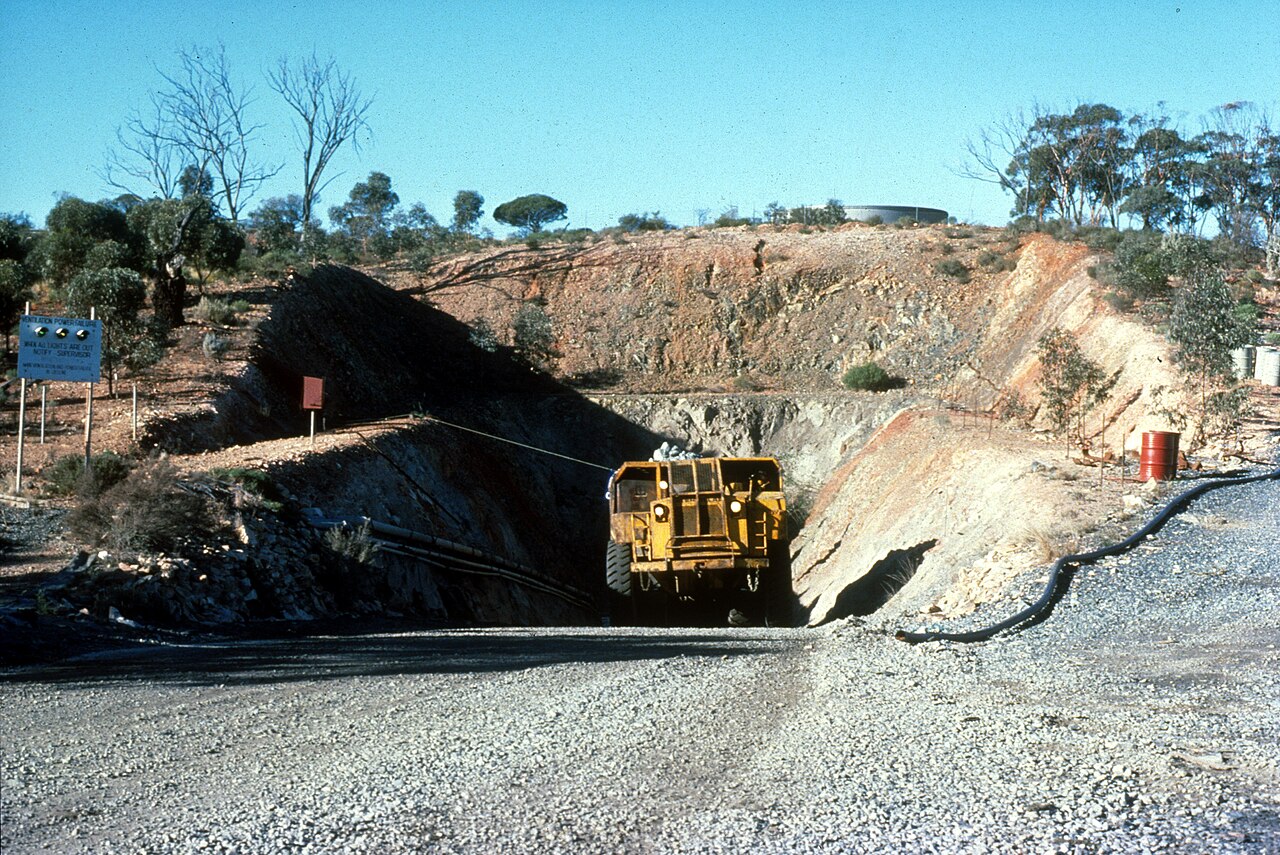
PICTURED ABOVE: A haul truck at the Silver Swan nickel mine in Australia. PC: CSIRO, CC 3.0.