 1
1
 0
0

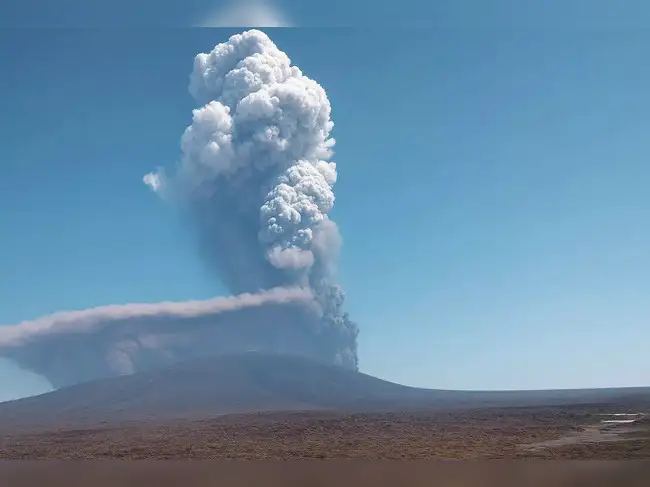
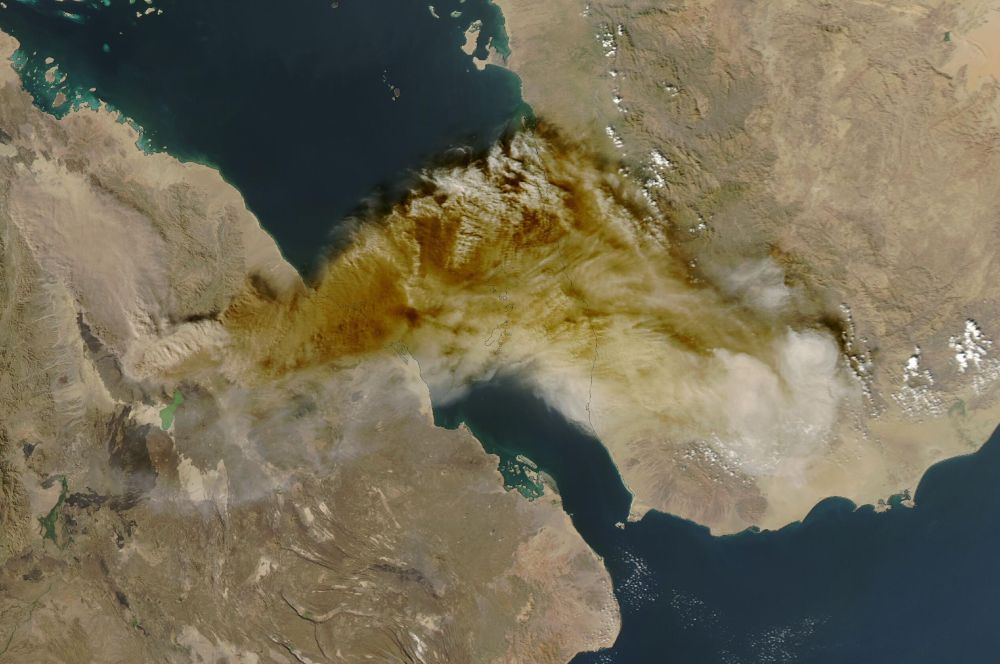
The Hayli Gubbi volcano in Ethiopia erupted for the first time in recorded history, after being dormant for about 12,000 years. The massive eruption sent a heavy cloud of smoke recorded at 9 miles (14km) into the sky, and has moved quickly across Yemen, Oman, India, Pakistan, and the Red Sea, causing various flight cancellations.
Located in the Denakil Plain of eastern Ethiopia, in the Afar region, Hayli Gubbi suddenly erupted Sunday morning for several hours of pre-eruption activity. With no reports of any civilian casualties, the nearby villages of Afdera were covered in heavy ash, affecting their livestock and homes.
The Smithsonian Institution’s Global Volcanism Program has no record of any eruption from Hayli Gubbi until this recent activity; this eruption became Hayli Gubbi’s first recorded eruption since the beginning of the Holocene. The Holocene Epoch is the current geological epoch that began roughly 11,700 years ago at the end of the last ice age.
Hayli Gubbi, not deeply studied, sits along a fault line in a region called the East African Rift System, where two tectonic plates have moved at a rate of about 0.4 to 0.6 inches from one another yearly. Hayli Gubbi is known as a shield volcano with similarities to a warrior’s shield, being flat. Famous shield volcanoes like Mauna Loa and Kilauea in Hawai’i, and Mount Wrangell in Alaska, typically don’t produce such strong eruptions, but rather a gentle flow of lava.
“To see a big eruption column, like a big umbrella cloud, is really rare in this area,” said Juliet Biggs, an earth scientist at the University of Bristol in England, to Scientific American.
Biggs points out that the possibility of Hayli Gubbi erupting was predicted since satellite data showed early seismic activity. A nearby volcano, Erta Ale, erupted in July, pushing more than 18 miles of magma under Hayli Gubbi. Leading up to Sunday’s massive eruption, the ground level rose from this magma undercurrent, and the cone showed little white puffs at its summit. One scientist from England’s University of Southampton was in Ethiopia when the eruption took place. Derel Keir was able to take samples of the magma to help answer what caused the eruption and further gather information about the unknown of Hayli Gubbi.
A moment’s notice
Though no deaths were reported, a health official from the Afdera district reported that mobile medical services were summoned to the Afar region to help the villages. Near the Danakil Desert, tourists and guides found themselves stuck in the villages on the way to the desert due to the excessive weight of ash.
“While no human lives and livestock have been lost so far, many villages have been covered in ash, and as a result their animals have little to eat,” said Mohammed Seid, a local administrator, to the Associated Press.
“Many animals, especially in the two affected kebeles, cannot drink clean water or feed on grass because it is covered by volcanic ash,” said Nuur Muss, an official in charge of livestock.
According to the Toulouse Volcanic Ash Advisory Centre (VAAC) in France, the thick ash cloud moved across Yemen, Oman, India, northern Pakistan, and China. The volcanic ashes have particles that can damage aircraft engines and make flying hazardous. In India, the ash covered the Western Rajasthan region, causing the cancellation of 11 flights. Air India, IndiGo, Akasa, and Dutch carrier KLM were a part of the flight collection in taking safety precautions. The Directorate General of Civil Aviation (DGCA) cautioned airlines to check on their aircraft if they have already flown through the affected areas.
Seven international flights scheduled to arrive at Indira Gandhi International Airport were canceled, with many others delayed. An Indian operator reports that Akasa Air had to cancel flights to the Middle East in areas where the ash had crossed over locations like Jeddah, Kuwait, and Abu Dhabi.
Hayli Gubbi, considered to be a dormant volcano, exemplifies the ability of volcanoes to suddenly reawaken. A dormant volcano is able to stay quiet for thousands of years without anything happening, but with the right motion of the magma and the tectonic plates, it can erupt rapidly. Many experts have reported that the Hayli Gubbi region in Ethiopia is not widely studied; it allows scientists to explore this hidden area, described as “one of the most inhospitable areas of the world,” by one volcano science travel website.
“So long as there are still the conditions for magma to form, a volcano can still have an eruption even if it hasn’t had one in 1,000 years to 10,000 years”, said Arianna Soldati, a volcanologist at North Carolina State University. WaL
We Humbly Ask For Your Support—Follow the link here to see all the ways, monetary and non-monetary.
PICTURED ABOVE: The Hayli Gubbi volcano at the moment of eruption. PC: Afar Government Communication Bureau.