 0
0
 0
0

Japan’s decision to move forward on a major tariff agreement with the United States without issuing a formal, written statement has created concern for opposition lawmakers and raised eyebrows when it comes to the nation’s negotiating posture.
At the center of this issue is Prime Minister Shigeru Ishiba’s administration, which concluded a trade agreement with the US on July 22nd that lowers tariffs on Japanese automobiles and other key exports, and commits to a sweeping $550 billion investment in US-bound projects. The agreement averted the imposition of a threatened 25% blanket tariff on Japanese imports, but in doing so, left many in Tokyo uneasy about the price paid, not in dollars, but in trust.
The absence of a joint communiqué or legally binding document outlining the terms of the deal has allowed for divergent interpretations from both governments.
Washington, for its part, has announced a 15% reciprocal tariff on most Japanese goods, effective August 7th, while keeping open the option of restoring higher tariffs should “the president be unhappy with implementation,” according to Treasury Secretary Scott Bessent. Japan’s Ministry of Finance, meanwhile, insists that tariff reductions have been secured across a range of sectors and that the agreement is functionally complete, even if not documented.
Economic Revitalization Minister Ryosei Akazawa, Japan’s chief negotiator, has admitted that a written text would have clarified misunderstandings but warned that pressing for such formalities could provoke a reversal by President Trump, who is known for discarding deals on a whim.
“We are dealing with an administration that changes its story by the hour,” said Yoshihiko Noda of the Constitutional Democratic Party. “Without a document, Japan risks being walked over indefinitely”.

Domestic dissonance and a lack of clarity
The trade agreement comes at a politically precarious time for Prime Minister Ishiba, whose Liberal Democratic Party (LDP) suffered a second consecutive defeat in last month’s Upper House elections. Calls for his resignation have grown louder, although they are not only driven by a perceived capitulation in trade negotiations but also by a broader frustration with his economic policies and foreign affairs management.
Ishiba has signaled his intent to stay in power and tied it to the importance of seeing the deal through to implementation. “Businesses must be protected from further instability,” he told the Lower House on Monday. “That is my responsibility, and I will not abandon it”.
Still, even within his own coalition, doubts are surfacing. Nippon Ishin no Kai’s Ryohei Iwatani likened the investment framework to “protection money,” and questioned the benefits of a deal that appears to heavily favor US interests.
The investment component of the agreement has become another source of friction. While U.S. officials describe a $550 billion Japanese investment into American industries, Tokyo has framed the commitment as a mix of equity investments, government-backed loans, and guarantees, only a fraction of which constitutes direct capital injection.
According to Akazawa, just 1–2% of the sum will take the form of equity, while the rest will be allocated through state-owned financial institutions to build joint supply chains deemed vital to national security.
Critics note that the semantics of “investment” may be obscuring the true nature of Japan’s financial burden. Discrepancies over profit-sharing ratios, rumored to favor the US nine to one, have further strained trust.
Another unresolved concern pertains to how overlapping tariffs might be applied. A clause in the US executive order released July 31 explicitly exempts EU goods from “stacking”—where multiple tariffs are applied simultaneously: No such assurance has been formally extended to Japan.
Akazawa said that US counterparts have verbally confirmed Japan will be treated on par with the EU.
The Japanese side is also pressing for clarity on when US auto tariffs will be lowered from 25% to 15%. Despite assurances from Washington, no implementation timeline has been made public. Ishiba has pledged to engage Trump directly on the issue but has yet to secure a new meeting.
Public opinion on the agreement is divided. A JNN poll over the weekend showed a modest rebound in cabinet support, rising to 36.8%, with nearly half of respondents opposing Ishiba’s resignation. However, polls from Mainichi and Asahi last week painted a bleaker picture, with approval ratings hovering around 29%.
Observers like Rintaro Nishimura of The Asia Group believe that the lack of documentation complicates implementation and undermines Japan’s ability to enforce compliance if disputes arise.
“If the economic impact of the agreement turns negative—particularly in the auto sector—we may see institutional pushback,” said Stephen Nagy of the International Christian University in Tokyo. “And if that happens without a written framework, there’s little recourse”.
Ishiba’s long-term viability as prime minister now depends on two fronts: successful tariff implementation and political survival within the LDP. WaL
We Humbly Ask For Your Support—Follow the link here to see all the ways, monetary and non-monetary.
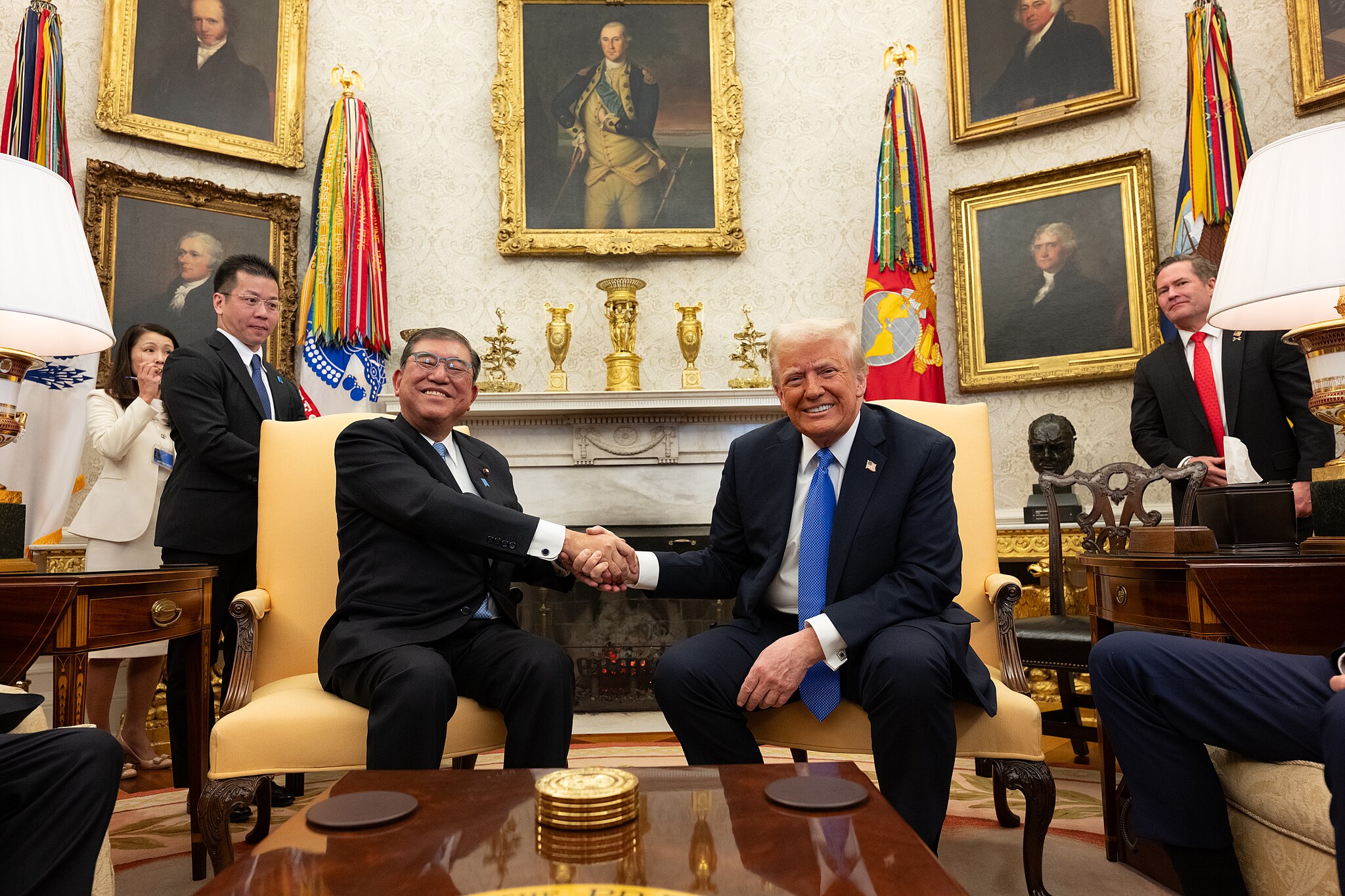
PICTURED ABOVE: American President Donald Trump shaking Japanese Prime Minister Shigeru Ishiba’s hand. PC: the White House via Wikimedia Commons