 0
0
 0
0

Multiple security and financial analysts have observed that all Iran must do to win this war imposed on them by the US-Israeli-Gulf axis is survive.
In a similar vein, Ansar Allah, the ruling Yemeni faction known shorthand for the surname of its leader: the Houthis, need only to continue their initial offensive actions of launching a few drones and missiles at southern Israel to seriously strain the IDF’s multi-layered missile defense system.
Additionally, each in turn need only to lob a missile or two at shipping going through the Strait of Hormuz and the Bab al-Mandeb at the southern tip of the Red Sea to create an apocalyptic scenario for the the Gulf economies, and choke off one-third of global petroleum production from export.
Sana’a and Tehran need only maintain these very straightforward and relatively simple power balances to stretch the ability for Washington and Tel Aviv to make war on Iran considerably.
Already, the Royal United Services Institute for Defense in the UK estimated last week that at least one of the layers in that multi-layer defense system was dangerously close to running out of ammunition. Versions 2 and 3 of the Arrow anti-ballistic missile interceptor represent the outermost-layer of Israel’s missile defense system, and 80% of them, the Institute estimated, have been used.
They are designed to protect against the highest-flying and farthest projectiles, like those the Houthis need to use to cross the whole of the Arabian Peninsula. The equivalent in the US defense arsenal is the Terminal High-Altitude Aerial Defense missile, or THAAD, the numbers of which the Institute believed to have been reduced by 60%.
Meanwhile, US intelligence officials speaking anonymously with Reuters suggested that Iran had only suffered 30% losses to its ballistic missile arsenal, a direct contrast to the bombastic statements made by War Secretary Hegseth, CENTCOM Commander Cooper, and President Trump about how the armed forces have been “decimated” or “obliterated”.
The loss of the THAADs will be felt more clearly in Israel than in the US, where public opinion is unlikely to be swayed if a few more Iranian missiles hit Tel Aviv per week. With Trump’s deployments of some 5,000 to 10,000 US soldiers to the region, there’s almost no chance that a THAAD will be used in defense of Israel, as was done extensively during the so-called 12-Day War.

Enter the Houthis
Few irregular militaries can boast the amount of immediate battlefield experience in Middle Eastern geography than the Houthis, and fewer still, the battlefield successes.
In 2025, the group successfully defeated a US carrier strike group led by the USS Theodore Roosevelt as it entered the Red Sea in an attempt to secure safe passage for ships transiting the Red Sea. In the 8-month long engagement, the Houthis were able to effectively conceal their equipment and strike locations, and launch enough missiles and drones as to cause the loss of two F/A-18 Super Hornet war planes that were on board the Roosevelt, even if they couldn’t manage a direct hit on the flagship.
Houthi air defenses successfully shot down 21 MQ-9 Reaper drones over the course of the hostilities, all while managing to routinely send drones and ballistic missiles towards Israel in protest of the genocide in Gaza. Apart from several spectacular civilian massacres committed by US naval and air forces, the CENTCOM signed a ceasefire and left the Red Sea without gaining a decisive moment.
Trump admitted the defeat following the announcement of the ceasefire, saying “…we hit them very hard”.
“They had a great capacity to withstand punishment,” he said. “You could say there’s a lot of bravery there”.
Earlier, during the Biden Administration when combat broke out with the Houthis, senior defense officials spoke to CNN about their ability to remain in the fight.
“They continue to surprise us. We just don’t have a good idea of what they still have,” the official said.
The comments proved prophetic, for after suggesting last week that their “finger was on the trigger,” Ansar Allah launched two attacks on Israel over the weekend, both of which were intercepted, but, one could say too that both of which were intercepted. It was believed before the war began that in a straight shootout, Iran had more missiles than Israel has interceptors. Now that the multi-layer defenses are guarding against both rockets from Hezbollah in Lebanon, and strikes from the Houthis, the timeline till the stockpiles read empty has been brought up substantially further.
Already, Al Jazeera was reporting on March 20th that it had been 3 weeks in which the populations of most of the major economic centers of Israel had not slept through the night one time since the war began, that nerves and patience were wearing thin. The Houthis will know that there is little to no chance that the IDF, now engaged in a substantial ground war in Lebanon and daily air raids into Iran, will spare the time, munitions, and fuel to cross the whole of Saudi Arabia to retaliate.
Barring response by the Americans, who themselves seem to be preparing for a ground war, they will enjoy carte blanche to pick targets and fire repeatedly. WaL
We Humbly Ask For Your Support—Follow the link here to see all the ways, monetary and non-monetary.
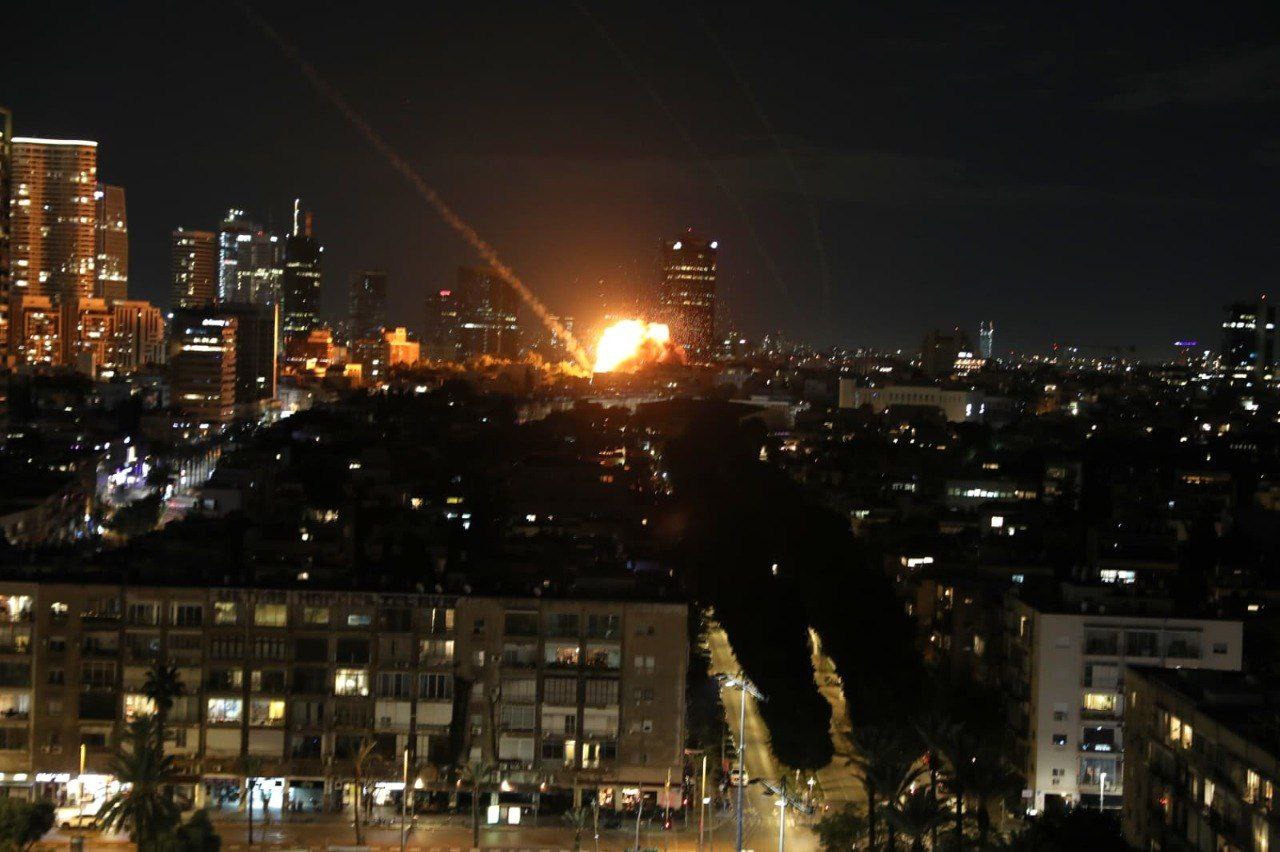
PICTURED ABOVE: The exact moment an Iranian missile impacts in Tel Aviv, on February 28th. PC: @OSINTWarfare.