 0
0
 0
0

Beijing’s ruling Communist Party has set an honest and low growth rate expectation for 2026 that its chief officials say reflects targeted growth “where conditions allow it” and which economists say reflects ongoing struggles with low domestic demand and a real-estate slump that’s gone on for over years.
The target of 4.5% growth—the lowest since 1991—is paired with disciplined commitments to reducing government deficit spending, and was included within the CCP’s 15th 5-year-plan.
Announced by Premier Li Qiang on March 5th at the opening session of the National People’s Congress (NPC), the GDP goal would prioritize more sustainable growth in high-quality areas rather than aggressive stimulus driven expansion. China’s economy grew 5% last year, more than double the United States, despite shocks from the tariff exchanges with the White House.
The growth target and the accompanied report were drafted before the surprise attack on Iran which has greatly disrupted global energy markets. The closure of the Strait of Hormuz, together with the impact of the tariffs and trade disruptions with Japan, must have contributed to the modest growth target, and indeed Premier Li said something to the effect during his speech to the NPC.
“Rarely in many years have we encountered such a grave and complex landscape, where external shocks and challenges were intertwined with domestic difficulties and tough policy choices,” Li said.
The response, it seems, according to extensive reporting from SCMP, is to balance investment “in people” with a focus on expanding the innovation and sci-tech economy, with investments into sectors like aerospace, biomedicine, and semiconductor manufacturing.
For the uninitiated, China’s economic power lies so much in its ability to manufacture and export. An economy that builds everything to export, however, results in lower domestic demand for those goods—which has been seen in China for some time despite having over 1 billion inhabitants, several hundred million of whom have spent the last decade transitioning to the middle class.
Several gonzo years of real estate investment blew up an enormous asset bubble that the country is still sorting through today, more than a year after it burst. This combination of real estate slump and low domestic demand weigh on the economy, as well as “chronically low market confidence,” according to a government report.
A policy of risk management, shoring up domestic demand through support for traditional industries and equipment replacement, and investments in pensions and parenting support is seen as a way to protect the economy from further outside shocks. A 9% increase in science and tech subsidy is seen as a way to promote the plan, while a 9.3% increased budget for diplomacy has been included in the recent spending projection to account for the turbulent times, and to promote China’s role as a bridge-builder, both figuratively and literally.
Fighting debt
Like all major economies, China engages in national debt expansion and deficit spending. However, unlike its major competitor the United States, which is projected to soar past $40 trillion this year, China’s 5-year-plan calls for “iron discipline” among local governments in spending only what is allotted to them.
Anyone who studies governments’ spending habits know that they are rarely constrained to the budgets appropriated by the legislature. Off-budget items, unforeseen expenditures, and continuations of past spending projects, amount to the “hidden deficit” which most countries run.
Li told the NPC that reductions in “non-compliant hidden debt,” and “fake debt reduction” must be guarded against.
China’s national debt-to-GDP ratio rose to 96.8% by the end of 2025, up from 88.4% a year earlier. Premier Li Qiang said that “curbing the growth of non-compliant hidden debt must be enforced with iron discipline”.
In the same report that contained the 4.5% growth target, the CCP outlined measures to curb unsustainable borrowing by including a “zero tolerance” standard, a restructuring of local government financing mechanisms that removes localized control of financing instruments, and the prohibition on the creation of new borrowing streams.
“Officials will face lifelong accountability and retrospective investigations for any non-compliant borrowing,” the report stated.
While the US has few inbuilt protections against presidents and congresses spending beyond their means, these reforms could be taken as an attempt to enforce just that in the far-less democratic Chinese government. Whether such limits can work is difficult to say. Emergencies, as they are declared, will always allow government legislatures to ease borrowing restrictions, and since every nation worth its budget has centralized control of the creation of money, the decision to borrow is simply made between two bureaucrats, neither of whom stand to bear the burden of policy failure, the inflation the new money creates, or be left holding the bag on malinvestments made on that borrowing. WaL
We Humbly Ask For Your Support—Follow the link here to see all the ways, monetary and non-monetary.
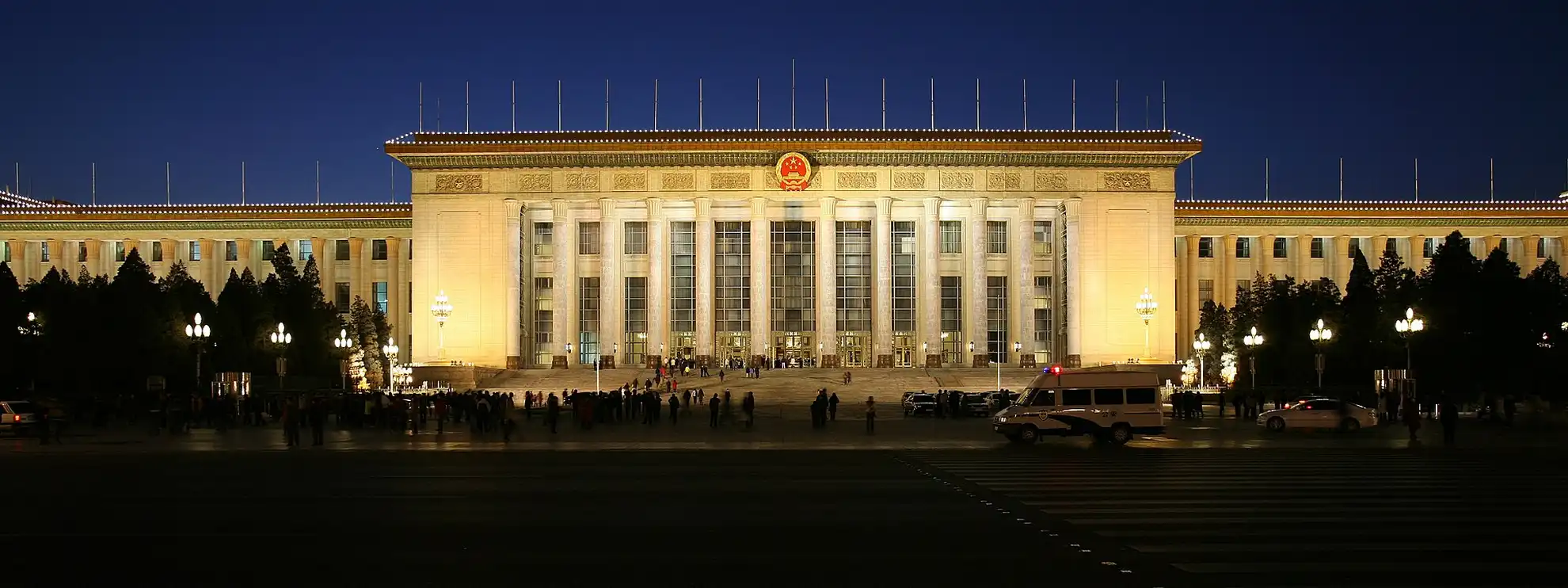
PICTURED ABOVE: Great Hall of the People, Beijing. PC Thomas Fanghaenel, CC 3.0. BY-SA .