 0
0
 0
0

On December 5th, the Georgian Ministry of Economy noted that it received a request from its eastern neighbor Azerbaijan: for transit of rail-bound oil shipments to Yerevan, Armenia.
Georgian Railways was immediately ordered to transport the cargo without applying any tariffs, with the ministry stating that “Georgia has always been, and remains, a supporter of peace and cooperation in the region”.
JAM News Baku reported on the day that coverage was very limited in Azeri media, and the Georgian Ministry’s statement confirmed what had been essentially unconfirmed speculation. JAM quoted analysts in the country skeptical of the oil shipment—pointing out that a full and lasting peace agreement regarding the now-conquered disputed territory of Nagorno-Karabakh has not yet been fully implemented, and that the Azeri government can’t guarantee the shipment would not be used against its own military in future fighting.
“Such cautious assessments help explain why Baku is reluctant to give this development too much visibility,” the quoted analyst said.
WaL reported recently in a special two-part feature that centennial enemies Azerbaijan and Armenia are closer than ever before towards establishing lasting positive relations, and freeing future generations from the burden of ethnic hatred and risk of violence. Last month, this effort towards peace, driven primarily from Armenia, resulted in the first shipment of Russian wheat transiting Azerbaijan on the way to Armenia in over 40 years.
For Armenia, which has no domestic fuel supply, to receive Azeri oil is a seismic event in regional geopolitics, not only because it’s a military-adjacent resource. Further, the jewel of the regional oil economy: the BTC Pipeline from Baku to Georgia to Turkiye, was designed by the current Azeri President to bypass Armenia as a means of depriving the nation both of vital energy and regional influence or control.
The fact that news of the oil shipment went somewhat under the radar could be attributed to the seriousness with which Baku takes this current opportunity for a lasting regional peace, which would amount to ultimate victory for the Aliyev dictatorship, but would also naturally inflame anti-Armenian sentiment which the government has been cultivating since before the Soviet Union fell.
JAM cited a Russian-language Azeri outlet familiar with the matter called Minval, which wrote that a lack of railway routes to Yerevan required the oil to be moved through Georgian territory, but that the Georgian government initially proposed an “intentional tariff” 40-times higher than normal for the privilege. Remarkably, though, a joint appeal from Armenia and Azerbaijan saw Georgian Prime Minister Irakli Kobakhidze waive the tariff entirely.
“What is clear is that the evolving peace process is reshaping the South Caucasus’ political landscape, with all sides now seeking to position themselves in this changing environment,” JAM wrote.
Decoupling; coupling
Azerbaijan is one of Europe’s great oil producers, and the only major alternative on the continent, apart from Norway, to Russia. As a result, normal geopolitical conditions would suggest that Armenia—which holds European Union ambitions, should make herself as dependent on Azeri oil as possible. Some 60% of the country’s imported diesel and petrol came from Russia in the average year.
Armenian President Nikol Pashinyan is known to be looking at how to reduce the country’s reliance and general association with Russia both for economic and political motives, and has cited this to his critics as a reason for his administration’s unprecedented attempt at creating a lasting peace with their bitter rivals Azerbaijan.
This has included, as WaL reported, leasing national territory to the United States which would then use it to allow Azerbaijan to transit to its exclave of Nakhichevan, and even amending the Armenian constitution to remove references to Armenian sovereignty over Nagorno-Karabakh.
The effort has been described by Pashinyan as “New Armenia” versus “Historic Armenia,” framing the former as a Brave New World of peace and opportunity (in so many words) and the latter as a doomed dream of the past.
It’s no surprise then that JAM described the fuel shipment as carrying “political significance that goes far beyond bilateral ties”.
“It has become part of a wider geopolitical game involving Russia, the United States and Georgia”.
Armenia has suffered under a bi-frontal trade embargo, from Turkiye to the southwest, and Azerbaijan to the east, for about 40 years. It is generally believed to have inflicted upon this former Soviet satellite a degree of economic stagnation and poverty not seen in similar countries. When November’s grain shipment arrived in Yerevan, the price of bread dropped, and the fuel from Azerbaijan is expected to lead to falling petrol prices since Armenia has no oil refining capacity; meaning the oil would have to arrive ready for use.
With a parliamentary election in 2026 coming up fast, lowering prices for such essential goods is as good a campaign strategy as one could hope for, and what is more, this first shipment was reported by Armenian authorities as being transit cost-free in a gesture of goodwill, which should likely lower the consumer cost further.
It’s long been believed that Pashinyan, who holds a mediocre 13% approval rating (still high for the country), had to deliver some very tangible economic benefits resulting from his pivot to building a “New Armenia,” since attempting to build relations with Azerbaijan and repair those with Turkiye made an instant enemy of the entire right-half of the domestic political spectrum and of virtually the entire Armenian diaspora.
Lower fuel prices will go a long way to convincing whatever independent or undecided voting blocs exists that New Armenia is the place to be. WaL
We Humbly Ask For Your Support—Follow the link here to see all the ways, monetary and non-monetary.
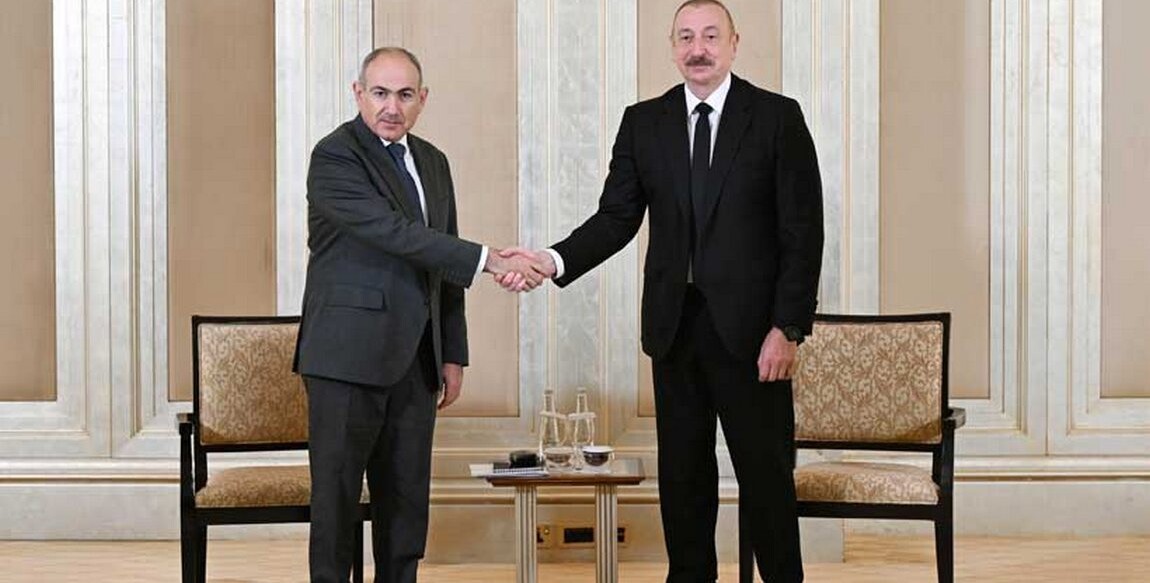
PICTURED ABOVE: Prime Minister Nikol Pashinyan (left) shakes hands with Azerbaijani President Ilham Aliyev. PC: Azerbaijani Presidential Press Office.